
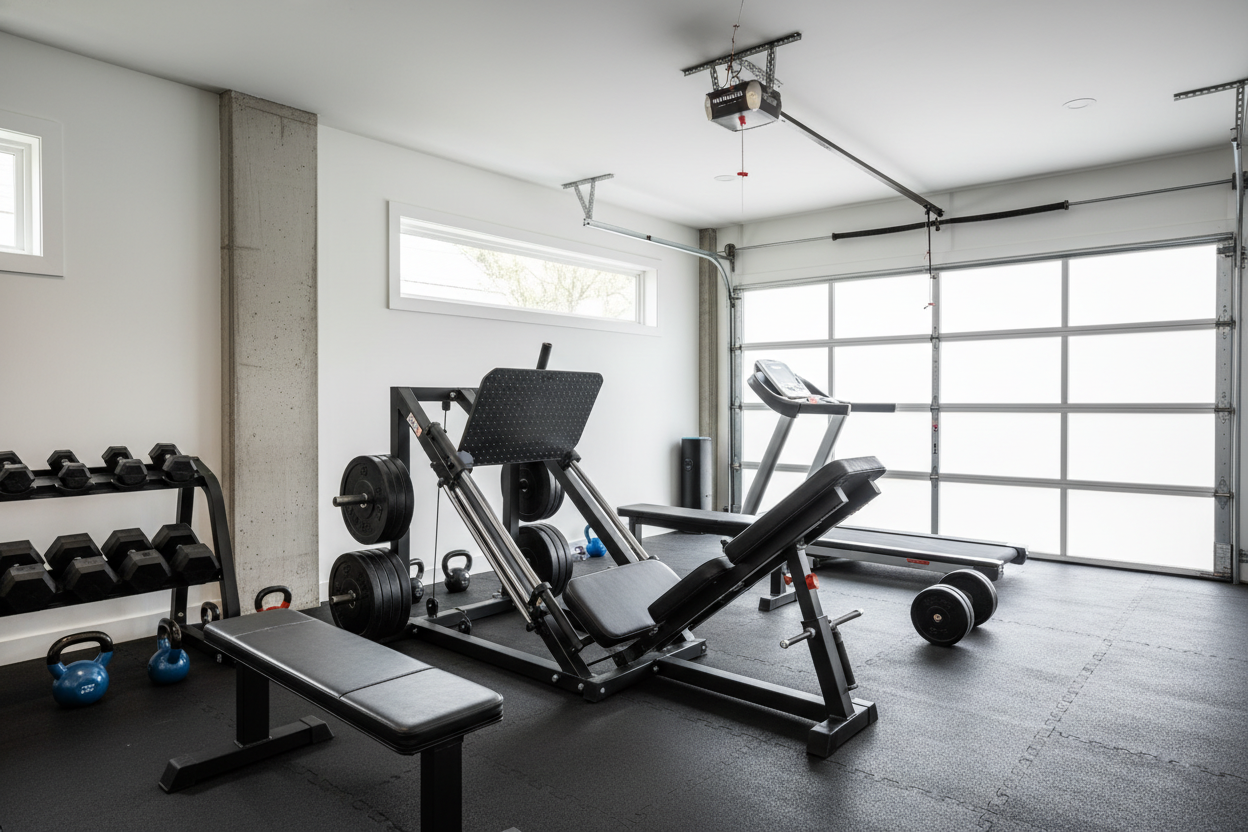
I remember the day my lower back finally called a strike. I was deep into a high-volume squat cycle, and while my quads wanted more, my spine was done. I spent that night scrolling through marketplace listings for a machine for leg press, realizing I was about to sacrifice my precious garage floor space for the sake of hypertrophy. It is a trade-off every serious home lifter eventually considers.
- Footprint is King: You need at least 8 feet of length for a standard sled.
- Bearings Matter: Linear bearings are the only way to get a smooth, gym-quality stroke.
- Plate Math: You will likely need to buy 400+ lbs of extra iron just for this machine.
- Combo Units: A hack squat/leg press hybrid is usually the smartest use of space.
Why Do You Even Want One in the First Place?
Most people start looking for a leg press machine for home when they realize the barbell has limitations. Don't get me wrong, I love squats, but they are a systemic movement. Your lower back, core, and nervous system often give out long before your quads do. A dedicated sled removes the stability requirement, letting you bury your legs into the seat and push until your vision gets a little blurry.
If you are chasing pure quad growth, the leg press exercise machine is arguably superior to the rack. You can manipulate foot placement to target the sweep or the teardrop without worrying about falling over. It is about high-quality volume without the high-stakes injury risk of a failing a heavy back squat in a dark garage at 6:00 AM.
The Absolute Reality of the Footprint
Let’s be honest: a home gym leg press machine is a massive piece of furniture. A commercial-style 45-degree sled isn't just the 7 or 8 feet of steel on the floor; it is the 2 feet of clearance you need on either side to actually load the 45-pound plates. If you put this in a tight corner, you will be cursing every time you have to shimmy around to add weight.
If you are working with a standard 2-car garage, a standalone sled is a massive commitment. This is why many lifters gravitate toward a 3 in 1 hack squat leg press combo. By stacking the movements vertically or using a flip-down footplate, you get two of the best lower body builders in the footprint of one. It makes the leg press machine price much easier to swallow when it replaces multiple pieces of equipment.
Linear Bearings vs. Nylon Rollers (Don't Mess This Up)
When you are shopping for leg press machines for sale, the biggest spec to watch is the drive system. Cheap machines use nylon or plastic rollers that sit on the outside of the guide rods. They feel okay with 100 lbs, but once you load up a real working set, they get jerky and loud. It feels like you're pushing a shopping cart through gravel.
The best leg press machine will always feature linear bearings. These are internal ball bearings that wrap around solid steel guide rods. They are buttery smooth, nearly silent, and can handle massive loads without binding. If the listing doesn't explicitly mention linear bearings, it’s probably a budget unit that will frustrate you within six months.
Can You Get Away With a Combo Unit?
The old knock on combo units was that they were a 'jack of all trades, master of none.' The angles were often weird, and the range of motion was shallow. However, engineering has caught up. A modern compact 30 degree leg press is designed to give you that deep, quad-stretching ROM without taking up the entire zip code.
If you want to go even further, you can find an all in one home gym with leg press functionality. These integrated systems are great if you are starting from scratch, but make sure the leg press attachment isn't an afterthought. You want a heavy-duty footplate and a seat angle that doesn't crush your lower back at the bottom of the rep.
The Hidden Cost Nobody Mentions: Weight Plates
The price of leg press machine isn't the only number hitting your bank account. Unlike a lat pulldown with a built-in stack, a leg press machine free weight setup requires iron. A lot of it. Most healthy adults will quickly outgrow a 200-lb load on a leg press. You are looking at needing 400, 600, or even 800 lbs of plates to keep the stimulus high.
If you already have a full set of bumpers for your rack, you might think you're set. But bumpers are thick; you'll run out of sleeve space on the sled before you hit a challenging weight. You almost always need to buy a separate set of thin cast iron plates specifically for your leg press exercise equipment.
Smith Machine Hacks: A Viable Alternative?
I see people trying the vertical leg press attachment for their Smith machines all the time. While it saves money, it is a compromise. Lying on your back and pressing a bar straight up is biomechanically awkward. The safety catches are often out of reach, and if you miss a rep, the bar is coming straight down on your hips.
I generally tell people to avoid the leg press smith machine setup if they have the budget for a real sled. A 45-degree angle is much more natural for the hip and knee joints. If you are serious about leg machines for sale, buy a tool built for the job rather than a dangerous workaround.
My Personal Experience
I once bought a small leg press machine for home that used a cable system instead of a sled. I thought I was being smart by saving space. Within three weeks, I realized the 'resistance' felt completely different at the top of the rep than at the bottom. It was useless for building muscle. I eventually sold it for half what I paid and bought a real 45-degree linear bearing sled. My garage is crowded now, but my quads have never been bigger. Measure twice, buy once.
FAQ
How much is a leg press machine?
Expect to pay between $1,500 and $2,500 for a high-quality home gym leg press. Commercial units can easily top $4,000. If you see one for $500, it likely uses cheap rollers and has a very low weight capacity.
Is a vertical leg press better than a 45-degree one?
No. Vertical presses are harder on the lower back and much more difficult to load and unload safely. The 45-degree sled is the gold standard for a reason.
Can I use bumper plates on a leg press?
You can, but you'll run out of room on the weight horns very quickly. Cast iron plates are much thinner and allow you to load the machine to its full potential.
Share:
Bored on Leg Day? Try This Brutal Smith Machine Squat Variation
Why Your Fried Lower Back Needs Seated Workout Machines