
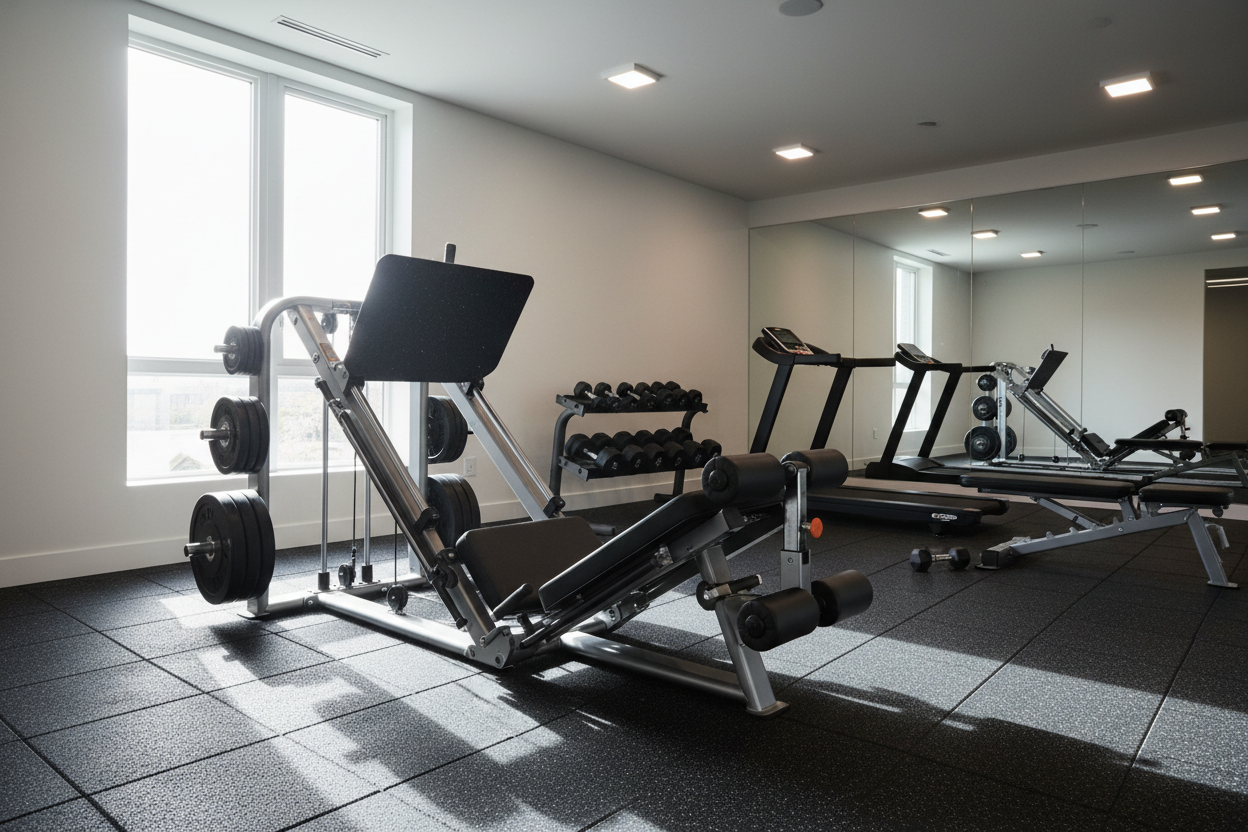
I remember staring at my garage floor, measuring tape in hand, trying to figure out how to fit a rack and a leg station without losing the ability to park my truck. That's when I first saw a leg press and curl machine online. It promised everything: heavy presses, deep extensions, and lying curls all in one frame. It felt like the holy grail for anyone working with a 10x10 space.
- Space Efficiency: Often requires a 7-foot clearance once you account for plate loading.
- Resistance Quality: Cable-driven units often suffer from friction that direct-load machines avoid.
- Mechanical Trade-offs: Combining linear sleds with rotary arms usually compromises the range of motion on one of the movements.
- The Verdict: Great for accessory volume, but rarely a replacement for a commercial-grade leg press.
Why Everyone Wants a Magic Lower Body Combo Machine
The logic is sound on paper. You want to blast your quads with a heavy leg press curl machine, then immediately hit isolation work to finish the job. In a commercial gym, you'd walk ten feet to the next station. In a garage, you're usually choosing between a dedicated leg station and a lawnmower.
A single leg press and leg curl machine feels like the ultimate hack to get big-box gym variety in a residential footprint. Most of us are tired of doing Bulgarian split squats as our only accessory. We want the ability to move heavy weight without the stability demands of a barbell, and we want to do it without building a second story on the garage.
The Biomechanical Clash: Heavy Pushing vs. Smooth Isolation
Here is the engineering headache: a good leg press needs a heavy sled moving on linear rods to handle 500+ lbs safely. A leg press extension machine, however, requires a smooth rotary pivot point. When manufacturers try to merge these two worlds, you often get a sled that feels 'crunchy' under heavy loads or an extension arm with a weird strength curve that drops off at the top.
If you're looking for that heavy, vertical drive to really build raw power, you might be better off with a dedicated leg press hip thrust machine. Those units prioritize the heavy push mechanics over the mediocre isolation found in many 3-in-1 combo units. You have to ask yourself if you'd rather have one movement that feels perfect or three that feel 'okay.'
Footprint Math: Are You Actually Saving Any Space?
Don't let the marketing photos fool you. A leg press leg curl machine might look compact in a vacuum, but once you account for the sled travel and the space needed to load 45-lb plates on both sides, you're looking at a massive footprint. You need at least two feet of clearance on either side just to slide the weights on.
By the time you add the swing arm for the leg press and extension machine, you've occupied a chunk of real estate nearly identical to two separate, specialized units. I’ve seen lifters buy these only to realize they can't actually use the curl function because the wall is in the way of the footplate. Measure your 'working area,' not just the machine dimensions.
The Sketchy Physics of Multi-Gym Cables
Resistance quality matters more than most people admit. Many budget-friendly leg press leg extension machine options use pulleys to move the weight. This introduces friction. You lose that 'direct' feel of the iron, and the negative portion of the rep feels light and floaty. It’s hard to get a mind-muscle connection when the cable is sticking.
I've seen some guys get so frustrated with the cable lag on these units that they resort to a leg press Smith machine setup just to get back to a fixed path with direct load. It is a classic trade-off: do you want the convenience of one machine, or the actual muscle tension required to grow? If the pulley system isn't high-end, your hamstrings will know the difference.
Smarter Ways to Build Massive Legs in a Garage
If I were starting my gym over, I'd skip the Frankenstein units. You get more bang for your buck by splitting the duties. I recommend getting a compact 30 degree leg press for your heavy compound work. It takes up significantly less room than a standard horizontal sled but still lets you load up several hundred pounds for quad development.
Then, pair it with a dedicated leg extension hamstring curl machine. This setup ensures your isolation movements actually feel like isolation, and your heavy presses don't feel like they're about to snap a budget cable. You get zero mechanical compromises and a much better training experience.
How much weight can these combo machines usually handle?
Most home-grade units are rated for 400 to 600 lbs. However, the pulley systems often have a 1:1 or 2:1 ratio that changes how that weight actually feels. If you're a 400-lb squatter, you'll max out a budget combo machine almost instantly.
Are they hard to switch between press and curl modes?
It depends on the brand. Some require you to pull three pins and remove a footplate, which can kill your momentum during a superset. Look for units that use a 'flip-over' footplate design to save your sanity.
Can I use standard 1-inch plates?
Almost all modern leg press and curl machines are built for 2-inch Olympic plates. Using 1-inch plates on an adapter is usually a recipe for rattled weights and bent sleeves. Stick to the Olympic iron for anything moving on a sled.
Share:
I Put the Life Fitness Multi Adjustable Bench Through Hell
Do You Actually Need to Memorize These Machines Gym Names?