
I'll tell you exactly when I started taking hip flexor training seriously: the third week of a heavy squat cycle, when I developed a sharp, pulling sensation deep in my front hip that stopped me mid-set and kept me out of heavy lower body training for two weeks.
My hip flexors weren't weak in isolation — I could lift my knee against resistance just fine. They were weak relative to the demands being placed on them. Heavy squats, sprints, and athletic movement all require hip flexors that can produce and absorb force dynamically. Mine couldn't keep up.
After that experience, I rebuilt my approach to hip flexor training from the ground up. I started programming dedicated hip flexor exercises into my own routine and my clients' programs. The results were consistent: better squat depth, reduced hip pain, improved running mechanics, and stronger athletic output across the board.
This guide covers everything — the anatomy, the best exercises, weighted progressions, and complete workout programming for hip flexors that actually makes them stronger.
Hip Flexor Anatomy: What You're Actually Training
Before getting into hip flexor exercises, understanding what the hip flexors actually are makes you a more effective trainer of them.
"Hip flexors" isn't a single muscle — it's a group of muscles that all contribute to hip flexion: bringing the thigh toward the torso, or the torso toward the thigh.
Iliopsoas (the primary hip flexor) The iliopsoas is actually two muscles — the iliacus and the psoas major — that merge into a single tendon and attach to the lesser trochanter of the femur. The psoas originates from the lumbar vertebrae (L1–L5), making it the only muscle that directly connects the spine to the lower extremity. This anatomy explains why tight or weak hip flexors have such profound effects on lower back health and posture.
The iliopsoas is the most powerful hip flexor and the primary target of most hip flexor training.
Rectus femoris The rectus femoris is one of the four quadriceps muscles, but it's also a hip flexor — it's the only quad muscle that crosses the hip joint. It contributes significantly to hip flexion, particularly at the beginning of the movement when the hip is near extension.
Tensor fasciae latae (TFL) The TFL runs along the outer hip and contributes to hip flexion, internal rotation, and abduction. It connects to the iliotibial (IT) band, which is why IT band problems are often related to TFL dysfunction.
Sartorius The longest muscle in the body, running diagonally across the thigh. Contributes to hip flexion, external rotation, and knee flexion.
Pectineus and adductor longus These adductor muscles contribute to hip flexion, particularly in the early range of movement.
For practical training purposes, the focus is primarily on the iliopsoas and rectus femoris — these are the muscles that limit performance and cause problems when undertrained.
Why Hip Flexor Strength Matters More Than Most Lifters Realize
Most gym content about hip flexors focuses on stretching them. Stretching is valuable — but it addresses only half the problem.
Tight hip flexors are often weak hip flexors. A muscle that's chronically shortened and under-used develops both tightness and weakness simultaneously. Stretching improves the tightness temporarily; strengthening addresses the underlying cause.
Strong hip flexors matter for:
Squatting and deadlifting. The hip flexors stabilize the pelvis during heavy lower body movements. Weak hip flexors contribute to anterior pelvic tilt under load, which compromises form and increases injury risk.
Running and sprinting. Hip flexion speed and power directly determine stride frequency and running economy. Research consistently shows that stronger hip flexors produce faster sprint times — this is why best hip flexor exercises for athletes are increasingly prioritized in sports conditioning programs.
Jumping and explosive movement. The drive phase of a jump requires powerful hip flexion to generate upward momentum. Weak hip flexors are a performance limiter that often goes unaddressed.
Lower back health. The psoas attaches directly to the lumbar spine. A weak or imbalanced psoas contributes to lumbar instability and chronic lower back pain — a connection that's often missed when treating back problems.
Daily function. Walking up stairs, getting out of a car, standing from a seated position — all involve hip flexion. For older adults especially, hip flexor strength is directly linked to functional independence.
The Best Hip Flexor Exercises: From Bodyweight to Weighted
Floor Hip Flexor Exercises
Dead Bug The dead bug is one of the most effective floor hip flexors exercises because it trains the hip flexors under simultaneous core stabilization demands — exactly the context in which the hip flexors need to function during real movement.
How to perform: Lie on your back with arms extended toward the ceiling and hips and knees bent to 90 degrees (tabletop position). Slowly lower one arm overhead while simultaneously extending the opposite leg toward the floor — keeping your lower back pressed firmly into the ground. Return to start and repeat on the other side.
The key is maintaining lumbar contact with the floor throughout. The moment your lower back arches, the core has lost tension and the hip flexors are compensating.
Sets and reps: 3 sets x 8–10 reps per side
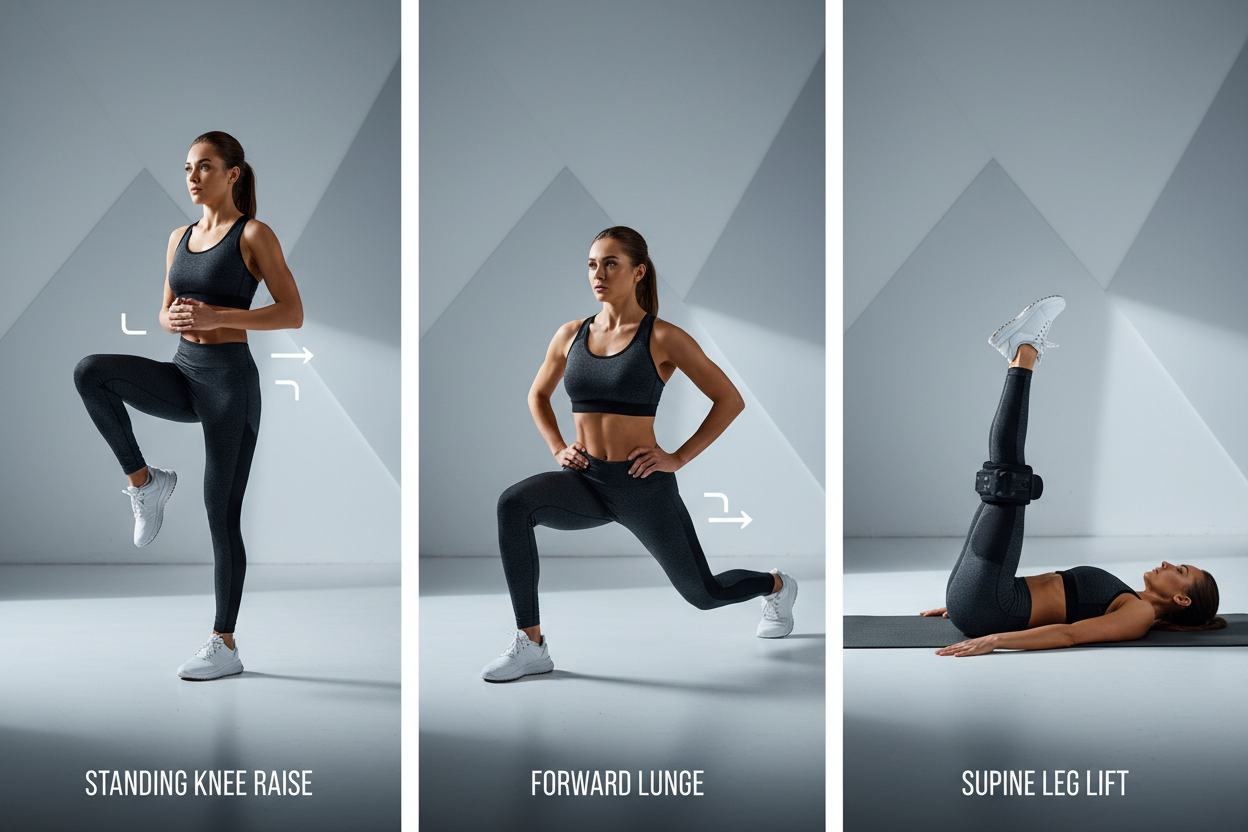
Lying Hip Flexion (Supine Leg Raise) The simplest direct hip flexor exercise. Lie flat on your back with legs straight. Keeping one leg flat, raise the other to about 45–60 degrees, hold briefly, and lower under control.
Progression: Add an ankle weight, a resistance band around the ankle, or a dumbbell held between the feet to increase resistance.
Sets and reps: 3 sets x 12–15 reps per side
Mountain Climbers A dynamic floor hip flexor exercise that builds endurance and power. In a high plank position, alternately drive each knee toward your chest as quickly as controlled form allows. The hip flexors work dynamically through a full range — from extension to deep flexion — in each repetition.
Sets and reps: 3 sets x 20–30 reps (total)
Flutter Kicks Lie on your back, lift both legs slightly off the floor, and alternate raising and lowering each leg in a small flutter pattern. The hip flexors work isometrically to maintain the position and dynamically through each kick.
Sets and reps: 3 sets x 30 seconds
Standing Hip Flexor Exercises
Standing Knee Drive (Bodyweight) Stand on one leg and drive the opposite knee up toward your chest as high as possible, pausing briefly at the top before lowering under control. This is the foundational standing hip flexor exercise — simple, accessible, and directly functional.
Progression: Add a resistance band around the working ankle attached to a fixed point behind you, increasing resistance as the hip flexes.
Sets and reps: 3 sets x 12–15 reps per side
High Knee March An active, rhythmic version of the knee drive. March in place, driving each knee to hip height or above with deliberate effort. Focus on the top of each rep — the point of maximum hip flexion — and briefly pause there to increase the muscular demand.
Sets and reps: 3 sets x 30 seconds
Standing Cable Hip Flexion Attach a cuff to a low cable pulley, strap it to your ankle, and stand facing away from the machine. Drive the working knee forward and upward against the cable resistance, pausing at the top. This is one of the most effective hip flexors exercises gym settings offer — the cable provides constant tension throughout the entire range of motion.
Sets and reps: 3–4 sets x 12–15 reps per side
Hip Flexor Weight Exercises: Loaded Progressions
Dumbbell Hip Flexor Exercises: Dumbbell Knee Drive Stand on one leg and hold a dumbbell on the thigh of the working leg. Drive the knee upward against the weight of the dumbbell. This is one of the most practical dumbbell hip flexor exercises because it requires no equipment setup and can be performed anywhere.
Weight selection: Start with 10–25 lbs depending on strength level. The dumbbell rests on the thigh — you're working against its weight as you lift the knee.
Sets and reps: 3 sets x 10–12 reps per side
Dumbbell Hip Flexor March (Weighted) Hold a dumbbell in each hand at your sides for additional stability demand, or hold one dumbbell on the working thigh. Perform a deliberate, slow high-knee march, pausing at the top of each rep. Adding load to the hip flexor march converts it from a warmup drill to a genuine strength exercise.
Sets and reps: 3 sets x 10 per side
Psoas March (Resistance Band) Lie on your back with a resistance band looped around both feet. Press one leg away from you (extending the knee and hip) while maintaining the other at 90 degrees. Alternate in a slow, controlled marching pattern. This exercise is specific to the psoas and iliopsoas and is a staple in physical therapy and sports conditioning contexts.
Sets and reps: 3 sets x 12–15 reps per side
Cable Hip Flexion with Knee Drive Facing away from a low cable with a cuff on the working ankle, perform a powerful knee drive against cable resistance. This hip flexor weight exercise allows meaningful progressive overload — you can systematically increase the cable weight over weeks and months, which is essential for building genuine hip flexor strength.
Sets and reps: 4 sets x 10–12 reps per side
Hanging Leg Raise Hang from a pull-up bar with arms fully extended. Raise both legs to parallel (knees bent for the standard version, straight legs for advanced) by flexing at the hips. Lower under complete control. The hanging leg raise is one of the most demanding hip flexor strength exercises available — it requires the hip flexors to move the full weight of both legs through a large range of motion with no momentum assistance.
Progression path: Bent knee raises → straight leg raises → L-sit hold → weighted hanging leg raises (dumbbell between feet or ankle weights)
Sets and reps: 3–4 sets x 8–15 reps depending on variation
Weighted Hip Flexor Machine (Hip Flexion Machine) Many commercial gyms have a dedicated hip flexion machine — a seated or standing unit with a padded resistance arm that you drive upward with your knee. If your gym has one, use it. It provides the most direct, isolated loading of the hip flexors available on any machine, with easy progressive overload through weight stack adjustment.
Sets and reps: 3–4 sets x 12–15 reps per side
Hip Flexor Exercises Weightlifting: Barbell-Based Movements
Barbell Hip Flexor March (Zercher or Front Rack Position) Hold a barbell in a front rack or Zercher position for additional loading. Perform deliberate high-knee marching steps, emphasizing maximum hip flexion at the top of each stride. The added spinal loading from the barbell increases core demand alongside the hip flexor work.
Deficit Reverse Lunge Stand on a small plate or step (2–4 inches). Step back into a reverse lunge, lowering the rear knee toward the floor. The deficit increases the range of motion demand at the bottom, placing the hip flexors of the front leg under a greater stretch and the hip flexors of the rear leg under a greater eccentric load.
Sets and reps: 3–4 sets x 10 per side
Sled Drag (Forward) Attach a harness to a loaded sled and walk or sprint forward, driving each knee up powerfully with each stride. Forward sled drags are one of the best hip flexor exercises for athletes because they train hip flexion in a fully functional, sprint-specific context with significant resistance. The resistance of the sled makes every stride a loaded hip flexor contraction.
Programming: 4–6 x 20–40 meter runs with 60–90 seconds rest
Step-Up with High Knee Perform a standard barbell or dumbbell step-up, but at the top of each rep, drive the trailing knee up toward your chest in a powerful knee drive before stepping back down. This turns a standard step-up into a combined hip extension and hip flexion exercise — training the full hip through both directions of movement in each rep.
Sets and reps: 3 sets x 10–12 per side
Best Hip Flexor Exercises for Athletes
Athletic performance places specific demands on the hip flexors that general fitness training doesn't fully address. Here are the exercises I consistently prioritize when training athletes:
1. Resisted Sprint Drills (Sled or Band) Sprinting is the most sport-specific hip flexor exercise that exists. Resisted sprinting — using a sled, resistance band, or parachute — amplifies the hip flexor demand of each stride. For any athlete whose sport involves running, this is the highest-priority hip flexor training modality.
2. Hanging Leg Raises (Weighted) Maximum hip flexor strength through the full range of motion. The hanging position eliminates any ground reaction force assistance, making the hip flexors do all the work. Adding ankle weights or a dumbbell between the feet creates meaningful progressive overload.
3. Cable Hip Flexion The cable provides constant resistance throughout the entire range of motion — including at the top where the hip is most flexed, which is where many other exercises lose tension. This makes it uniquely effective for developing hip flexor strength at end range.
4. Standing Band Hip Flexion A resistance band around the ankle attached to a fixed point behind the athlete creates a training environment close to sprint mechanics. Drive the knee forward and upward against band resistance repeatedly, focusing on explosive concentric effort.
5. Deficit Reverse Lunge with Knee Drive Combines unilateral hip extension loading with a powerful hip flexion drive at the top. The deficit increases the range of motion and the knee drive converts the top of the movement into an active hip flexor contraction. Multi-joint, athletic, and demanding.
6. Psoas March The most specific exercise for the iliopsoas — the deepest and most important hip flexor for athletic performance. Performed with a resistance band, it directly loads the psoas through its primary movement pattern.
How to Workout Your Hip Flexors: Complete Programming
Program 1: Hip Flexor Activation and Strength (Beginner — 2x/Week)
For those who have been neglecting hip flexor training entirely, or who are dealing with chronic hip flexor tightness and weakness.
Warmup (5–8 minutes):
- 90/90 hip stretch — 2 minutes each side
- Couch stretch — 90 seconds each side
- Hip circles — 10 each direction per side
Workout:
- Dead Bug — 3 x 8 per side
- Standing Knee Drive (bodyweight) — 3 x 12 per side
- Psoas March (resistance band) — 3 x 12 per side
- Flutter Kicks — 3 x 30 seconds
- Mountain Climbers — 3 x 20 total
Notes: Perform this as a standalone session or as a warmup block before lower body training. Focus on quality of movement — control every rep, avoid momentum, feel the hip flexor working.
Program 2: Hip Flexor Strength Building (Intermediate — 2x/Week)
For those with a baseline of hip flexor strength who want to systematically build meaningful strength and muscular development.
Day 1:
- Cable Hip Flexion — 4 x 12 per side
- Hanging Knee Raise — 3 x 12
- Dumbbell Knee Drive — 3 x 10 per side
- Deficit Reverse Lunge — 3 x 10 per side
- Dead Bug — 3 x 10 per side
Day 2:
- Standing Band Hip Flexion (explosive) — 4 x 10 per side
- Hanging Straight Leg Raise — 3 x 10
- Step-Up with High Knee Drive — 3 x 10 per side
- Psoas March — 3 x 15 per side
- Mountain Climbers — 3 x 30 seconds
Progressive overload: Increase cable weight, dumbbell load, or band resistance by the smallest available increment when you can complete all sets and reps with good form.
Program 3: Athletic Hip Flexor Power (Advanced — 2–3x/Week)
For athletes or advanced gym-goers focused on hip flexor power, sprint speed, and explosive athletic output.
Day 1 (Strength):
- Weighted Hanging Leg Raise — 4 x 8–10
- Cable Hip Flexion (heavy) — 4 x 8 per side
- Deficit Reverse Lunge with Knee Drive — 4 x 8 per side
- Barbell Step-Up with Knee Drive — 3 x 8 per side
Day 2 (Power and Speed):
- Resisted Sprint or Sled Drive — 5 x 30 meters
- Explosive Standing Band Hip Flexion — 4 x 8 per side (fast and powerful)
- High Knee March (weighted, fast) — 3 x 20 seconds
- Psoas March — 3 x 12 per side
Day 3 (Volume and Endurance):
- Cable Hip Flexion (moderate weight, higher reps) — 3 x 15 per side
- Flutter Kicks (weighted) — 3 x 45 seconds
- Mountain Climbers — 4 x 30 seconds
- Dead Bug — 3 x 10 per side
Common Mistakes in Hip Flexor Training
Training only through stretching. Stretching addresses tightness temporarily. Strengthening addresses the underlying cause. Do both — but don't skip the strength work because stretching feels like enough.
Using momentum instead of muscle. Many hip flexor exercises are easy to cheat by swinging the leg or using momentum. Slow down. Control every rep. If you can't feel the front of your hip working, the exercise isn't doing its job.
Neglecting end-range strength. Most hip flexor exercises load the muscle through the mid-range. True functional strength requires control at end range — when the hip is fully flexed. Cable work and hanging leg raises train this effectively.
Training hip flexors in isolation only. The hip flexors function as part of an integrated system with the core, glutes, and lower back. Include exercises that train this integration — dead bugs, sled drags, and loaded lunges — not just isolated hip flexion movements.
Ignoring the imbalance between sides. Unilateral hip flexor weakness or tightness is common — often the left and right sides are measurably different. Train each side independently to identify and correct imbalances.
Final Thoughts: Start Taking Hip Flexor Training Seriously
The hip flexors are involved in virtually every lower body movement you perform — in the gym and in daily life. They're often the limiting factor in athletic performance, a contributor to chronic lower back pain, and one of the most undertrained muscle groups in most people's programs.
Building genuine hip flexor strength doesn't require complicated equipment or hours of additional training time. Two dedicated sessions per week of 20–30 minutes, using the exercises and progressions in this guide, will produce noticeable improvements in hip function, athletic performance, and lower body training quality within a few weeks.
Start with the floor hip flexor exercises if you're a beginner. Progress to weighted hip flexor exercises as you build strength. Add the athletic variations if performance is your goal. Track your progress, apply progressive overload, and treat the hip flexors with the same seriousness you give any other major muscle group.
Your hips — and your lower back — will thank you.
This article is based on personal coaching experience and current exercise science. Always consult a qualified fitness professional or physician before beginning a new training program, particularly if you are managing existing hip or lower back issues.
Share:
The No-BS Planet Fitness Workout Plan to Build Muscle
Stop Buying Flimsy Gear: Home Gym Ideas Small Spaces Actually Need