
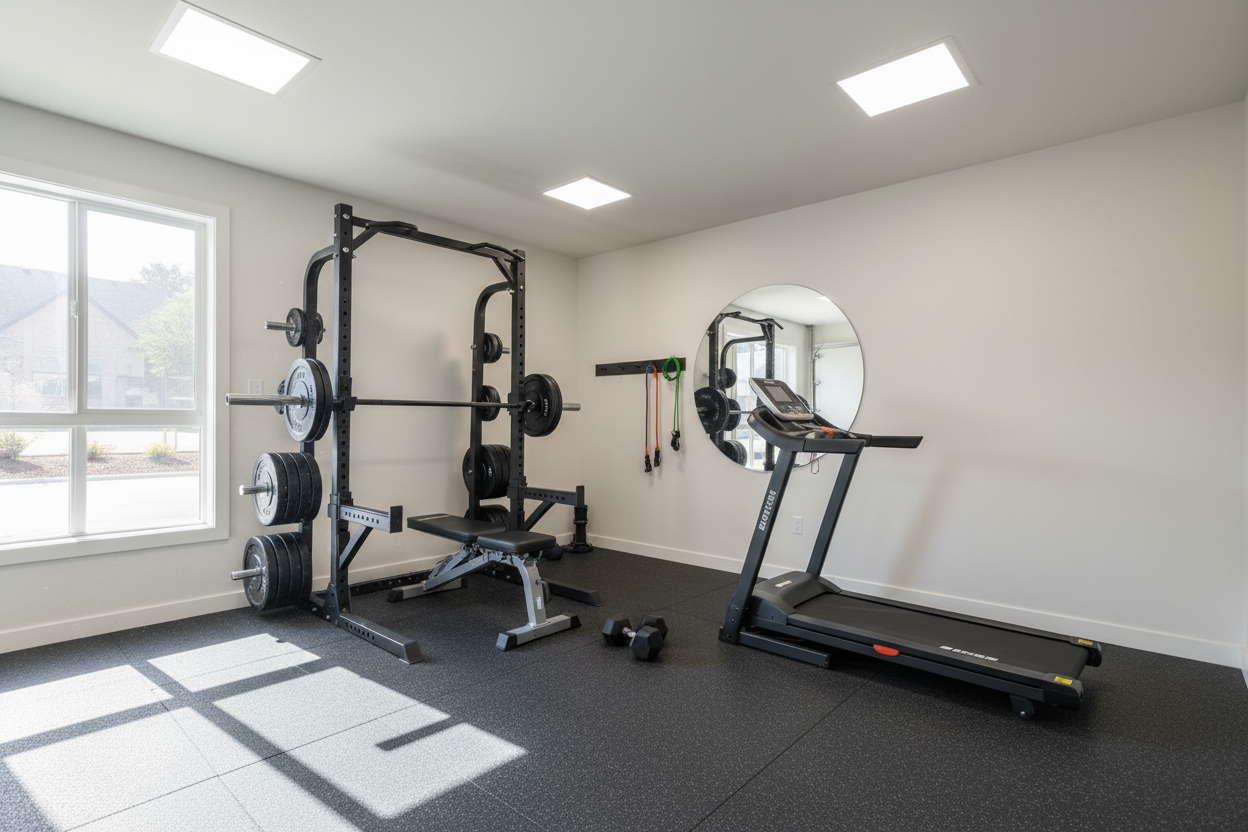
Most 'small home gym' guides are written by people who think a 10-lb kettlebell and a yoga mat constitute a workout. If you actually lift, you know that's a joke. I remember trying to wedge a full-sized power rack into a spare bedroom and realizing I couldn't even slide the plates onto the bar without hitting the closet door. It was a mess. Finding home gym ideas small spaces can actually handle requires a shift in mindset: you aren't looking for 'mini' gear; you're looking for high-density gear.
- Prioritize Footprint: Choose gear that folds or mounts to wall studs to keep floor space open.
- Think Vertically: If you aren't using your walls for plate and bar storage, you're wasting 70% of your room.
- Quality Over Quantity: One heavy-duty functional trainer beats five cheap, standalone machines every time.
- Measure the 'Working Zone': A barbell is 7 feet long; you need at least 9 feet of width to actually use it safely.
The 'Miniature Equipment' Trap You Need to Avoid
The biggest mistake I see is people buying lightweight, 'compact' versions of real equipment. These flimsy racks made of thin 14-gauge steel might look okay in a catalog, but the second you try to rack a 225-lb squat, the whole thing wobbles like a Jenga tower. In a small home exercise room, you actually need 11-gauge steel and commercial-grade engineering even more than you would in a massive garage. Why? Because you'll be interacting with every square inch of that gear constantly.
The goal is density, not downsizing. You want to build a serious home gym that feels substantial. If the equipment feels like a toy, you'll stop using it within three months. Stick to brands that use standard 2x3 or 3x3 tubing so you can actually use attachments like dip bars or landmines without the whole setup tipping over.
Measure Thrice, Buy Once: The Math Behind Tiny Training Rooms
You need to map out your 'functional clearance.' For example, a standard Olympic bar is 86 inches long. If your room is only 9 feet wide, you have less than 11 inches on either side to slide plates on. I’ve seen guys have to tilt their bars at 45-degree angles just to load a 45-lb plate. It’s annoying and, frankly, dangerous. Small home workout room ideas only work if you account for the human element—where your elbows go during a bench press or where your head ends up at the top of a pull-up.
Check your ceiling height before you even look at a rack. Most standard home ceilings are 8 feet, but many power racks are 90+ inches tall. Once I built a home gym small enough for a bedroom, and the only reason it worked was because I chose a 'shorty' rack specifically designed for 7-foot ceilings. Measure the 'swing' of your doors and the height of your overhead lights, or you'll be replacing lightbulbs every time you do an overhead press.
The Three Heavy-Duty Anchors for a Tiny Footprint
If I had to build a small gym at home from scratch with zero space, I’d start with three things: a wall-mounted folding rack, a high-end adjustable bench, and a pair of heavy adjustable dumbbells. A folding rack is the king of small room home gym ideas because it retracts to sit just 4-5 inches off the wall when you're done. You get the stability of a four-post rack without losing the room's floor space for the rest of the day.
Don't cheap out on the bench. In a cramped space, your bench often doubles as a step-up box or a seat. Look for one with a handle and wheels; being able to vertically stow your bench in a corner is a massive win for small home fitness room layouts. Pair that with adjustable dumbbells that go up to at least 80 lbs. A full rack of fixed dumbbells takes up a 6-foot wall; a pair of adjustables takes up two square feet.
Why Multi-Station Machines Make Sense in Cramped Quarters
Purists will tell you that all-in-one machines are for commercial gyms, but they’re wrong. In a small gym room at home, a single Smith machine home gym station can replace a squat rack, a cable crossover, and a pull-up station. By consolidating these into one footprint, you're saving about 40 square feet of floor space. Modern versions use high-quality needle bearings and aircraft-grade cables, so they don't feel like the 'clunky' machines from the 90s.
If you're training for hypertrophy, having a cable system in your small house gym is a necessity. It allows for constant tension that you just can't get with limited dumbbell sets. Look for a unit that uses a 2:1 pulley ratio; it makes the movement smoother and allows for more incremental weight jumps, which is vital if you're working on smaller muscle groups like rear delts or triceps.
Cardio Without the Clutter: Rethinking the Treadmill
Treadmills are the enemy of small fitness room ideas. They are massive, heavy, and usually end up as expensive laundry racks. If you need steady-state cardio, look for a foldable upright exercise bike. These have a footprint about the size of a doormat and can be tucked into a closet when your session is over. It gives you the heart rate boost you need without permanently killing your ability to do deadlifts in the center of the room.
Another option for small space home gym ideas is a high-quality jump rope or a set of battle ropes that anchor to your rack. Battle ropes can be coiled up in a bucket, and a jump rope fits in a drawer. If you absolutely must have a treadmill, look for the 'under-desk' styles that lack the bulky arms, though keep in mind they usually max out at lower speeds.
Vertical Storage Will Save Your Sanity (and Your Shins)
The floor is for feet and equipment in use. Everything else belongs on the wall. Small home gym designs fail because people leave their change plates and foam rollers scattered on the ground. Use wall-mounted plate pegs to get those 45s off the floor. Not only does it look cleaner, but it also adds structural weight to your wall-mounted rack, making it feel even more 'planted' during heavy sets.
Hang your barbells vertically. A horizontal bar rack is a shin-bruiser in a small workout space. A vertical 'gun rack' or a simple wall-mounted sleeve keeps the knurling protected and the floor clear. Even your resistance bands and lifting belts should be on hooks. When you can see every piece of gear clearly organized on the wall, the room feels like a professional training center rather than a cluttered storage unit.
My Personal Experience: The Wobble Factor
Years ago, I bought a 'space-saver' bench from a big-box store because it folded completely flat. The first time I tried to hit a heavy set of incline presses, the locking pin sheared slightly, and the backrest dropped two notches mid-rep. It was terrifying. I learned the hard way that in a small gym room, you can't compromise on the 'bones' of your setup. I eventually replaced it with a heavy-duty 11-gauge bench that doesn't fold as small but actually holds my weight. Sometimes, the best 'space-saving' idea is just buying one piece of gear that actually works.
FAQ
How much space do I really need for a home gym?
At a minimum, you need an 8x8 foot area for a rack and a bench. If you're using a full 7-foot barbell, aim for a room that is at least 10 feet wide so you can load plates without hitting the walls.
Are folding racks actually safe for heavy squats?
Yes, provided they are bolted into wooden wall studs with heavy-duty lag bolts. Most high-quality folding racks are rated for 800+ lbs, which is more than enough for 99% of home lifters.
What is the best flooring for a small home exercise room?
Skip the cheap foam puzzle mats. They compress and slide. Go with 3/4-inch recycled rubber stall mats. They are heavy, they don't move, and they protect your subfloor from dropped dumbbells.
Share:
Hip Flexor Workout: The Complete Guide to Strengthening Your Most Neglected Muscle Group
Can the Day 1 Fitness Adjustable Bench Handle Real Weight?