
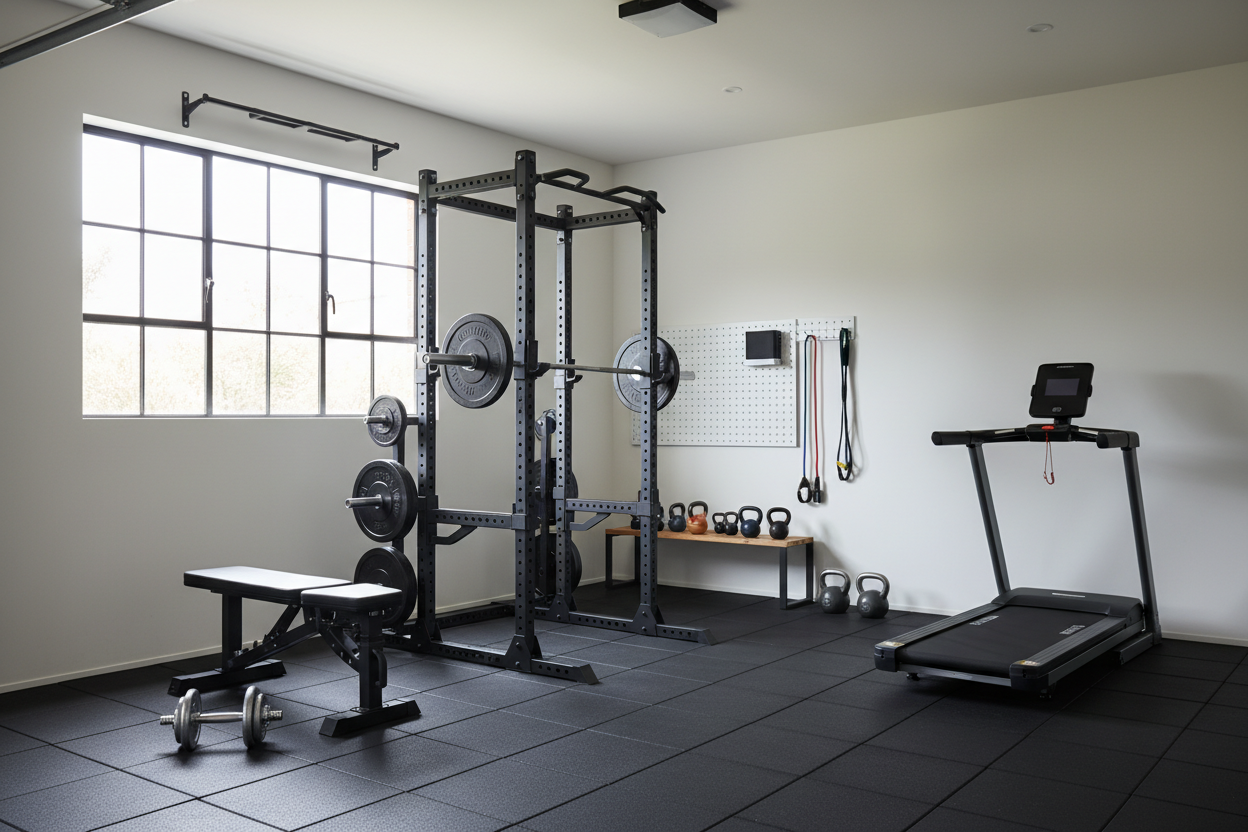
I remember the day I quit my commercial gym. It wasn't the price hike or the guy filming TikToks in the squat rack—it was the realization that I was paying $80 a month to wait in line for a leg press. I went home, looked at my empty garage, and wondered if I could actually replicate a gym exercise at home without a quarter-million dollars in selectorized machines.
The truth is, your muscles don't have eyes. They don't know if you're using a $5,000 Italian-made chest press or a pair of rusty dumbbells on a plywood floor. They only know tension and load. If you understand the mechanics of the movement, you can hack almost any gym moves at home with a fraction of the footprint.
Quick Takeaways
- Free weights offer more stabilizer muscle activation than fixed-path machines.
- Resistance bands are the best way to mimic the constant tension of cable stacks.
- Single-leg variations (like Bulgarian split squats) turn light weights into heavy-duty stimulators.
- A sturdy pull-up bar is non-negotiable for upper body development.
The Commercial Machine Illusion
Commercial gyms are designed to look impressive. Rows of shiny guide rods and leather padding make you feel like you're in a high-performance lab. But this variety is often an illusion. Most machines are just ways to stabilize your body so you can move a weight from point A to point B. When you transition to a garage, you become the stabilizer.
Many lifters worry that they'll lose progress because they can't hit the exact angles of a Hammer Strength row. In reality, the transition usually leads to better core strength and joint health. If you are debating Exercise At Home Or Gym Which Setup Actually Gets Used, remember that the best gym is the one you can walk into in your pajamas at 6:00 AM without a commute.
You Don't Need a Leg Press (And What to Do Instead)
The 45-degree leg press is a staple for quad hypertrophy because it lets you move massive weight without taxing your lower back. To replicate this gym exercise home style, you need to get comfortable with the Bulgarian Split Squat. Put one foot back on a bench or a sturdy chair and squat with the other. It targets the quads with surgical precision and requires about 20% of the weight you'd use on a machine.
If you miss the heavy loading of a hack squat, grab a barbell and perform heel-elevated front squats. By putting your heels on a pair of 5-lb plates, you shift the center of mass forward, torching the quads just like a hack squat machine would. It’s harder, it’s sweatier, and it builds more real-world stability.
Hacking Your Setup for Heavy Back Work
The biggest challenge in a home gym is often vertical pulling. If you don't have a 7-foot tall cable tower, you might think lat pulldowns are off the table. They aren't. A simple doorway pull-up bar or a wall-mounted rack is the foundation of any Home Gym. If you can't do a full pull-up yet, loop a heavy resistance band over the bar and put your foot in it for assistance.
For horizontal rows, stop trying to find a seated cable row machine. Chest-supported dumbbell rows on an adjustable bench set to a 45-degree incline provide more isolation than most cables ever could. You get the same stretch in the lats without the momentum that most people use to cheat on the cable stack.
Swapping Cable Crossovers for Real Free Weight Alternatives
Standing dumbbell flyes are a waste of time. Gravity only pulls down, so there is zero tension at the top of the movement. To get that cable-like constant tension for your chest, try floor flyes. Doing flyes on the floor limits your range of motion just enough to protect your shoulders while allowing you to go heavier than you would on a bench.
Another pro tip: banded push-ups. Wrap a resistance band around your back and hold the ends in your hands. The band gets tighter as you reach the top of the push-up, mimicking the peak contraction of a cable crossover. It’s a brutal way to finish a chest day without needing a 10-foot wide cable crossover machine.
When Certain Gym Moves at Home Actually Require a Guide Rod
I'm a free-weight purist, but I'll admit that certain movements are just better on a track. If you're coming off an injury or you're a bodybuilder looking for absolute peak isolation, a free-falling barbell can be a liability. This is where a Smith Machine Home Gym Station becomes a smart investment. It allows you to push to absolute failure on movements like overhead presses or calf raises without worrying about balance.
For those with limited space, a Smith machine can actually replace several other pieces of gear. It’s the one 'machine' that justifies its footprint because it provides a safe way to perform heavy compound lifts when you don't have a spotter. If you’re training solo in a basement, that peace of mind is worth every penny.
Stop Trying to Copy Your Old Routine Exactly
The biggest mistake I see people make when they start training at home is trying to force their old 12-machine commercial routine into a 2-car garage. You have to pivot. Instead of looking for a 'leg extension replacement,' look for 'quad-dominant movements.' Focus on the movement patterns: squat, hinge, push, pull, and carry.
Stop worrying about having the exact same handle or the same pulley ratio. Focus on the effort. You can get more out of a single pair of 50-lb dumbbells and a high level of intensity than you can from a room full of machines and a half-hearted work ethic. You need to Stop Blaming Your Gear How To Actually Exercise At Home Gym Setups and start focusing on the work. The iron doesn't care where it's stored.
Personal Experience: The Band Mistake
Early in my home gym days, I tried to replicate a cable woodchopper by anchoring a cheap resistance band to a plastic towel rack in my bathroom. Five reps in, the towel rack ripped out of the drywall and the band smacked me right in the forehead. I learned two things that day: 1) Always anchor to something made of 11-gauge steel, and 2) If you're going to use bands for heavy work, buy the multi-layered latex ones, not the cheap tubular ones with plastic handles. Quality gear isn't just about performance; it's about not getting a black eye in your own house.
Frequently Asked Questions
Can I build muscle with just dumbbells at home?
Absolutely. Muscle grows from mechanical tension and metabolic stress. As long as you are progressively increasing the weight or the reps, your body will adapt. Use tempo sets (slow eccentrics) to make lighter dumbbells feel much heavier.
What is the best floor protection for a home gym?
Skip the cheap foam puzzle mats. They compress under heavy weight and slip during dynamic moves. Go to a farm supply store and buy 3/4-inch thick rubber horse stall mats. They are indestructible, dampen noise, and will last longer than your house.
How do I do heavy squats without a rack?
If you don't have a rack, you shouldn't be back squatting. Instead, master the Steinborn Squat (advanced) or stick to heavy Goblet Squats and Zercher Squats. Zercher squats involve holding the bar in the crooks of your elbows, which allows you to pick the bar up from the floor or a low bench safely.
Share:
Logging Lifts? The Real Upper Body Workout Machines Names Explained
Why the TuffStuff CSM 600 Might Be Too Much Machine for You