
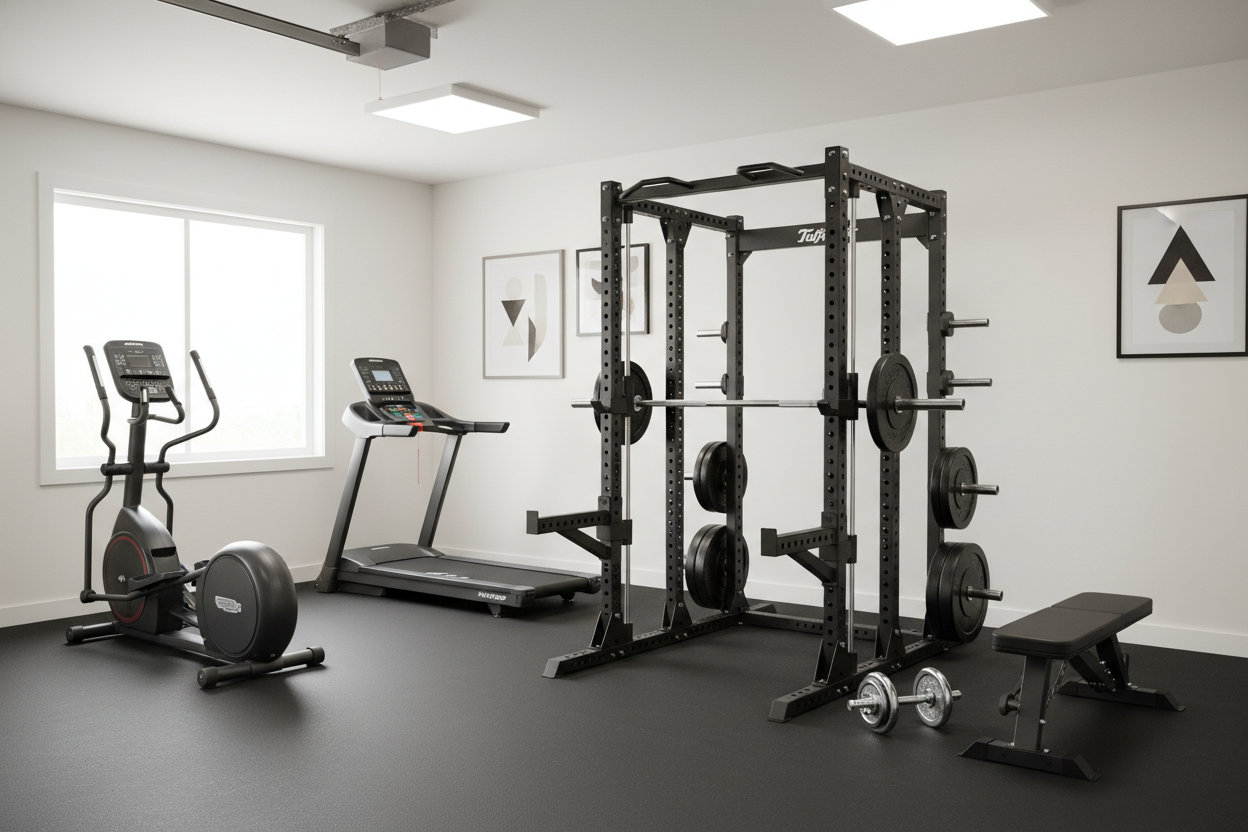
I spent three hours last Tuesday scrolling through forum threads and spec sheets, trying to figure out if my garage floor could actually handle another thousand pounds of steel. We’ve all been there—that late-night obsession where you realize your current squat stand feels like a coat rack and you start eyeing professional-grade gear. If you are looking at the csm 600, you aren't just looking for a place to hang your towels. You are looking for a tank.
Quick Takeaways
- Commercial-grade 11-gauge steel construction that will likely outlive your house.
- A 7-degree slanted Smith track designed to mimic the natural bar path of a human press.
- Integrated half-rack for free weight work, though it eats up a massive 80-inch depth footprint.
- The price point is strictly for those who value 'buy once, cry once' over budget-friendly alternatives.
What Makes the TuffStuff CSM 600 So Ridiculously Heavy?
Let’s talk about the tuffstuff csm-600 and its sheer mass. This isn't one of those flimsy racks you buy at a big-box sporting goods store that wobbles when you rack a 225-lb bench press. This unit weighs in at nearly 450 lbs before you even put a single plate on the bar. It uses 2x3 inch 11-gauge tubular steel. In plain English: it’s overbuilt for a home setting.
The footprint is the first thing that hits you. You need a dedicated 7-foot by 8-foot space just to breathe around this thing. The 7-degree slant is the standout feature here. Most cheap Smith machines are vertical, which feels awkward for your shoulders during a bench press. TuffStuff angled this track to follow the natural arc of your arms. It feels intuitive, but that angle also means the machine sticks out further into your room than a standard vertical cage.
If you have a low ceiling, pay attention. This thing stands about 84 inches tall. It’s tall enough for pull-ups but short enough to fit in most standard garages, provided you aren't trying to bolt it onto a raised platform. The steel is finished with a platinum sparkle powder coat that looks great, but honestly, you’re paying for the structural integrity, not the paint job.
The Truth About Using a Power Cage Smith Machine Combo Daily
Living with a power cage with smith machine is a specific kind of lifestyle. The workflow is different. On a standard rack, you just move the J-hooks. On the CSM 600, you have a Smith bar permanently living on a track. The linear bearings on this machine are incredibly smooth—we’re talking 'push it with one finger' smooth. It doesn't have that gritty, plastic-on-metal friction you find on mid-tier hybrids.
Transitioning from a Smith machine shoulder press to a free-weight deadlift is surprisingly easy. You just park the Smith bar at the top of the track and use the front uprights as a standard half rack. However, the convenience comes with a trade-off. Because the Smith track is angled, the bar path moves toward or away from you depending on where you start. You have to be mindful of your bench placement every single time.
I’ve found that the safety stoppers on the Smith track are loud. If you’re training at 5 AM while the kids are asleep, dropping the bar onto the spring-loaded catches is going to wake up the whole block. But for heavy solo sessions? Those catches are a literal lifesaver. You can go to absolute failure on a heavy incline press without worrying about ending up on a 'gym fails' compilation video.
Free Weights vs. The Track: How the Half Rack Holds Up
This is technically a smith machine half rack combo, which means it’s trying to be two things at once. Usually, hybrids fail at both. Here, the half rack portion is actually robust. The J-hooks are plastic-lined to protect your barbell’s knurling, which is a nice touch for a machine in this price bracket. Many commercial machines skip that and just give you raw metal-on-metal.
The spotter arms are about 18 inches long. That’s enough for squats, but it can feel a bit cramped if you like to walk your squats out three or four steps. You’re forced to stay within a tight window. The Smith bar stays out of the way when it’s racked at the very top, but if you’re a taller lifter (over 6'2"), you might find your head getting dangerously close to the Smith bar during pull-ups on the integrated multi-grip bar.
One thing I love: the plate storage. It has ten storage pegs. If you own a few hundred pounds of iron, you can load this machine down to make it even more stable. It eliminates the need for a separate plate tree, which helps justify that massive footprint. It’s a self-contained ecosystem for heavy lifting.
Space and Alternatives: Could You Do Better for the Money?
The CSM 600 is an investment. You’re likely looking at a bill north of $3,000 once you factor in shipping and tax. For that kind of money, you have to ask if a single hybrid unit is better than two specialized ones. If you have a three-car garage, you might be better off buying a dedicated power rack and a separate functional trainer.
If your goal is maximum versatility in a small space, a dual pulley power rack might actually serve you better. Cables offer a constant tension that a Smith machine simply can’t replicate. The CSM 600 is great for heavy compound movements, but it lacks the isolation capabilities of a good cable system. You're buying this for the stability of the Smith track, not for cable crossovers.
On the flip side, if you are working in a tight single-car garage where every inch matters, you might want to look at a folding wall mounted power rack. It won't give you the Smith machine safety, but it gives you your floor back when you're done. The CSM 600 is a permanent resident. Once you bolt it together, you aren't moving it without a crew and a lot of swearing. It’s a piece of equipment for people who have committed to their space and don't plan on rearranging it every six months.
The Final Verdict: Is It Worth the Garage Space?
The TuffStuff CSM 600 is for the lifter who wants the safety of a commercial gym in their own home. It’s for the person who trains alone and wants to push heavy weights on the bench or squat without a human spotter. It is heavy, expensive, and takes up a lot of room. But the build quality is undeniable.
If you’re a casual lifter or someone who moves every two years, this is overkill. You'll hate moving it, and you won't appreciate the 11-gauge steel. But if you’re building a 'forever gym' and you want a machine that feels exactly like the ones at the high-end athletic clubs, this is it. It’s a premium tool for a serious trainee.
My Personal Experience
I remember the day I helped a buddy assemble his CSM 600. We thought we could knock it out in an hour. Four hours later, we were still tightening bolts. My biggest mistake was not checking the floor level first. Because the machine is so rigid, if your garage floor has a significant slope for drainage, the Smith track can feel slightly 'off.' We had to use some heavy-duty shims to get it perfect. Take the time to level it—your joints will thank you later.
FAQ
Does the CSM 600 include the barbell?
It includes the integrated Smith bar, but it does NOT include a standard Olympic barbell for the half-rack portion. You'll need to buy that separately.
Can I add a lat pulldown to this?
Yes, TuffStuff offers a high/low pulley attachment (the CHL-610WS) that bolts directly to the back. It turns the machine into a total-body station but adds even more depth to the footprint.
What is the weight capacity?
The Smith bar and the half rack are rated for heavy use, typically around 600 lbs. If you’re squatting more than that, you probably don't need my advice anyway.
Share:
How to Actually Do Every Major Gym Exercise at Home
How to Spot Fake Weight Limits on Home Leg Press Machines