
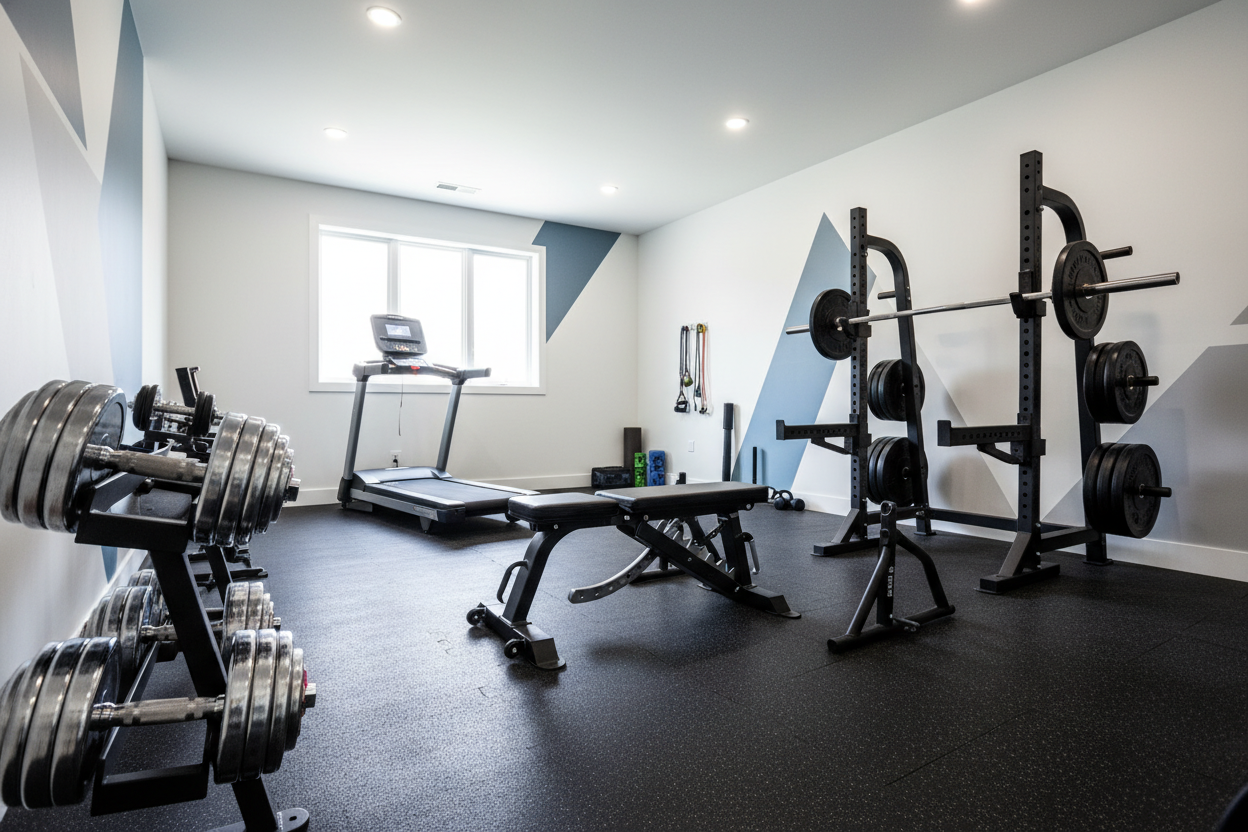
I remember the day my 40kg pairs started feeling like toys. I was staring at the rack, realizing that if I wanted to keep progressing on incline press, I had to make the jump to the 50 kg dumbbell. It is a psychological barrier as much as a physical one. Once you cross the 100-pound mark per hand, the margin for error in a solo garage gym disappears. You are no longer just lifting; you are managing heavy-duty logistics.
Quick Takeaways
- Kicking weight up is a technical skill, not just a brute force move.
- Floor protection is mandatory—standard stall mats often aren't enough for 110lb drops.
- Fixed rubber hex is generally safer for bailing than most adjustable units.
- Wrist stability becomes the primary failure point before your chest or back.
You Finally Maxed Out the Rack (Now What?)
You have likely built a weight and dumbbell set that covers the basics, but the 50kg mark is where the 'big boy' gym territory starts. A 50 kg dumbbell is roughly 110.2 lbs. That is a lot of mass to have hovering over your face without a spotter. It is intimidating, and it should be. When you move from 40kg to 50kg, the stabilization requirements do not just increase linearly—they explode. Your rotator cuffs will feel every single gram of that jump.
The Brutal Reality of Moving 50 kg Weights Around
Moving 50 kg weights isn't like grabbing a 20kg pair for curls. You need to 'dead-stop' them from the floor to your knees first. The kick-up for a chest press needs to be aggressive and timed perfectly. If you are timid with the kick, the weight stays too low, your shoulder gets stuck in a compromised position, and you are toast before the first rep. I have seen more injuries during the setup than during the actual set.
Why You Can't Treat Heavy Dumbbells Like a 50kg Barbell
A 50kg barbell is a warm-up. But two 50kg dumbbells? That is 220 lbs of independent mass fighting to rotate your wrists and tear your labrum. You cannot just rack it on pins if things go south. You have to be the rack. If you lose balance on one side, you cannot just 'bail' like you would with a squat. You have to guide that weight away from your ribcage and floor with precise spatial awareness.
Fixed Iron vs. The 50kg Adjustable Dumbbell
Can a 50kg adjustable dumbbell handle the heat? Some high-end sets can, but many selectorized blocks feel 'clanky' when you max them out. If you are doing Kroc rows where you might drop the weight, I am hesitant to recommend anything with plastic internal gears. For heavy bails, fixed iron is king. While adjustables save a massive amount of floor space, the structural integrity of a solid piece of cast iron is hard to beat when 110 lbs is crashing down.
How to Safely Bail Without Destroying Your Floor
When you hit failure, do not just drop them from the top. You need to tuck your elbows and let the weight pull you forward into a seated position, then drop them off your knees. Using a fixed rubber hex dumbbell is safer here because the flat sides prevent the weight from rolling into your shins or through your drywall after it hits the mat. I also highly recommend double-stacking your mats or using dedicated crash pads if you plan on pushing to absolute failure.
Sourcing a 50kg Dumbbell Set (Without Paying Freight Prices)
Buying a complete 50kg dumbbell set is the dream, but shipping 1,000+ lbs of iron is a financial nightmare. If you are on a budget, buy the 5kg-30kg set and then cherry-pick your 40kg, 45kg, and 50kg pairs. Your mail carrier will hate you, but your bank account will thank you. Look for retailers that offer flat-rate shipping or local pickup to avoid those massive freight surcharges that often cost as much as the weights themselves.
Personal Experience: The 'Concrete Crater' Incident
I once tried to ego-press a pair of 50s after a long day. I didn't have my crash pads out because I thought I was 'too experienced' for them. I hit failure on the fourth rep, panicked, and dropped the right one straight down from the top. It bounced off the edge of my stall mat and put a literal crater in my garage concrete. Now, I never lift the 50s without a landing zone. It was a $300 mistake in floor repairs that I could have avoided with a bit of humility.
FAQ
Is 50kg too heavy for a home gym?
Not if your floor and your joints are ready for it. Just ensure your bench is rated for at least 800-1000 lbs total capacity to account for your body weight plus the 220 lbs of iron.
Do I need specialized flooring for 50 kg weights?
Standard 3/4-inch stall mats are the bare minimum. If you're dropping 50kg regularly, you need a lifting platform or crash pads to protect the subfloor.
Should I use straps with a 50 kg dumbbell?
For rows, absolutely. Your back can likely handle 50kg, but your grip might fail first. Straps allow you to actually target the muscle without your fingers giving out.
Share:
Why Trying to Make an At Home Gym All at Once Is a Massive Mistake
How to Spot 'Ghost' Gym Equipments Companies Before You Buy