
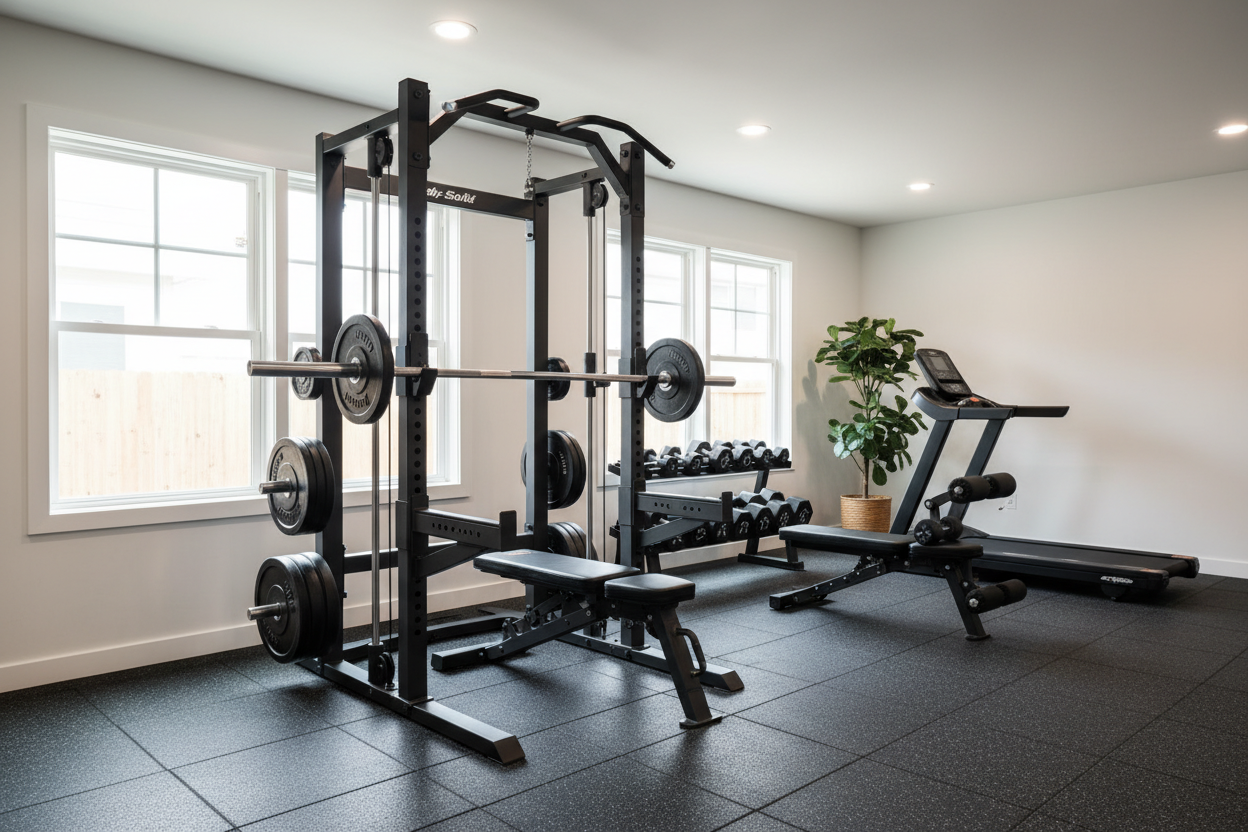
I spent years defending my four-post power rack like it was a holy relic. But after the third time I stubbed my toe on a stabilizer bar while trying to move a bench in my cramped garage, I had a realization. My training space was roughly 200 square feet, and a massive steel cage was eating the center of it while half the frame was just holding up dust and resistance bands. I needed a pivot. I needed the body solid smith machine with lat pulldown.
- Reclaims roughly 15-20 square feet of floor space compared to a rack and standalone tower.
- Integrated high/low pulley system handles everything from heavy rows to face pulls.
- 7-degree slant provides a more natural path for pressing and squatting.
- Linear bearings offer a smooth glide that beats budget bushings.
The Day I Decided to Evict My Power Rack
The frustration didn't happen overnight. It was a slow burn. It was the realization that as a solo lifter, I was using my power rack primarily as a safety net. I wasn't doing dynamic movements that required a 3x3 steel cage anchored to the slab. I was doing squats, presses, and rows. When I looked at the footprint of my rack plus my standalone lat tower, I realized I had no room left to actually move. I was living in a cage, literally.
I decided to swap the bulk for a hybrid system. Most people think switching to a Smith machine is a step backward, but they haven't tried to fit a full leg day and a back day into a one-car garage. By moving to a machine that combines the barbell track with a cable stack, I opened up enough floor space to actually lay down a yoga mat or a set of adjustable dumbbells without tripping. It wasn't about getting soft; it was about getting smart with my square footage.
Why a Body Solid Smith Machine With Lat Pulldown Actually Makes Sense
The logic is simple: efficiency. When you combine a fixed-track barbell with a high/low cable pulley system, you eliminate the need for two separate pieces of heavy equipment. For a solo lifter, the safety aspect is the biggest draw. You don't need a spotter when a flick of the wrist locks the bar into place. The Body-Solid Series 7 Smith machine is the prime example of this hybrid setup done right. It’s built on a 7-degree reversed pitch, which mimics the natural path of your body during a squat or bench press.
The footprint is the real winner here. You’re looking at a machine that stays contained within its own frame. Unlike a power rack where you might have weight horns sticking out the sides or a bench that needs to be pulled three feet out, this setup is compact. It allows you to keep your plates, your bar, and your cables in one single station. If you're working with a tight garage or a spare bedroom, that 15-square-foot saving is the difference between a functional gym and a storage unit full of iron.
Let's Talk About the Cable Pulley Mechanics
I’ve used plenty of cheap cable attachments that feel like they’re filled with sand. This isn't that. The lat pulldown on this unit uses a plate-loaded carriage that glides on its own dedicated guide rods. It’s a 1:1 ratio, which is a big deal. If you stack 100 pounds on the pegs, you are pulling 100 pounds of resistance. Many functional trainers use a 2:1 ratio that makes the weight feel half as heavy, which can be annoying when you’re trying to track real strength gains.
The smoothness is what surprised me. While it might not have the buttery feel of a $5,000 commercial-style Smith machine you’d find at a high-end club, it’s remarkably fluid for a residential unit. The high pulley is perfect for lats and triceps, while the low pulley handles seated rows and curls. It effectively replaces a standalone selectorized tower, provided you have the Olympic plates to load it up. The transition between the Smith bar and the cables is seamless, making supersets actually possible in a home environment.
Getting the Most Out of Body-Solid Smith Machine Attachments
The base machine is great, but the body-solid smith machine attachments are what turn it into a full-body station. I’m a big fan of the low row footplate; it’s sturdy and gives you a solid base to pull from without the machine tipping. However, you have to be selective. Don't buy every plastic add-on they offer. Focus on the ones that expand your movement library, like the pec dec or the extra weight horns for storage.
If you realize halfway through your build that you actually want dual pulleys for cable crossovers, you might want to look at an all in one Smith machine with cable crossover instead. But for most of us, the single high/low stack is plenty. The key is to keep the attachments organized. The biggest mistake I made was buying a bunch of handles and letting them clutter the floor, which defeats the whole 'space-saving' purpose of the machine.
The Realities of Lifting Heavy on This Setup
Let's address the elephant in the room: the 'Smith machines are for ego lifting' myth. If you load 405 on this, it’s still heavy. The linear bearings are industrial-grade and can handle significant loads without binding, but the feel is different. You don't have to stabilize the bar, which allows you to focus entirely on the muscle group you're targeting. For hypertrophy, this is actually an advantage.
One thing you must do is track your numbers accurately. You can't just assume the bar is 45 lbs. I actually took the time to find the exact Body-Solid Smith machine bar weight so I could log my sets correctly. Because the bar is attached to a carriage and bearings, the starting weight is usually lighter than a standard Olympic bar. If you don't account for that, you'll be confused when you go back to a traditional barbell and everything feels 20 pounds heavier.
Should You Make the Swap in Your Garage?
This setup isn't for everyone. If you’re a competitive powerlifter who needs to master the stabilization of a free-floating bar, keep your rack. But if you’re a solo lifter, a bodybuilder, or someone dealing with a cramped one-car garage, this is the ultimate hack. You get the safety of a fixed track, the versatility of a cable tower, and you reclaim your floor space. It turned my garage from a cluttered mess into a streamlined training center where I actually enjoy spending time.
Is it hard to assemble?
It’s a project. Expect to spend 4 to 6 hours. Use your own socket set because the tools they include are basically toys.
Can I use standard plates?
No, the weight pegs are designed for 2-inch Olympic plates. Using 1-inch standard plates will just rattle around and ruin the finish.
Does the bar rotate?
Yes, the bar rotates on a pivot so you can hook it into the safety pegs at any point in the movement. It’s very intuitive once you get the hang of it.
Share:
I Ranked the Types of Exercise Equipment for the Home (Most Are Junk)
Let's Be Honest About the Pros and Cons of Smith Machine Lifts