
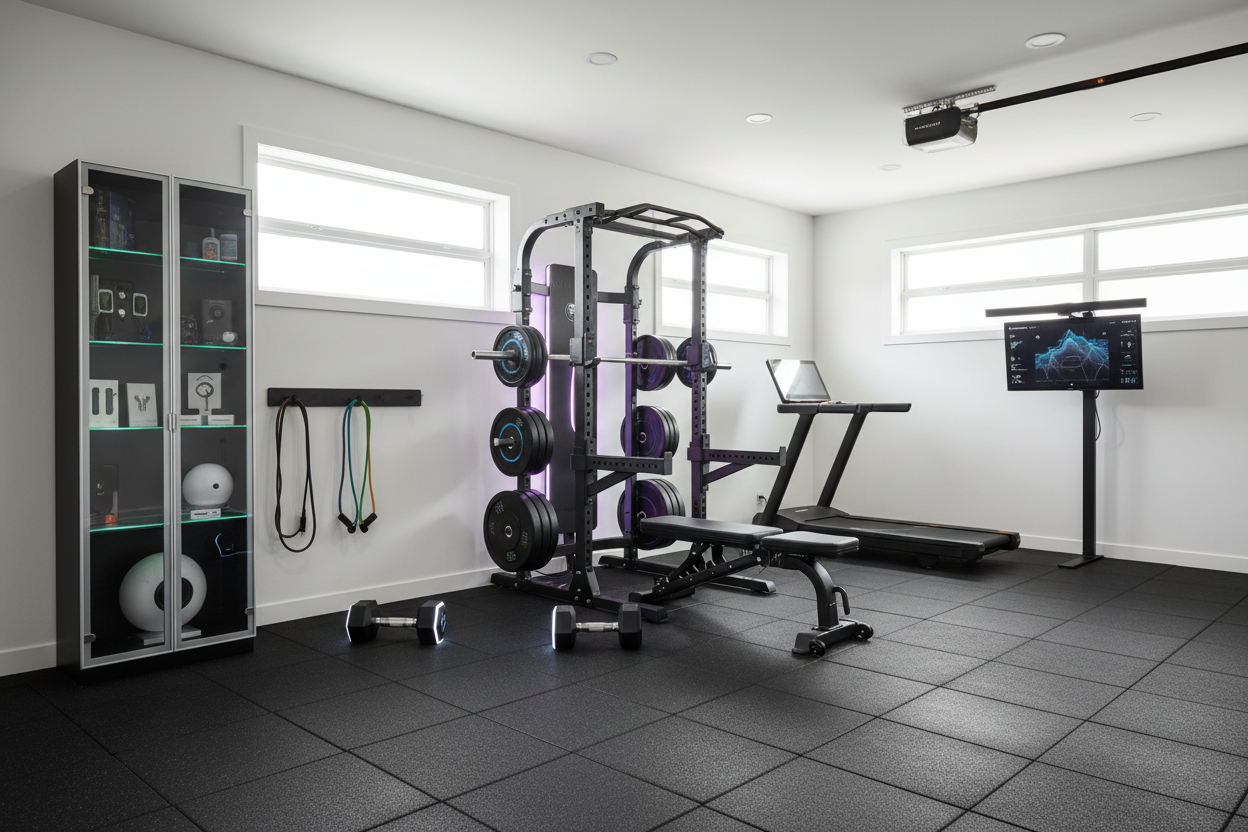
I have spent the last two decades in a garage that smells like old rubber and WD-40. My setup has always been simple: 11-gauge steel, cast iron plates that clank loud enough to annoy the neighbors, and a barbell that has probably seen more sweat than a Finnish sauna. But lately, my social media feed has been a non-stop parade of gym technical gear. Every week, there is a new 'smart' rack or a Bluetooth-enabled kettlebell promising to use AI to optimize my rest periods.
I decided to stop being a hater for a month and actually put this stuff to the test. I swapped my analog plates for digital resistance, strapped sensors to my shins, and let a touchscreen coach yell at me. I wanted to see if the influx of technology in fitness was actually going to help me hit a new PR, or if I was just paying a premium to turn my gym into a giant iPad. After thirty days of troubleshooting firmware updates instead of lifting, I have some thoughts.
- The Subscription Trap: If your equipment requires a monthly fee to function, you do not own it; you are just renting a heavy piece of furniture.
- Velocity is King: Velocity-based training (VBT) is the only technology fitness upgrade that actually moved the needle for my strength.
- Screen Fatigue: You spend all day looking at a monitor. You do not need a 22-inch 4K screen staring you down while you are trying to breathe through a heavy set of triples.
- Durability Issues: Most gym tech equipment is built with too much plastic and not enough structural integrity to survive a real home gym environment.
Why I Finally Caved and Tried Smart Equipment
I am the guy who still uses a paper logbook. There is something about writing down a weight with a physical pen that feels more permanent than tapping a screen. But as I get older, my recovery is not what it used to be. I started wondering if the new technology in fitness could help me train smarter, not just harder. Maybe my old-school 'go until you can't' approach was leaving gains on the table. I saw the ads for gym technology that tracks your bar path and calculates your 1RM on the fly, and I felt a twinge of FOMO.
I also realized that the landscape of the technology gym is changing fast. It is no longer just about heart rate monitors. We are talking about electromagnetic resistance that can add or subtract weight mid-rep to match your strength curve. That sounded like science fiction, and frankly, I wanted to see if it could actually replace a rack of dumbbells. I spent a small fortune on new tech gym equipment, cleared out a corner of my garage, and prepared to be impressed. I wanted to be wrong about my skepticism.
The reality hit me about ten minutes into the first setup. I spent more time connecting to 2.4GHz Wi-Fi than I did warming up. That was the first red flag. When you are ready to lift, you want to lift. You do not want to wait for a progress bar to reach 100% so your squat rack can 'sync' with the cloud. But I pushed through, hoping the actual training would justify the digital headache.
The 'Gym Technical' Features That Actually Matter
Once I got past the initial annoyance, I found that some fitness equipment technology is legitimately useful. The standout for me was velocity-based training. Using a small sensor that clips to the bar, I could see exactly how fast my reps were moving in meters per second. This is huge for auto-regulation. If I am supposed to be doing speed work and my velocity drops below 0.5 m/s, the tech tells me to strip weight or stop the set. It takes the ego out of the equation.
Digital pin loading is another interesting development. On some high-end machines, you can change the weight with a button or a voice command. While it feels a bit lazy, it is incredibly efficient for drop sets. However, these features should only be considered after you have finished outfitting a basic home gym with the essentials. No amount of gym tech equipment can compensate for a lack of a solid rack and a quality bar. The tech should be the garnish, not the main course.
Another winner in the technology gym equipment space is the integration of high-quality load cells in cable machines. Being able to see the exact tension—not just the weight of the plates—helps identify where you are weakest in a movement. But again, these are marginal gains. If you are not already squatting twice your bodyweight, you probably do not need a computer to tell you that you need to get stronger. Most technology in gym settings is designed to sell you a solution to a problem you do not have yet.
When Fitness and Technology Become a Distraction
The biggest issue I found is that tech fitness equipment often gets in the way of the work. I tested one 'smart' mirror that had a beautiful interface but required me to touch the screen every time I wanted to change an exercise. My hands were covered in chalk. By the end of the workout, the screen looked like a crime scene. It is clear that many of these products are designed by software engineers who have never actually done a heavy set of deadlifts.
Then there is the distraction of the data itself. Technology in fitness can lead to 'paralysis by analysis.' I found myself staring at my phone between sets, analyzing my bar path from the previous set, instead of focusing on my breathing and getting my head right for the next one. The tech makes the workout feel like an office job. You are checking boxes and monitoring metrics instead of feeling the weight. This is where gym technology fails the average lifter. It turns a primal activity into a data entry task.
And let's talk about the 'forced' ecosystems. Many of the newest tech fitness equipment brands won't let you use the machine's basic functions unless you pay for their $40-a-month app. If you stop paying, your $3,000 machine becomes a paperweight. That is not innovation; that is a hostage situation. I want equipment that works because of physics, not because a server in California is still running.
Replacing the Hype: Dumb Iron That Outlasts Tech
After a month of testing, I found myself gravitating back to my 'dumb' gear. Why? Because iron doesn't have a software glitch. A 45-lb plate is always 45 lbs. It doesn't need to be charged, it doesn't need a firmware update, and it will still be functional in fifty years. When you look at a reliable lat pulldown station, you see a tool that is built to handle 300 lbs of abuse day in and day out. There are no sensors to break and no screens to crack.
Mechanical reliability is the ultimate feature. In the world of gym tech equipment, 'new' often means 'untested.' I’ve seen smart cables snap and digital motors overheat during high-volume sessions. Meanwhile, a plate-loaded machine just keeps working. If a cable on a mechanical machine breaks, I can go to the hardware store and fix it for ten bucks. If the motherboard on your smart trainer fries, you are looking at a six-week lead time for a proprietary part that costs more than a new barbell.
The longevity of gym technology is also a major concern. Think about your smartphone from five years ago. It’s slow, the battery is shot, and it probably doesn't support the latest apps. Now imagine that is your squat rack. You want gear that grows with you, not gear that has a planned obsolescence date. The best technology in fitness is the stuff that stays out of your way and lets you focus on the mechanical tension that actually builds muscle.
The Only 3 Tech Upgrades Worth Your Money
If you have some extra cash and want to add some gym technical flair to your setup, do not buy a whole new machine. Buy accessories. First, get a decent VBT sensor. It’s a small puck that works with any bar and gives you the most actionable data you can get. Second, invest in a high-quality, wearable heart rate monitor (the chest strap kind, not the wrist kind) to track your recovery between sets. Third, get a set of smart adjustable dumbbells that use a mechanical dial—not an electronic one—to change weights quickly.
Before you go down the rabbit hole of new technology in fitness, remember that the best home gym fitness equipment usually consists of three things: a way to squat, a way to pull, and a way to press. If you have those covered with high-quality steel, then—and only then—should you look at adding sensors. Most of the stuff being marketed today is just a distraction from the hard work that actually produces results.
Personal Experience: The Day the Gym Crashed
I was in the middle of a heavy bench session using a smart bar that tracked my power output. On my third rep of a heavy set, the bar's internal sensor lost Bluetooth connection with the tablet. The tablet started beeping an error code, which completely broke my focus. I nearly dropped 275 lbs on my chest because a piece of silicon decided it didn't want to talk to another piece of silicon. That was the moment I realized that for serious lifting, 'smart' can often be dangerous. I went back to my old power bar the next day and haven't looked back.
FAQ
Is smart gym equipment worth the extra cost?
For 90% of people, no. You are paying for a screen and a subscription. Spend that money on better plates or a higher-end barbell that will last a lifetime.
What is the best way to track progress without tech?
A $5 notebook and a stopwatch. It never runs out of battery, and it forces you to be mindful of your training instead of just scrolling through an app.
Does VBT (Velocity Based Training) actually work?
Yes, it is the one piece of gym tech that is actually based on solid sports science. It helps you avoid overtraining by telling you exactly when your central nervous system is fried.
Will my smart equipment be obsolete in 5 years?
Almost certainly. Software moves fast; iron is forever. If the company goes out of business, your 'smart' features will likely stop working entirely.
Share:
Stop Wasting Your Workout on the Wrong Leg Exercise Machine
The Only 4 Gym Equipment Categories You Actually Need to Care About