
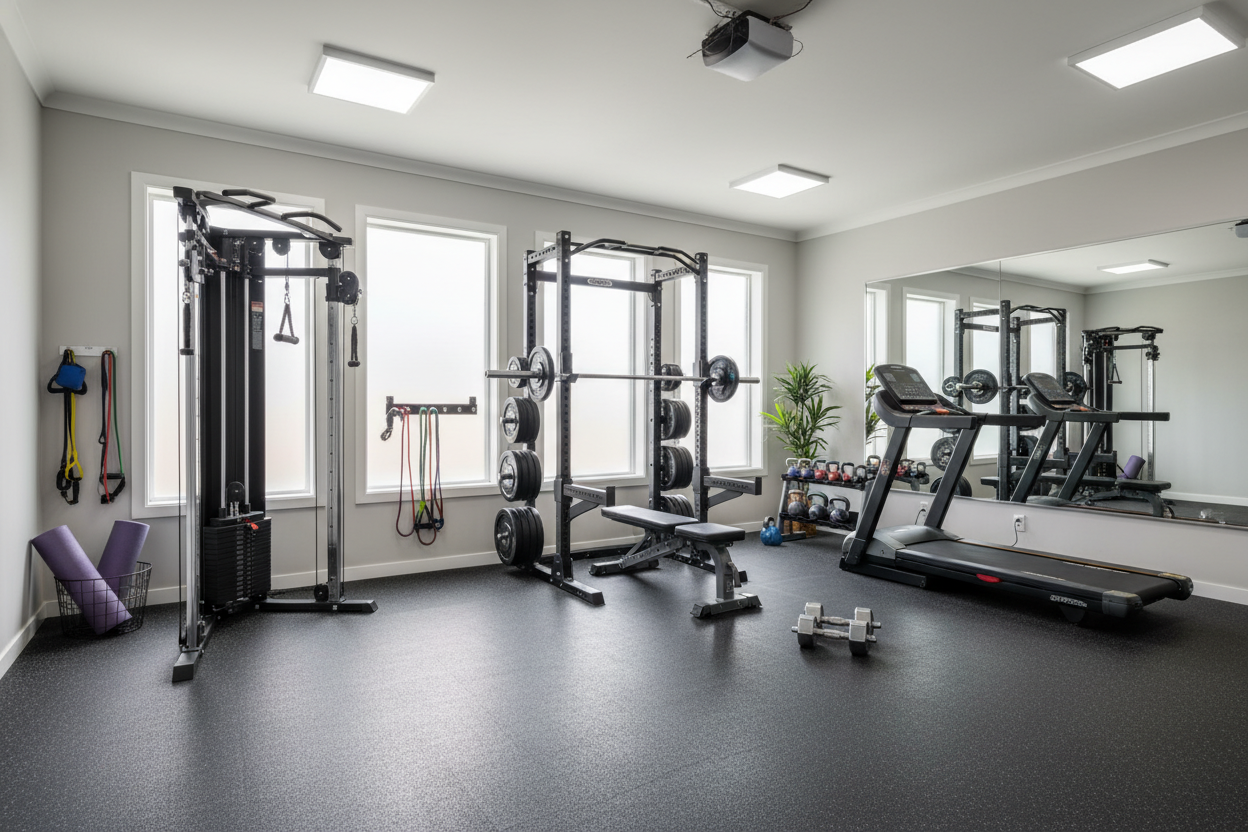
I remember walking into a massive commercial warehouse gym for the first time and feeling like I was in a spaceship hangar. Rows of chrome, plastic shrouds, and diagrams that looked like IKEA instructions for a human body. It is overwhelming, and frankly, it is meant to be. When you look at a massive gym equipment categories list, it is easy to think you need every single piece to see results.
I’ve spent the last decade loading, dropping, and occasionally breaking gear in my own garage and commercial spaces. I have learned that about 80% of what you see on a typical gym floor is just marketing fluff designed to make the membership price look more justified. If you want to build a real physique, you need to ignore the noise and focus on how the weight actually moves.
Quick Takeaways
- Free weights are the non-negotiable foundation for real-world strength.
- Plate-loaded machines offer the safest way to push heavy loads to failure without a spotter.
- Selectorized (pin-loaded) machines are best for isolation and high-volume hypertrophy.
- Cable systems provide the most versatile constant tension for accessory work.
Why the Commercial Gym Floor is Designed to Confuse You
Equipment manufacturers want to fill every square inch of their catalog. They will try to sell you a 'dedicated inner-thigh blaster' when a simple set of dumbbells does the job better. When you are scrolling through a fitness gym equipment list, remember that more machines do not equal more gains. They usually just equal more floor maintenance.
The confusion is intentional. If a gym owner can show you a list of gym instruments that spans four pages, they can charge you more. But for the lifter, this leads to 'paralysis by analysis.' You end up doing three different chest machines that all do the exact same thing, wasting time and recovery capacity. Stripping these down into four core categories lets you audit your workout and ensure you are hitting every stimulus without the fluff.
Category 1: Free Weights (The Unforgiving Foundation)
This is the gold standard. Barbells, dumbbells, and kettlebells. A barbell does not care about your feelings; it is just gravity and steel. These tools require you to stabilize the load yourself, which recruits more muscle fibers and builds 'functional' strength that actually carries over to real life. Whether it is an Olympic bar with a 1,500-lb capacity or a set of 52.5-lb adjustable dumbbells, these are the highest ROI items you can own.
If you are building a home setup, realizing the best home gym fitness equipment is just 3 things can save you thousands. You need a way to squat, a way to press, and a way to pull. That is your gym exercise equipment list foundation. Everything else is just a luxury. I always tell people to buy the best barbell they can afford—the knurling should feel like a firm handshake, not a cheese grater or a wet noodle.
Category 2: Plate-Loaded Systems (Heavy Duty, Zero Balance)
These are the heavy hitters. Think of a Hammer Strength chest press or a massive leg press where you manually slide 45-lb plates onto the pegs. These machines provide a fixed path of motion, which means you do not have to worry about the weight tipping left or right. This is where you go to get dangerously strong without needing a gym buddy to watch your every move.
For solo lifters or those with limited space, a Smith machine home gym station is the ultimate hybrid here. It gives you that fixed-path safety and the ability to rack the weight with a flick of the wrist. It is a staple on any serious gym machines list because it allows for high-intensity techniques like rest-pause sets that are too risky with a standard barbell. If you want to push your legs until they feel like jelly, a plate-loaded leg press is your best friend.
Category 3: Selectorized Machines (The 'Pin-Loaded' Stuff)
These are the classic weight stack machines. You move a metal pin to select your weight, sit down, and go. While barbell purists love to hate on them, they are incredible for isolation. If you want to blow up your triceps or hamstrings without fatiguing your entire central nervous system, this workout machine list category is where you spend your time.
The downside? They are expensive and take up a lot of room for only doing one thing. A dedicated leg extension machine might have a 4x4 ft footprint but only works your quads. In a commercial gym, they are great for circuit training. In a home gym, they are usually the last thing you should buy unless you have a massive budget and a spare three-car garage.
Category 4: Cable and Pulley Systems (Constant Tension)
Cables are the secret sauce of aesthetics. Unlike a dumbbell, where the tension drops off at the top of a curl, a cable keeps pulling. This constant tension is a different kind of stimulus that leads to massive pumps and better mind-muscle connection. This is the most versatile gym apparatus list item because you can adjust the height of the pulley to hit muscles from any angle.
A good functional trainer with a 2:1 pulley ratio allows for smooth, fast movements. If you are looking at a gym tools list and want something that replaces ten other machines, a dual-cable column is the answer. You can do rows, flyes, crossovers, and even belt squats if you get creative with the attachments.
How to Use This Framework to Audit Your Own Training Space
Stop trying to collect every single item on a list of fitness equipment. Most people need a 70/30 split: 70% free weights for the heavy lifting, and 30% cables or machines for the 'finishers.' If your gym is 90% machines, you are missing out on the stabilization benefits of free weights. If it is 100% free weights, your joints might eventually start screaming for the fixed paths of a machine.
I learned this the hard way. I once had a garage so full of 'specialty' bars and odd-object trainers that I couldn't even do a proper burpee without hitting my head. Eventually, I sold 80 of my gym equipment in home storage heres what I kept because I realized I was spending more time moving gear than lifting it. Efficiency is the name of the game. Pick one solid tool from each category and you will have a better setup than most commercial clubs.
Personal Experience: The 'All-in-One' Trap
Early in my lifting career, I bought one of those cheap '100-in-1' home gyms from a big-box store. It used a single cable for everything. It was a disaster. The resistance felt 'mushy' because of the cheap plastic pulleys, and the frame wobbled every time I went over 100 lbs. It taught me a valuable lesson: it is better to have one high-quality barbell than a dozen mediocre plastic machines. Now, I prioritize 11-gauge steel and sealed bearing pulleys. If it rattles when you shake it, don't buy it.
Frequently Asked Questions
What are the gym equipment essentials for a beginner?
Start with a solid set of dumbbells or a barbell and rack. This covers the free weight category which is the most important for building a base. A bench is the next logical step.
Is gym all equipment necessary for a good workout?
Absolutely not. You can get a world-class workout with just one category (free weights). The other categories are just tools to add variety and specific isolation once you are already strong.
Why do some machines feel heavier than others?
It usually comes down to the pulley ratio. A machine with a 2:1 ratio means 100 lbs on the stack feels like 50 lbs in your hand. Always check the specs, not just the numbers on the plates.
Share:
I Tested the Newest Gym Technical Gear (Most of It Is Trash)
Is the Best All-In-One Gym Machine Just a Huge Compromise?