
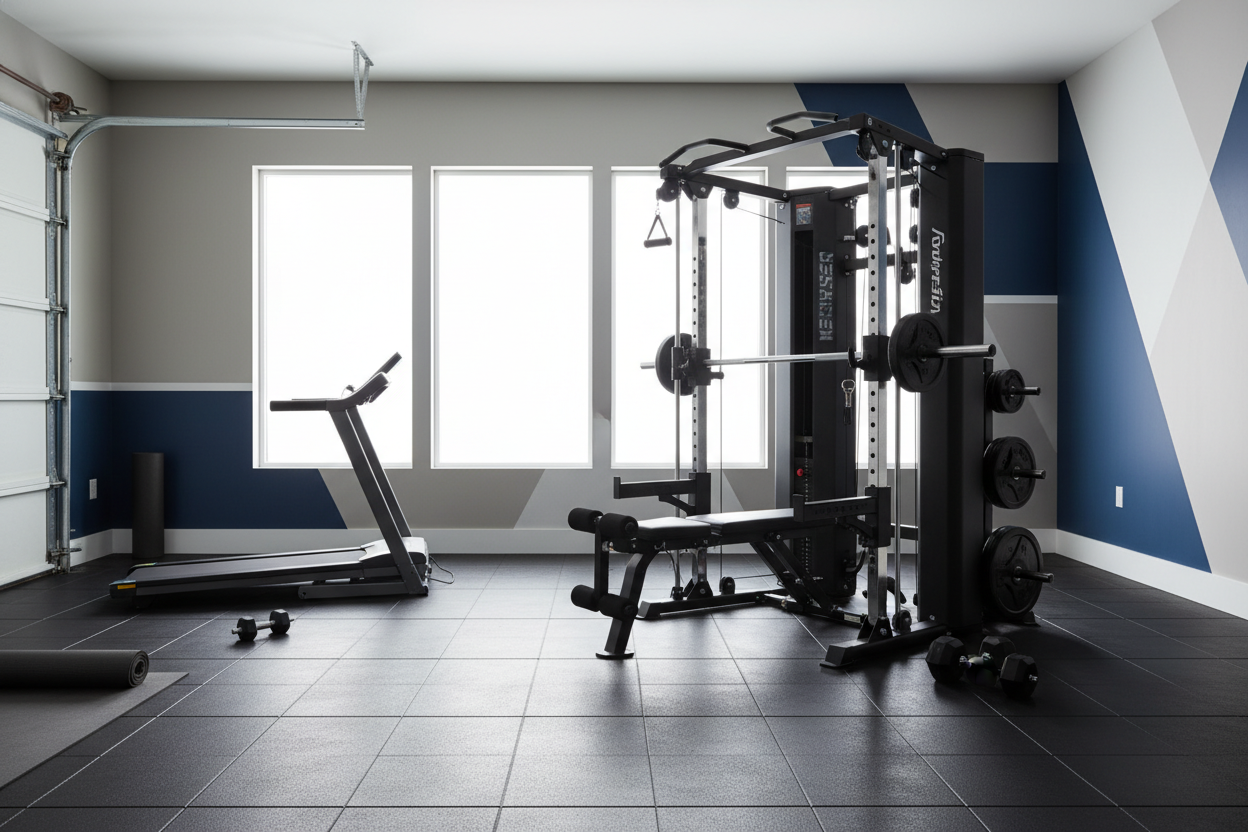
I spent three years playing a high-stakes game of Tetris with a power rack, a functional trainer, and a dedicated leg press in a standard suburban garage. Every time I wanted to squat, I had to move the bench. Every time I wanted to do lat pulldowns, I had to shimmy past a stack of plates. My training was suffering because I spent more time moving gear than lifting it. I finally hit my limit and swapped the clutter for a single all in one home gym system.
- Footprint: You can reclaim about 40-60% of your floor space by consolidating stations.
- Pulley Ratios: Look for 2:1 ratios for functional movements and 1:1 for heavy strength work.
- Versatility: A solid rig handles everything from heavy squats to cable flyes without a 10-minute setup.
- Durability: If it weighs less than 400 lbs total, it’s a toy, not a training tool.
The Breaking Point: When a Cluttered Garage Ruins Your Workout
There is a specific kind of frustration that comes from tripping over a dumbbell while you’re trying to find your groove on a heavy set. My garage was so packed with individual stations that I couldn’t even extend my arms for lateral raises without hitting a wall. I realized that having five different pieces of equipment didn't matter if I hated being in the room. This is the main reason lifters are ditching the 'one of everything' approach for Home Gym setups that actually let them breathe.
Switching to combined gym equipment isn't about doing less; it’s about doing more in the same footprint. When your rack, cables, and Smith machine occupy the same 4x6 foot space, your transition times drop. You stop searching for clips and start focusing on the pump. In a 1-car garage, that extra floor space is the difference between a dungeon and a sanctuary.
What Even Counts as an All-In-One Rig These Days?
The market is flooded right now. On one end, you have the flimsy all in one gym kit you see at big-box retailers—usually made of thin-walled steel with plastic pulleys that scream after a month of use. On the other end, you have the commercial-grade all in one fitness center style units that weigh half a ton and use aircraft-grade cables.
A real all in one training machine needs to be the centerpiece of your room. We’ve moved past the days of 'total gym' clones. Modern rigs are essentially power racks with integrated dual-weight stacks and a Smith machine built into the frame. But does it actually work? Does an All-in-One Machine Actually Equal a Complete Gym for Home? For most of us, the answer is a resounding yes, provided you don't buy the cheapest version on the internet.
The Trade-Offs Nobody Tells You About
Let's get real: no piece of equipment is perfect. When you use an all in one weight machine for home use, you are dealing with shared components. If you’re training with a partner, you might find yourselves fighting over the same uprights. The biomechanics of a Smith machine also have a fixed path—it’s great for hypertrophy, but it won't replace the stabilizing muscle demand of a completely free barbell squat.
There is also the 'cable friction' factor. Cheap pulleys on an all in 1 fitness machine feel sticky, especially at the bottom of a rep. You lose that tactile connection to the weight. If you’re used to a standalone $3,000 functional trainer, a budget all in one training setup will feel different. You have to decide if that slight loss in 'feel' is worth the 30 square feet of floor space you just got back.
The Features That Actually Matter for Real Lifting
If you're going to pull the trigger, don't obsess over the number of attachments. Obsess over the specs. You want a 2:1 pulley ratio for your cable work—this gives you more cable travel and a smoother feel for things like crossovers and face pulls. The weight stacks should be at least 200 lbs per side. Anything less and you'll outgrow the machine in six months of consistent all in one training.
Check the quality of the all in one workout bar and the landmine attachment. If the knurling is smooth as a baby's arm, you’re going to hate it when your hands get sweaty. The All In One Smith Machine With Cable Crossover S1 V4 is a solid example of a rig that doesn't compromise on the heavy-duty stuff. It uses commercial-grade linear bearings, so the Smith bar doesn't catch or stutter when you're grinding out that last rep of incline press.
Let's Talk Money: Are You Actually Saving Anything?
The home gym machine all in one price tag usually sits between $2,000 and $5,000. That sounds like a gut-punch until you price out the alternatives. A quality power rack ($800), a functional trainer ($2,000), a Smith machine ($1,500), and a leg press ($2,000) will easily clear seven grand—and that’s before you buy the plates.
When you look at a Smith Machine Home Gym Station, you're paying for the engineering required to make those systems play nice together. You save on shipping, you save on assembly time, and most importantly, you save the cost of a larger house. For me, the investment paid for itself the first time I finished a full-body circuit in 45 minutes without once having to move a piece of heavy equipment out of my way.
FAQ
Is an all-in-one machine good for powerlifting?
It’s great for accessory work, but if you’re a competitive powerlifter, you still need a dedicated barbell and a rack with 1-inch hole spacing for precise safety heights. Most all-in-ones are built more for bodybuilding and general strength.
How hard are these things to assemble?
Expect a full weekend project. These rigs arrive in multiple heavy boxes. You’ll need a socket set, a friend to help hold the uprights, and a lot of patience. Don't rush the cable routing—get that wrong and the machine will never feel smooth.
Can I do pull-ups on these rigs?
Almost all of them come with multi-grip pull-up bars. Just make sure your ceiling height can accommodate the top of the machine plus the height of your head. You usually need at least 84 to 90 inches of clearance.
Share:
Why That $150 Adjustable Bench With Weights Is a Terrible Idea
My 300-Lb Scare Made Me Buy a Heavy Duty Olympic Weight Bench