
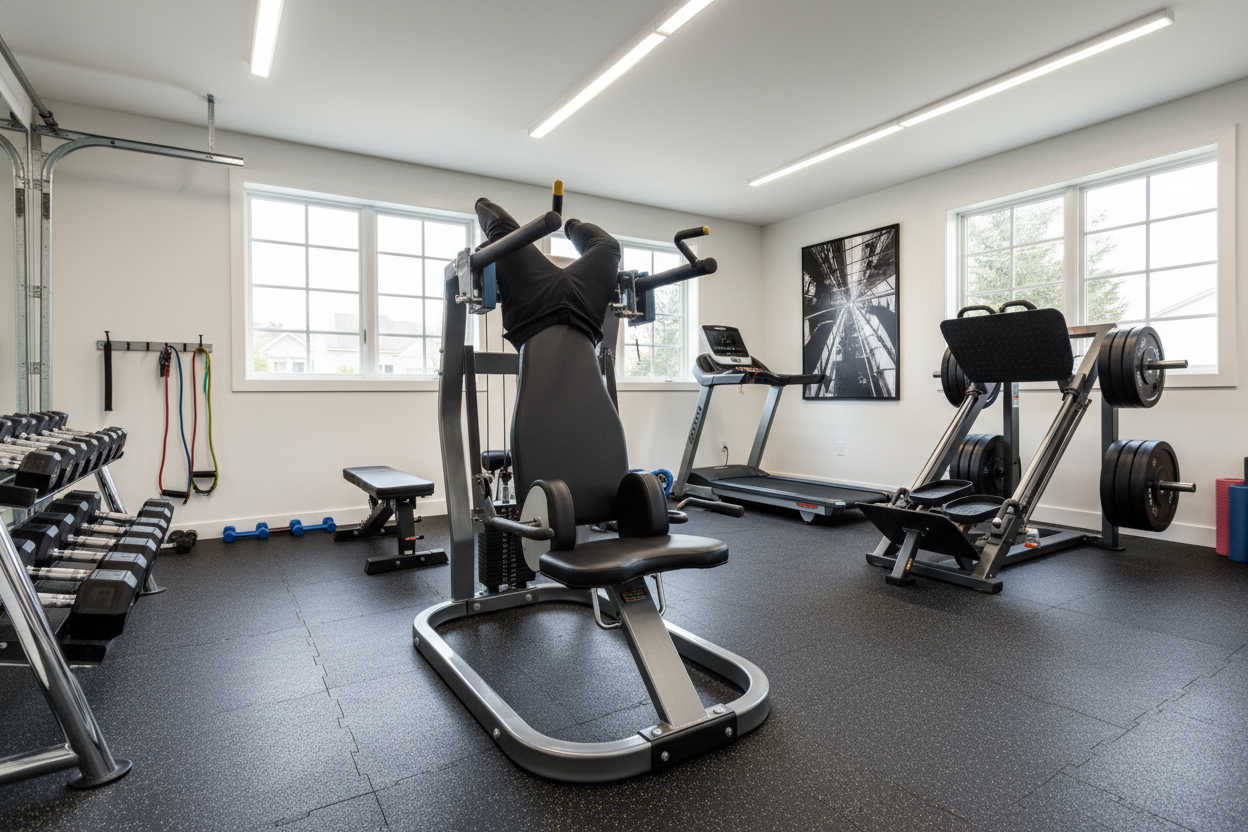
My lower back has been a ticking time bomb since a botched deadlift set in 2018. Since then, heavy back squats have felt less like a strength builder and more like a game of Russian roulette with my L5-S1 vertebrae. I was scrolling through marketplace listings at 2 AM when I saw it: a vertical leg press, or as the internet calls it, an upside down squat machine. It looked like a medieval torture device, but the promise of hitting my quads without the spinal compression was too tempting to pass up.
Quick Takeaways
- Zero Spinal Load: Since the weight is supported by your feet and your back stays flat on the floor, your spine is completely out of the equation.
- Small Footprint: Most models take up about a 4-foot by 3-foot area, making them way more garage-friendly than a massive 45-degree leg press.
- Pure Quad Isolation: There is no 'cheating' here; the 90-degree angle forces your quads to do 100% of the work.
- Loading Is a Pain: You have to reach up and slide plates onto the carriage while lying down, which is a workout in itself.
What the Hell Is an Upside Down Squat Machine?
If you have ever seen old-school footage of Tom Platz, you might have spotted a vertical leg press. It is exactly what it sounds like: you lie flat on your back, place your feet on a platform directly above your hips, and press the weight straight up toward the ceiling. It is the ultimate upside down squat experience.
Unlike a traditional leg press that sits at a 45-degree angle, the resistance here is entirely vertical. Gravity is working directly against the weight plates. This means 300 pounds on this machine feels significantly heavier than 300 pounds on a standard angled sled. It is a raw, unforgiving movement that strips away the mechanical advantages of leverage.
The Spinal Decompression Promise (Does It Actually Work?)
The biggest selling point for me was the lack of axial loading. When you squat, the bar sits on your traps, compressing your spine. Even if you are not hating the Smith machine squat for its fixed path, you are still dealing with that downward force. On the vertical press, my back was glued to the padded floor mat.
After 30 days of using this as my primary leg movement, my back felt incredible. I was able to push to absolute failure on my quads without that familiar 'nervy' twinge in my lumbar. If you are a lifter over 30 with high-mileage joints, the relief of training legs without a heavy bar on your shoulders is worth the price of admission alone. It turns leg day from a systemic CNS drain into a localized muscle pump.
How It Feels Compared to Standard Leg Sleds
The range of motion is the first thing you notice. On a 30 degree leg press hack squat combo, you have a natural arc that allows for some hip involvement. The vertical press is a different beast. Because you are at a strict 90-degree angle, your hips are tucked, and the stretch at the bottom of the rep is intense.
I found that I couldn't move nearly as much weight as I could on a 45-degree sled. My ego took a hit, but my quads were screaming after just two sets. The machine I tested had a 400-lb capacity, but honestly, with the vertical gravity, 250 pounds felt like a house. The footprint is also a massive win; it fits into a corner where a standard leg press would require half the garage.
The 'Guillotine' Factor: Is This Thing Safe to Fail On?
Let's address the elephant in the room: having 300 pounds of iron hovering over your face. The first time I loaded it up, I was terrified. You are essentially trapped under the weight. However, most modern versions come with dual safety pins and adjustable stops. I intentionally 'failed' a rep with 180 pounds to see what happened.
The safety stops caught the carriage about 12 inches above my chest. It was loud, and it shaken the frame, but I was fine. The psychological barrier is real, though. You have to trust your equipment. If you are buying a budget version with thin 14-gauge steel, I would be a lot more nervous than I was with the 11-gauge frame I tested. Always double-check those welds before you slide underneath.
Should You Actually Put One in Your Garage Gym?
If you are tight on space and your back is trashed, this is a solid buy. It is usually much cheaper than a full-sized commercial leg press. But be warned: it is a one-trick pony. You can't really do calf raises comfortably, and the loading process is awkward as hell—you’re basically bench pressing the plates into position while lying down.
If you have the budget and an extra 20 square feet, a hack squat leg press combo is probably a better long-term investment. It offers more versatility for your hamstrings and glutes. But for pure, unadulterated quad growth without the spinal tax, the vertical press is a niche tool that actually delivers on its promises. I’m keeping mine, if only for the days when my back says 'no' but my quads say 'yes.'
FAQ
Is a vertical leg press better than a regular leg press?
It’s not necessarily better, just different. It takes up less space and provides more direct vertical resistance, but it’s harder to load and has a steeper learning curve for foot placement.
Can you do calf raises on an upside down squat machine?
You can, but it’s sketchy. Your feet are high in the air, and if your grip on the platform slips, the weight is coming down fast. I’d stick to a dedicated calf block or a seated machine.
Does it help with lower back pain?
It doesn’t 'cure' it, but it allows you to train legs without making it worse. By removing the weight from your shoulders, you eliminate the compression that usually triggers back flare-ups during squats.
Share:
Is a Vintage Cybex Exercise Machine Actually Worth the Space?
Why I Ditched Cables for a Simple Free Weight Home Gym System