
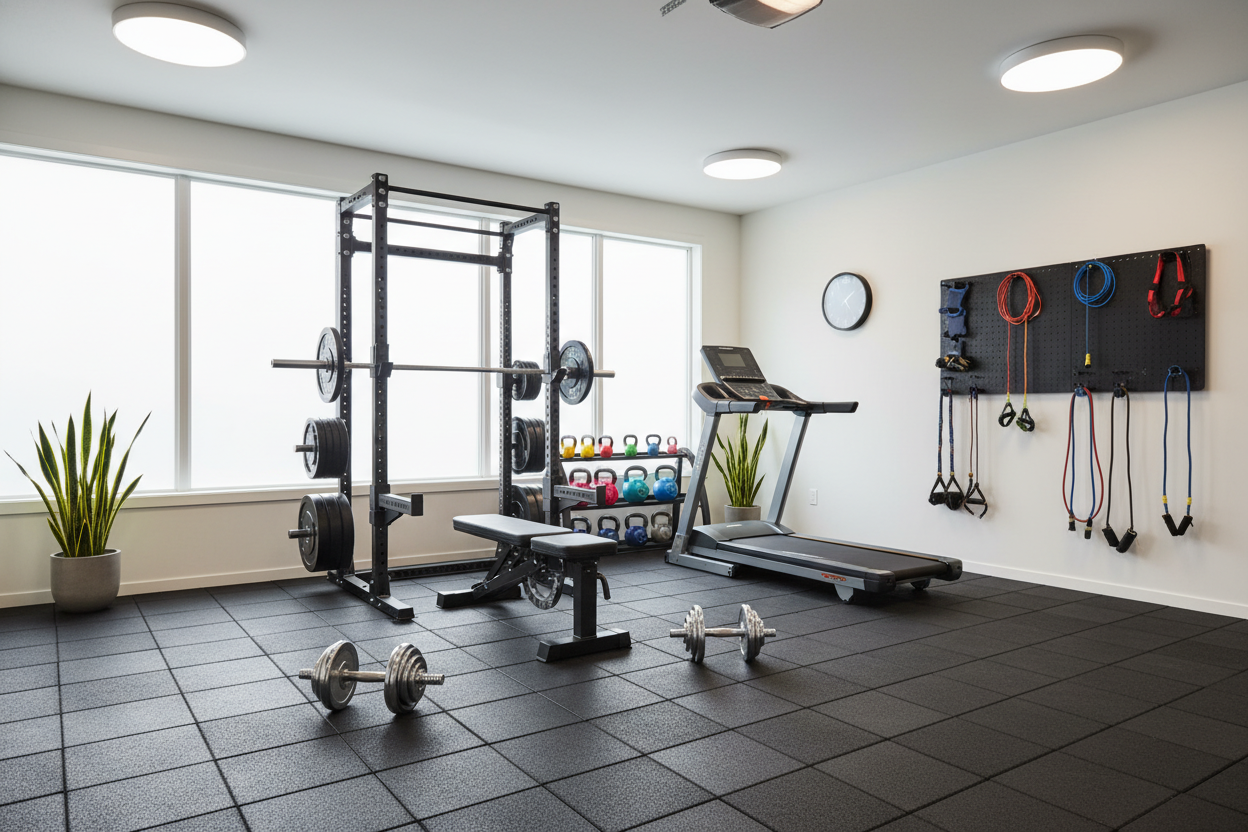
We have all been there. You walk into a warehouse-style gym, see a massive piece of steel with pulleys and handles, and have no idea what to call it. You end up pointing at it and telling your partner, 'I’m going to use the pull-down thingy.' It’s a bit embarrassing, and it makes searching for gear for your own garage a nightmare. Understanding exercise equipment and names is the first step toward actually knowing what you are doing in the weight room.
The 'Point and Grunt' Phase of Lifting is Over
I remember my first week in a commercial gym. I spent half my time wandering around looking at labels, trying to figure out if a 'Leg Press' was the same thing as a 'Hack Squat.' It wasn't just about the ego; it was about efficiency. When you don't know the fitness gym equipment names, you can't follow a program properly. You see 'Lat Pulldown' on your PDF and you spend ten minutes looking for a machine that might just be labeled 'Vertical Pull' or something equally vague.
Shopping for gear online is even worse. If you search for 'gym stuff,' you get a million results for yoga mats and resistance bands. You need to know the specific gym equipment name to find the heavy-duty steel that actually lasts. Sometimes, just having gym equipment pictures and names explained is the only way to bridge the gap between 'I want to get strong' and 'I just bought the wrong barbell.'
- Power Rack: The four-post cage that keeps you from dying during a failed bench press.
- Functional Trainer: A dual-adjustable pulley system used for everything from chest flies to cable crossovers.
- Olympic Barbell: The standard 7-foot, 45-lb bar with 2-inch sleeves for plates.
- Bumper Plates: High-density rubber weights designed to be dropped without cracking your floor.
- Smith Machine: A barbell fixed within steel rails, moving only in a vertical (or near-vertical) path.
Racks vs. Rigs vs. Stands: Framing Your Workout
The centerpiece of any serious home gym is the rack. But walk into a CrossFit box and they call it a 'rig.' Go to a minimalist garage setup and they have 'squat stands.' What is the difference? A power rack is a full cage. It usually has four or six posts. It’s the safest option because it has safety 'spotter' arms or straps that catch the bar if you fail a rep. If you’re training alone, this is non-negotiable.
A squat stand is just two uprights. It’s smaller, fits in a tight corner, but offers zero safety if you tip backward. Then you have the 'half rack,' which is a hybrid—two main uprights with a smaller secondary set for plate storage and short safety arms. Finally, a 'rig' is a modular system, often bolted to the floor and wall, used in commercial spaces to allow multiple people to pull up or squat at once. Knowing these gym apparatus names saves you from buying a $200 stand when you actually needed a $800 cage.
Decoding the Pulley Maze: Cable Machine Names
Cables are where the terminology gets truly messy. Most people use the term 'cable machine' for everything, but there are distinct differences. A 'Functional Trainer' is the gold standard. It has two independent weight stacks and adjustable pulleys that slide up and down. If you want to do a 'cable crossover,' this is the gym machine name you’re looking for. It’s versatile, usually featuring a 2:1 pulley ratio, meaning 100 lbs on the stack feels like 50 lbs of actual resistance—perfect for isolation work.
Then you have dedicated machines like the 'Lat Pulldown' and the 'Low Row.' These are often combined into a 'Lat Tower.' Unlike the functional trainer, these usually have a 1:1 ratio. If you load 100 lbs, you are pulling 100 lbs. If you’re looking for a specific workout machine name to build a thick back, the Lat Pulldown is the one with the long bar and the knee pads. The Low Row is the one where you sit on the floor or a bench and pull a handle toward your stomach.
The Track-Guided Heavy Hitters
Fixed-path machines are great for hypertrophy because they remove the need for stabilization. The 'Leg Press' is the king here. You sit low, your back is supported, and you push a platform away from you. But don’t confuse it with the 'Hack Squat,' where you stand up against a backpad and squat down at an angle. Both are gym exercise machine names you’ll see in every leg day vlog, but they hit your quads differently.
Then there is the Smith machine home gym station. For years, 'hardcore' lifters hated on the Smith machine because the bar is on a track. But for bodybuilding, it’s incredible. You can push to absolute failure without a spotter. Some modern setups even offer a Smith machine with cable crossover, which combines the fixed bar with the versatility of pulleys. This is the ultimate machine name in gym circles for those with limited space who want to do everything in one footprint.
Free Weights: You Know Dumbbells, But What Else?
Free weights aren't just 'heavy iron.' The names of fitness equipment in the free weight area are specific for a reason. An 'Olympic Barbell' has 2-inch diameter ends (sleeves) that rotate. A 'Standard Barbell' is usually 1-inch thick throughout and doesn't rotate—avoid these for heavy lifting. Then you have 'Kettlebells,' which are gravity-fed cannonballs with handles, and 'Dumbbells,' which come in 'Hex' (six-sided so they don't roll) or 'Round' (pro-style) varieties.
Even the plates have names. 'Iron plates' are the loud, clanky ones. 'Bumper plates' are rubberized and the same diameter regardless of weight (a 10-lb bumper is the same size as a 45-lb bumper). If you’re doing deadlifts or cleans, you want bumpers. If you’re just benching in a rack, iron is cheaper and takes up less space on the bar. Knowing the names of gym equipment like 'fractional plates' (those tiny 0.5-lb or 1-lb weights) can be the difference between hitting a plateau and hitting a PR.
How Knowing the Right Names Saves You Money
The 'fitness' industry loves to rename old tools to charge you more. They’ll call a basic resistance band a 'Total Body Tension System' and charge $50. When you know the actual gym workout equipment names, you can cut through the marketing. You stop looking for 'ab burners' and start looking for a 'GHD' (Glute Ham Developer) or a simple 'Ab Wheel.' You stop buying 'all-in-one' plastic junk and start hunting for commercial-grade steel.
Using the precise name of equipment in gym searches allows you to find used gear on Marketplace that people are selling for pennies because they don't know what they have. I’ve found 'Power Racks' listed as 'metal cage' for $50. I’ve seen 'Olympic Barbells' listed as 'heavy pole.' If you know the names of exercise equipment, you have the upper hand. You can build a gym that actually works, rather than a collection of expensive clothes hangers.
Personal Experience: The 'Standard' Mistake
Early in my lifting career, I found a 'great deal' on a barbell and 300 lbs of weight. I didn't know the name of machine in gym parts back then. I bought a 'Standard' 1-inch set. Three months later, I realized I couldn't use any of the high-quality plates at the local gym, and my bar started bending at 200 lbs. I had to sell the whole set at a loss and buy an Olympic setup. It was a $300 lesson in why gym items list details matter. Don't be like me—know your sleeve diameters before you pull the trigger.
FAQ
What is the 'cage' in the gym called?
It is officially called a Power Rack or Power Cage. It consists of four vertical posts and is designed for safety, allowing you to squat or bench press without a human spotter.
What is the difference between a functional trainer and a cable crossover?
A functional trainer is usually compact with two adjustable pulleys close together. A cable crossover is much wider, often with a pull-up bar connecting two distant towers, designed for large-arc movements like chest flies.
What do you call the machine for leg extensions and curls?
Usually, it is just called a Leg Extension/Curl Machine. Some are 'seated' and some are 'prone' (meaning you lie on your stomach). If a machine does both, it's often called a 'Combo Leg Machine.'
Share:
Struggling With Quad Growth? Try the Narrow Stance Smith Machine Squat
Is Fitness 19 Equipment Actually Good Enough for Serious Lifters?