
Why I Stopped Caring About Touchscreens and Classes
I remember standing in my garage three years ago, staring at a 22-inch high-definition 'smart' console that refused to boot up. The treadmill itself was fine, but because the proprietary software had a glitch, the entire machine was a $2,000 paperweight. That was the day I realized that the best treadmills for home gym owners aren't the ones that look like iPads; they are the ones built like tanks. Most people get sucked into the marketing of live-streamed classes and scenic runs through the Alps, forgetting that software becomes obsolete in 36 months, while a solid steel frame and a heavy-duty motor should last fifteen years.
When you buy a treadmill for the screen, you are paying a massive premium for tech that will eventually lag, stutter, and lose support. I’ve seen it happen with every major brand. The tablet dies, the company locks the 'manual mode' behind a paywall, or the WiFi chip fries. Instead of hunting for the prettiest dashboard, I started looking at the guts of the machine. I want a motor that doesn't smell like ozone after a three-mile run and a deck that doesn't feel like I'm running on a trampoline. If I want a screen, I’ll mount a $200 TV on the wall or prop up an iPad. That way, when the tech dies, my best treadmill for home gym training still actually works.
Quick Takeaways
- Prioritize Continuous Duty Horsepower (CHP) over 'Peak' ratings.
- Look for rollers that are at least 2.5 inches in diameter to save your belt.
- Skip the $500 'budget' treadmills if you plan on actually running.
- Ensure you have a dedicated 15-amp or 20-amp circuit to avoid tripping breakers.
The 3 Unsexy Specs That Actually Matter
Marketing teams love to talk about 'cushioning technology' and 'interactive coaching,' but they rarely lead with roller diameter or motor torque. If you want a machine that survives daily beatings from a 200-pound runner, you have to look at the mechanical trifecta: the motor capability, the roller size, and the deck construction. These are the components that determine if your machine stays in your gym or ends up in a landfill. A treadmill is essentially a giant belt being pulled over a board by a motor. If any of those three parts are weak, the whole system fails. I’ve tested machines that felt great for a week but started squeaking and slipping the moment I added any real speed or incline. Don't get distracted by the plastic shrouds; look at the iron underneath.
Continuous Duty (CHP) vs. Peak Horsepower (The Marketing Lie)
This is the biggest scam in fitness equipment. You’ll see a treadmill at a big-box store labeled '4.0 HP Peak Motor.' Sounds powerful, right? Wrong. Peak horsepower is the maximum power a motor can hit for a split second before it literally melts. It is a useless metric for running. What you need to look for is Continuous Duty Horsepower (CHP). This is the power the motor can maintain safely for the duration of your workout. If you are a runner, do not buy anything under 3.0 CHP. If you’re a heavy runner or planning on long-distance training, 3.5 to 4.0 CHP is the sweet spot.
A weak motor has to work twice as hard to move the belt when your foot strikes the deck. This creates heat. Heat is the number one killer of treadmill electronics. I’ve seen 'Peak 3.0' motors struggle to maintain a consistent pace during interval training because they simply don't have the torque to handle the friction of a human body. When the motor struggles, the belt hesitates, and your gait gets ruined. Stick to the CHP rating and ignore the 'Peak' nonsense. If the manufacturer doesn't clearly list the CHP, walk away. They are hiding something.
Why Roller Size is the Secret to Belt Longevity
Rollers are the metal cylinders that the belt wraps around at the front and back of the machine. Most entry-level treadmills use tiny 1.6-inch or 1.9-inch rollers. This is a mistake. A smaller roller requires the belt to be under significantly more tension to prevent slipping. It also forces the belt to make a much sharper turn, which increases heat and wear. Think of it like a rubber band stretched to its absolute limit; it’s going to snap or wear out much faster than one with some slack.
The best treadmills for home gym use typically feature rollers that are 2.5 inches or larger. Large rollers have more surface area to grab the belt, which means you can run them with less tension. This reduces the strain on the motor and the bearings. In my experience, machines with 2.5-inch to 3.0-inch rollers feel smoother and are significantly quieter. You won't hear that high-pitched whine of a struggling belt, and you won't have to replace your walking belt every two years. It’s a small spec that makes a massive difference in the 'feel' of the run.
Do You Actually Have the Space (and Budget) for This?
Let’s get real: a quality treadmill is a massive piece of furniture. We aren't talking about a folding chair. A standard residential treadmill has a footprint of roughly 7 feet by 3 feet. You also need 'safety' clearance behind the machine so you don't get launched into a drywall stud if you trip. If you are trying to squeeze this into a cramped spare bedroom or a crowded home gym, you need to measure twice and buy once. I’ve seen people buy a commercial-grade unit only to realize they can't actually open their gym door once the machine is inside.
Then there is the budget. A treadmill that won't fall apart costs money. You can find 'deals' for $600, but those are walking pads disguised as treadmills. If you want to run, you are looking at a $1,500 to $2,500 entry fee for something that lasts. If your total budget is tight, you might be better off skipping the motorized cardio altogether. I often tell people Why the Best Home Gym Under $1000 Doesn't Have a Treadmill because at that price point, you're buying a headache, not a tool. You'd be better off with a jump rope and a heavy set of kettlebells than a treadmill that rattles every time your heel hits the deck.
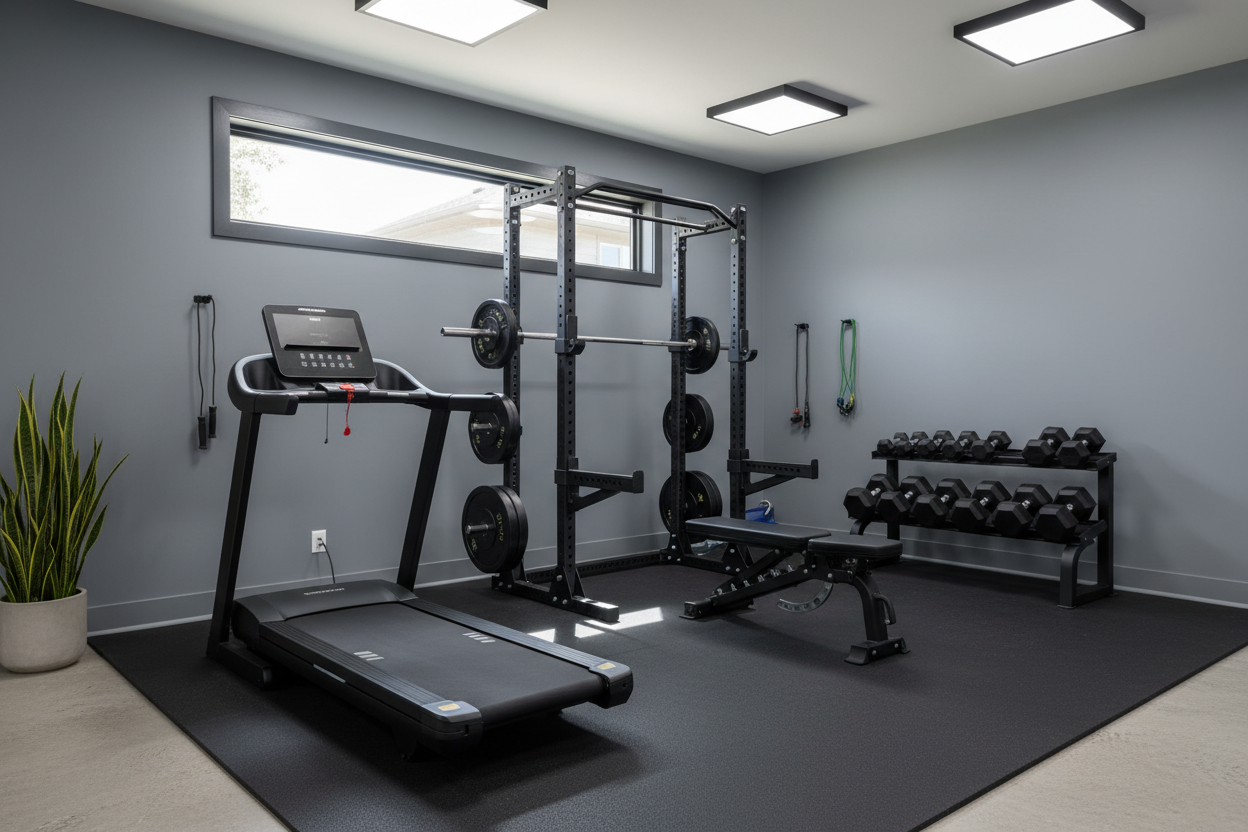
Also, consider your floor. A 300-pound machine plus a 200-pound runner equals 500 pounds of vibrating force. If you’re on a second floor with thin joists, your neighbors (or your spouse) will hate you. Even in a garage, you’ll want a high-density rubber mat to protect the motor from dust and to keep the machine from 'walking' across the concrete during sprints.
My Criteria for the Best Treadmills for Home Gym Spaces
After years of testing, my checklist for the best treadmills for home gym setups has become very simple. First, the frame must be welded steel, not bolted together plastic. If I can shake the uprights with my hand and the console wobbles, it’s a 'no' from me. Second, I look for a deck thickness of at least 1 inch. Thin decks flex too much and eventually crack under heavy use. Third, I check the warranty. A company that only offers 1 year on the motor knows their machine is junk. Look for 10 years to lifetime on the frame and motor, and at least 2 years on parts.
I personally prefer 'dumb' treadmills—machines with a simple LED dot-matrix display that shows time, distance, and pace. They are harder to find now, but brands like Sole or Spirit still make them. They are the AK-47s of the fitness world: they work every time you hit the start button, regardless of your WiFi signal. I once owned a treadmill with a built-in fan and speakers that sounded like a tin can; I never used them once. I used my Bose headphones and a floor fan that actually moved air. Stop paying for the extras and put your money into the motor and the belt. That is how you build a gym that actually lasts.
My Personal Experience
I once bought a 'budget-friendly' treadmill from a big-box store because it was on sale for $799 and had great reviews from casual walkers. Within three months of training for a half-marathon, the deck literally snapped in half during a 7.0 mph interval. The manufacturer told me that 'heavy running' wasn't covered under the normal wear-and-tear clause. It was a brutal lesson. Since then, I’ve only bought machines that weigh at least 250 pounds. If it’s light enough for one person to move, it’s too flimsy for me to run on.
FAQ
How often do I need to lubricate the belt?
Most residential treadmills need silicone oil every 3 months or 150 miles. If the underside of the belt feels bone-dry, you're killing your motor with friction. Check it monthly.
Can I put a treadmill in an unheated garage?
It’s risky. Extreme cold can cause the liquid crystal in displays to freeze and the belt to stiffen, which stresses the motor. If you do it, use a space heater to warm the room for 20 minutes before turning the machine on.
Are manual treadmills better?
Manual (curved) treadmills are incredible for sprints and metabolic conditioning, but they are much harder to use for long, steady-state zone 2 cardio. They also usually cost twice as much as a motorized unit.
Share:
How to Spot a Trash Fitness Machine Home Setup Before Buying
I Tested Electric Generating Exercise Equipment (Did It Cut My Bill?)