
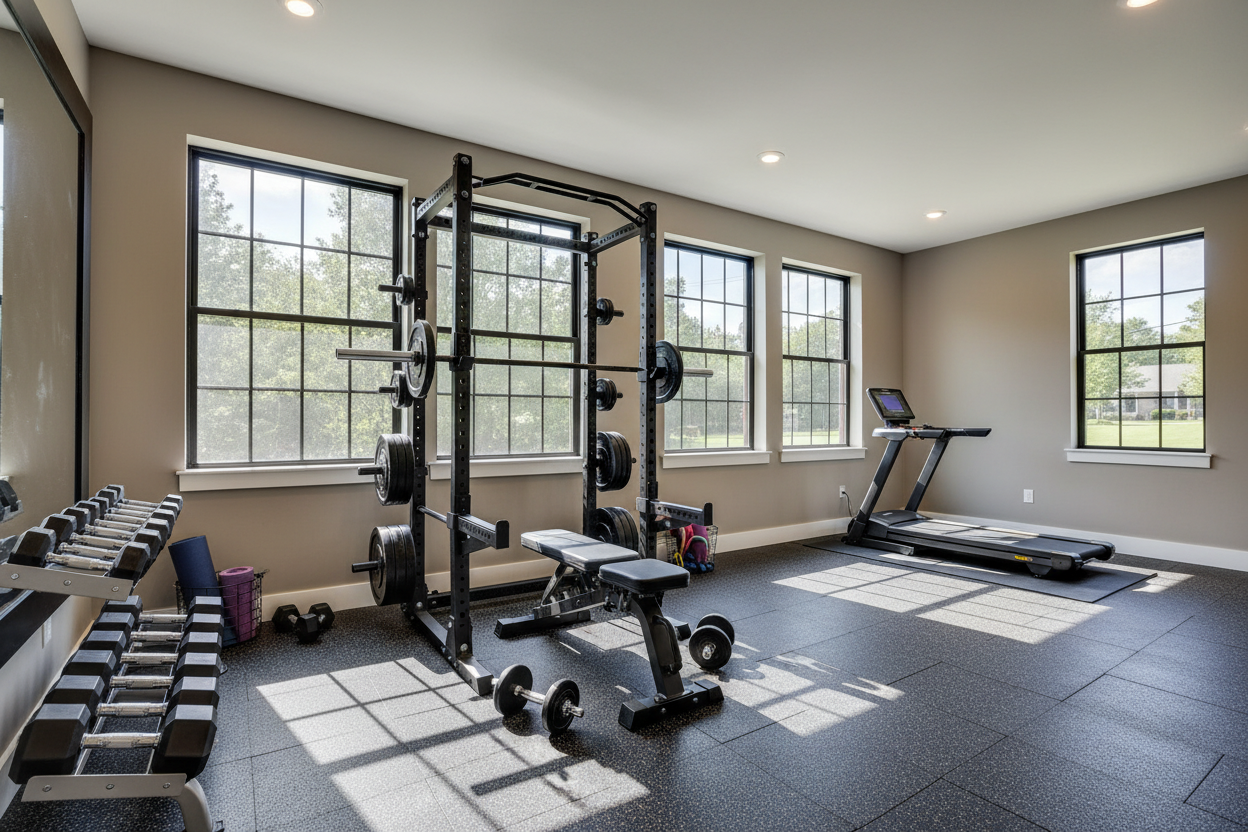
I remember the exact moment I realized my living room workout setup was a disaster. I was trying to deadlift 225 lbs on a yoga mat spread over laminate flooring. One slightly heavy eccentric later, and the floor sounded like a gunshot. The dent is still there, a permanent reminder that home and fitness don't just 'blend' together because you want them to. If you are serious about training, your house is under attack.
- Skip the big-box store 'compact' junk; if it folds, it probably wobbles.
- Your floor is your foundation—standard rugs or foam tiles won't save your subfloor.
- Multi-functional gear is the only way to survive in a residential footprint.
- Ventilation is non-negotiable unless you want your house to smell like a locker room.
The Instagram Lie: Aesthetics vs. Heavy Iron
We've all seen those minimalist workout spaces on social media. A single white kettlebell, a monstera plant, and a pristine hardwood floor. It looks great, but it’s a total lie for anyone actually moving weight. Real training is gritty. It involves chalk, sweat, and the inevitable clank of 45-lb plates. When I finally got tired of the fluff, I swapped my app for a real home fitness trainer because I needed a program that demanded more than my living room decor could handle.
True performance gear is designed for function, not feng shui. Heavy-duty racks use 11-gauge steel and 3x3 uprights. That stuff is heavy, it’s industrial, and it doesn't care about your color palette. If you're building a space for home fitness, you have to decide early: do you want a room that looks pretty, or a room where you can actually hit a PR?
Why You Should Avoid the Average Fitness Home Store
Walking into a typical big-box fitness home store is a recipe for regret. They sell equipment designed to fit in a box on a shelf, not to withstand a decade of abuse. You’ll see benches with a 300-lb weight capacity—and remember, that includes your body weight. If you're a 200-lb guy benching 135, you're already over the limit. That's how frames bend and welds snap.
Cheap pulleys are another trap. They use plastic sheaves that drag and fray cables within six months. When you shop at these places, you're paying for convenience, but you're sacrificing safety. I’ve seen 'compact' racks that sway an inch in either direction when you rack a bar. That’s not a feature; it’s a liability.
The 3 Rules for Protecting Your House (And Your Joints)
If you're building a lasting home gym, you have to treat your house like a commercial facility. Rule one: check your floor. Standard residential flooring isn't built for point-loading 500 lbs of iron. Rule two: airflow. A single human working at 85% HRmax can turn a 10x10 room into a swamp in twenty minutes. Get a high-velocity fan. Rule three: clearance. You need at least 18 inches of buffer around your bar sleeves so you don't punch a hole in the drywall every time you load a plate.
Stop Relying on Flimsy Mats
Those colorful puzzle-piece mats from the toy aisle are useless. They compress under weight, meaning your footing is unstable when you're squatting. If you drop a dumbbell, they offer zero protection to the concrete or wood underneath. Go to a farm supply store and buy 3/4-inch thick rubber horse stall mats. They are heavy, they smell like a tire shop for a week, but they are the only thing that actually protects your foundation.
Choosing Gear That Actually Makes Sense for Residential Lifting
You don't need twelve different machines to get a world-class workout. In fact, buying one high-quality piece beats a room full of junk every single time. Clutter is the enemy of consistency. If you have to move three things just to get to your pull-up bar, you're going to skip pull-ups.
Look for versatility. A versatile weight bench station allows you to hit your primary compounds and your isolation work without needing a 2,000-square-foot warehouse. I prefer gear that has a footprint of about 4x6 feet but offers multiple attachment points for things like leg developers or preacher curls. It keeps the floor clear and your head in the game.
Anchoring Heavy Equipment Safely
If you aren't bolting your rack to the floor, you are living on the edge. Even a heavy-duty Smith machine station can shift if you're aggressive with your re-racks. If you're on a concrete slab, use Tapcon screws. If you're on a wood subfloor, you need to build a plywood platform to distribute the weight. Never assume a tall piece of equipment is stable just because it feels heavy. Gravity is a cruel teacher when 400 lbs of steel decides to tip toward your drywall.
Personal Experience: The 'Rug' Mistake
When I first started, I thought a thick Persian rug would be enough to protect my spare bedroom's hardwood. I was doing high-rep kettlebell swings, got sweaty, and the bell slipped. It didn't go through the floor, but it left a crater that no amount of wood filler could fix. I also learned the hard way that cheap chrome barbells rust if you don't wipe them down. My first bar looked like it had been pulled from a shipwreck after one humid summer. Buy stainless or Cerakote if you can't control the climate perfectly.
FAQ
Can I put a squat rack on the second floor?
Technically yes, but you need to know which way your joists run. Ideally, place the rack against a load-bearing wall and across multiple joists. If the floor bounces when you jump, don't drop a heavy barbell there.
How do I stop the 'gym smell' from spreading?
Ventilation and cleaning. Use a dehumidifier to keep the air dry, which prevents mold and funk. Wipe down your bench after every session with a simple vinegar solution or gym wipes. Don't leave your sweaty wraps in a pile.
Is a Smith machine better than a power rack for home use?
It depends on your goals. If you train alone and want built-in safety without a spotter, a Smith machine is excellent. If you want to build maximum stabilizer strength, a power rack is the gold standard. Both need to be high-quality steel.
Share:
Stop Buying Junk: Serious Home Gym Ideas on a Budget
I Bought the 'Best Gym Equipment' and Sold Half of It