
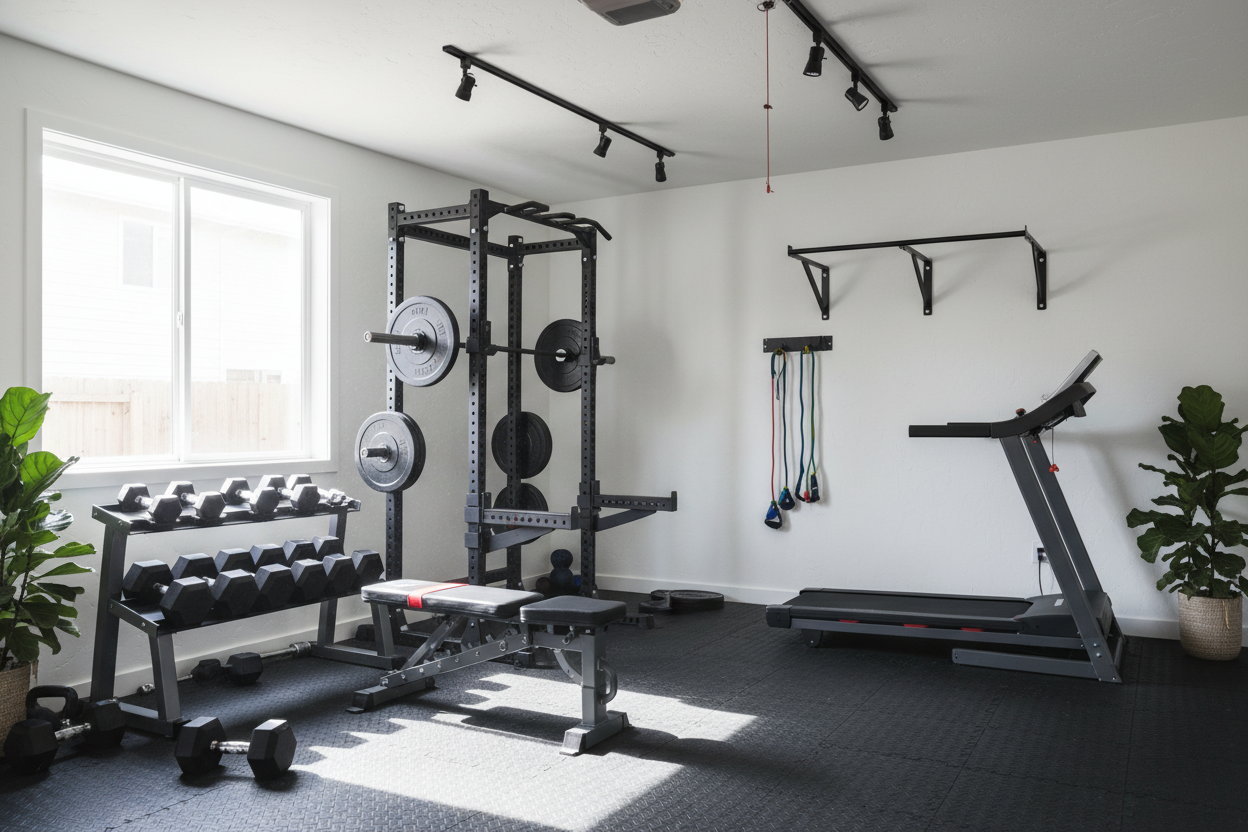
I remember the day my first 'complete' home gym arrived. Three battered cardboard boxes sat on my driveway, promising a lifetime of gains for the price of a single year's commercial gym membership. I spent the afternoon unboxing 300 pounds of iron and a shiny chrome barbell, feeling like I had finally cracked the code to home fitness. But three weeks later, when I tried to load 225 pounds for a set of squats, the bar started to look like a wet noodle, and the plates rattled with a sound that screamed 'low quality.'
Quick Takeaways
- Most bundled barbells have a dangerously low 300-lb static capacity and zero sleeve rotation.
- Pre-packaged kits often overload you with 5-lb and 10-lb plates you won't use while skimping on the 45s you need.
- Budget plates are frequently 'filled' with sand or cement rather than solid iron, leading to cracks and leaks.
- Bundled benches are usually built with thin-gauge steel that wobbles under anything heavier than a moderate dumbbell press.
The Illusion of the All-in-One Bargain
The marketing for exercise weight sets is brilliant. It targets that specific moment when you're fed up with the local gym's rising prices and crowded racks. You see a 'complete' kit—bar, weights, and maybe even a bench—all for one flat price. It feels like a shortcut. The psychological trap is the 'one-click' convenience. You think you're buying a professional setup, but the retail math tells a different story. To hit those low price points, manufacturers have to cut corners somewhere, and usually, it's everywhere.
When you buy fitness weight sets in a bundle, you aren't paying for quality; you're paying for the convenience of shipping a heavy box to your door. If a 300-lb set costs $400, and shipping a 300-lb crate costs $150, you're left with $250 worth of equipment. Subtract the manufacturer's profit margin, and you're training on gear that cost about $100 to make. That is not the kind of steel you want over your face during a heavy bench press. These sets are designed for the person who might lift once a month, not the person trying to build real strength.
The Barbell is Always the First Casualty
The barbell is the most important piece of equipment in your gym. It is the bridge between you and the weight. In most all-in-one kits, the bar is essentially a decorative pipe. These bars typically have a 1-inch diameter or a very low-grade 2-inch Olympic sleeve with no actual bearings or bushings. This means the weights don't spin. When you're doing a clean or even a simple curl, that lack of rotation sends all the torque straight into your wrists and elbows. It's a recipe for tendonitis.
Then there's the knurling—or the lack of it. A quality bar has a 'bite' that helps you hold on when your hands get sweaty. Bundled bars usually have a slick, decorative knurling that feels like it was sanded down. Add in a weight capacity that usually tops out at 300 lbs, and you've got a safety hazard. If you're a 200-lb man, you'll be deadlifting more than that bar's limit within your first six months of training. Once a bar takes a permanent bend, it's garbage. You're better off buying a dedicated bar with a 190,000 PSI tensile strength rating from the start.
Useless Increments and Sand-Filled Iron
Let's talk about the plates. Bundled sets love to boast about the 'number of pieces' included. They'll give you four 5-lb plates and six 10-lb plates to make the box feel heavy. In reality, you'll reach a point very quickly where you need more 45-lb plates, and you'll be stuck with a mountain of small change plates that just clutter your floor. Furthermore, the weight tolerance on these budget plates is abysmal. I've weighed '45-lb' plates from starter kits that actually weighed 41 lbs on one side and 48 lbs on the other. That kind of imbalance is a fast track to an injury.
The materials are even worse. If you see a plate that looks unusually thick or is coated in thick plastic, be wary. You should Stop Buying Cement Filled Junk The Truth About Cheap Weight Sets because they simply do not last. Once the plastic casing cracks, the sand or concrete inside spills out, and your 'weight' is now just a mess on your floor. If you want gear that survives a garage environment, look for Rubber Plate Sets Colored Md01. They handle the impact, protect your foundation, and actually stay the weight they're supposed to be.
Where Exactly Are You Going to Press That?
If your weight set comes with a 'free' bench, proceed with extreme caution. A standard, safe weight bench should be made of at least 11-gauge or 14-gauge steel. The benches bundled into these kits are often made of 16-gauge or 18-gauge steel—the kind of stuff they use for lawn furniture. They have a total weight capacity (user plus weights) of maybe 400 lbs. If you weigh 200 lbs and you're benching 200 lbs, you are at the absolute structural limit of that piece of equipment. That is a terrifying place to be.
Instead of relying on a flimsy bundle, you should look for a dedicated Weight Bench that offers a wide tripod base or a heavy-duty frame. A solid Adjustable Weight Bench Owb01 will provide the stability you need for incline and decline work without the terrifying side-to-side wobble. Most bundled benches are also too tall, preventing you from getting your feet flat on the floor for proper leg drive. A proper bench is an investment in your safety, not an afterthought to be thrown in for free.
How to Build an A La Carte Setup That Lasts
The smarter play is to buy your gym piece by piece. Start with a high-quality barbell—one that you'll never have to replace. This is where you spend the bulk of your initial budget. Next, buy a pair of 45-lb plates and a small set of change plates (2.5s, 5s, and 10s). You can do an incredible amount of work with just 135 total pounds and a good bar. As you get stronger, buy more plates. This 'pay as you grow' model ensures that every piece of iron in your gym is actually worth owning.
When you buy a la carte, you control the quality. You can choose plates with handles for easier loading, or thin powerlifting plates if you're tight on sleeve space. You aren't paying for shipping on 50 lbs of plastic-coated sand that you'll throw away in a year. By the time you've built up to a 300-lb set, you'll have a collection of gear that is safe, accurate, and has a resale value. Try selling a bent, rusted starter bar on Facebook Marketplace—you'll be lucky if someone takes it for free.
Personal Experience: The Bar That Became a Banana
My first 'bargain' set was a 300-lb Olympic iron kit from a big-box retailer. I was so proud of it until I hit a 315-lb deadlift. As I pulled the weight, I felt the bar give way. It didn't snap, but it didn't snap back either. I ended up with a bar that had a permanent 2-degree bend in the middle. Every time I tried to bench with it after that, the bar would rotate in my hands to find its 'center,' which made the lift feel incredibly unstable. I ended up spending more money to replace that bar than I would have spent if I'd just bought a decent one from the start. Lesson learned: buy once, cry once.
FAQ
Is a 300-lb weight set enough for a home gym?
For a beginner, yes. But the issue isn't the total weight; it's the quality of the bar and the plate increments. You'll quickly find you need more 45-lb plates and a bar that won't bend when you actually use all 300 pounds.
Why do my weights feel 'unbalanced' in a cheap set?
Budget plates have high weight tolerances, meaning a '10-lb' plate could be 9 lbs or 11 lbs. If you have a light plate on one side and a heavy one on the other, it creates an uneven load that can mess with your form and joints.
What should I look for in a starter barbell?
Look for a 28mm to 29mm diameter, a tensile strength of at least 160,000 PSI (ideally 190k+), and sleeves that use bronze bushings or bearings for smooth rotation. Avoid any bar that doesn't list its weight capacity or steel specs.
Share:
My $1,500 Mistake Buying a Multi-Station Gym Machine for Home
What Actually Happens in Fitness Equipment Manufacturing