
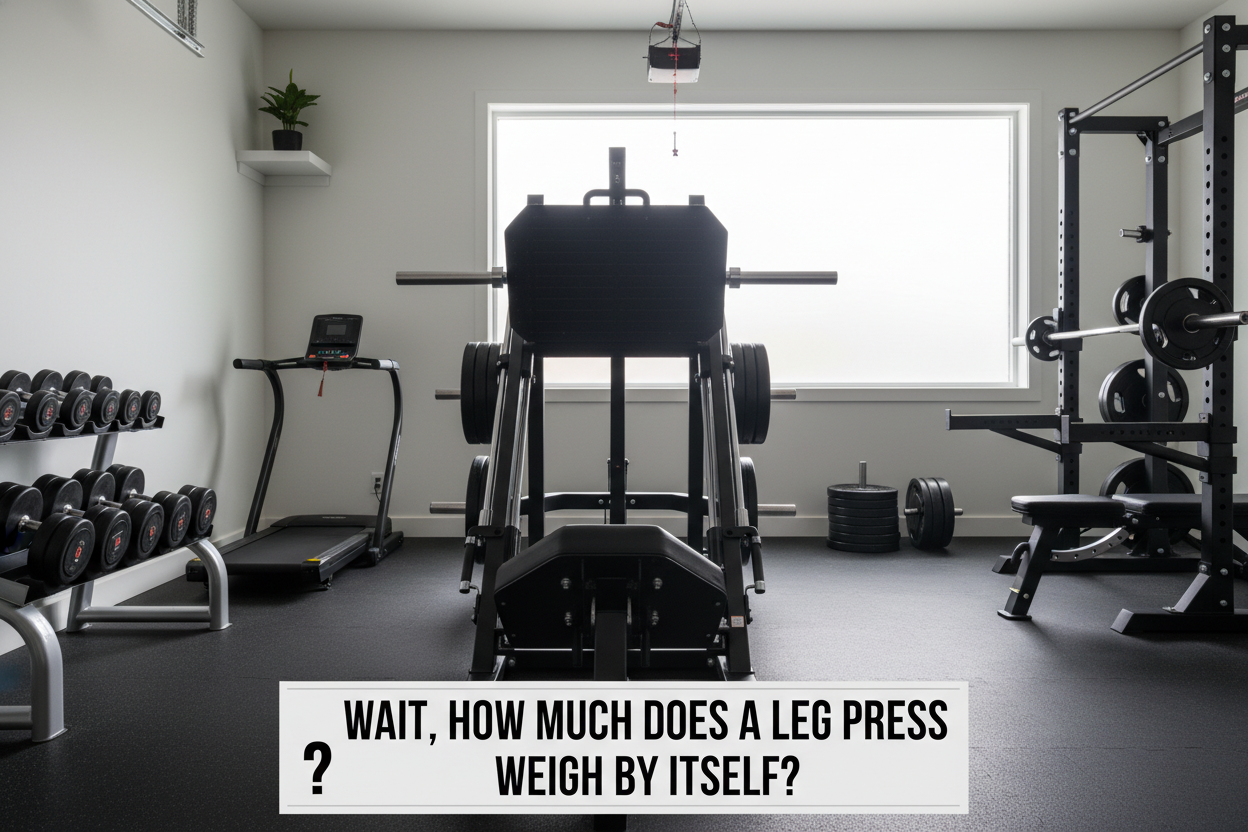
I remember the first time I loaded four plates on each side of a commercial leg press and felt like a god. Then I moved to a different gym, did the same thing, and nearly got pinned during the first set. The difference wasn't my strength or a bad night of sleep; it was the sled. If you are serious about your training log, you have probably asked yourself: how much does a leg press weigh by itself?
- Most commercial 45-degree leg press sleds weigh between 100 and 125 pounds.
- The 'effective resistance' is usually around 70% of the actual weight due to the angle.
- Budget home gym units often have much lighter sleds, sometimes as low as 35-50 pounds.
- Friction from linear bearings or rollers can add a few pounds of perceived weight.
The Illusion of the Unloaded Sled
We all know what a 45-pound barbell feels like. It is the universal constant of the iron game. But the moment you sit in a leg press, that certainty vanishes. You see a massive steel carriage, beefy handles, and oversized footplates, yet when you unrack it empty, it might feel surprisingly light—or unexpectedly heavy. This confusion stems from the fact that a leg press isn't just a weight; it is a machine with friction, angles, and mechanical advantages at play.
When people ask how much does a leg press weigh by itself, they are usually looking for a single number to add to their total. In reality, the physical weight of the steel carriage is only half the story. Unlike a squat where you move 100% of the load against gravity, the leg press sled is supported by rails and bearings. This setup creates a disconnect between the dead weight of the parts and the effective resistance you actually feel in your quads.
I have tested machines where the sled was a beastly 150-pound weldment, and others where it felt like a toy. If you are switching between a high-end club and a garage setup, ignoring this number is a recipe for a plateau or a strained hip flexor. You cannot just count the plates and call it a day.
The Physics: How Much Does a Leg Press Weigh by Itself?
To understand the weight of an empty leg press, we have to talk about the carriage assembly. This is the part that holds the weight pegs and the footplate. On a standard commercial unit, like a Hammer Strength or a Cybex, this assembly is built from heavy-gauge 11-gauge steel. The physical weight of this metal usually clocks in between 100 and 135 pounds. That sounds like a lot, but you aren't actually 'lifting' 135 pounds when the machine is empty.
Because the sled sits on a 45-degree angle, gravity is only doing part of the work. The rest of the weight is being supported by the frame and the guide rods. This is why you can move an empty sled with one hand, whereas a 135-pound barbell would require a bit more effort. However, the physical mass still matters for momentum and inertia. A heavier carriage provides a smoother, more stable stroke, whereas a light, cheap carriage can feel 'jumpy' when you change directions at the bottom of the rep.
In my experience, the beefier the carriage, the better the workout. Thin, light carriages tend to flex under heavy loads, which causes the bearings to bind. If you are looking at a machine and the sled looks like it was made from thin tubing, keep walking. You want mass. Mass equals stability.
Wait, How Much Weight Is an Empty Leg Press Actually Pushing Back?
So, how much weight is an empty leg press actually hitting you with? This is where we break out the high school trigonometry. For a standard 45-degree leg press, the effective resistance is calculated by taking the weight of the sled and multiplying it by the sine of the angle. Since the sine of 45 degrees is approximately 0.707, a 100-pound sled actually feels like about 71 pounds of resistance.
If you are at a commercial gym using a heavy-duty sled that weighs 120 pounds, your starting resistance is roughly 85 pounds. That is nearly the equivalent of two 45-pound plates. If you ignore that in your logbook, you are undercounting your volume by a massive margin. On the flip side, some vertical leg presses have a 1:1 ratio because they move straight up and down, meaning a 100-pound sled feels like exactly 100 pounds.
Don't forget about friction. Even the best linear bearings have a small amount of drag. While it doesn't add much to the static weight, it can make the 'felt' weight slightly higher during the eccentric phase. I usually tell my clients to round up. If the math says 71 pounds, call it 75. It is better to be consistent than to be mathematically perfect but practically confused.
Does the Weight of Empty Leg Press Machine Rigs Vary by Brand?
The weight of empty leg press machine components varies wildly once you start looking at different brands. For example, the Rogue ISO Leg Press is an absolute tank. Its carriage is massive, designed to handle thousands of pounds, and its starting weight is significantly higher than a standard gym unit. Conversely, if you buy a budget-friendly unit from a big-box store, the carriage might only weigh 40 or 50 pounds to save on shipping costs.
High-end brands like Life Fitness or Hammer Strength usually stay in that 100-115 pound range for the sled. They use thick footplates because they know users are going to be pushing off them with massive force. A thinner footplate on a cheaper machine won't just weigh less; it will actually bend over time, which ruins the tracking of the bearings. I once used a budget machine where the empty sled felt so light I thought the cable had snapped. It turned out the sled was just made of thin-walled aluminum.
If you are training in a garage gym, you might be using a plate-loaded attachment for a power rack. These are the lightweights of the world. Often, the carriage on these units is 30 pounds or less. If you are used to the big machine at the local powerhouse gym, you will need to add an extra plate just to get back to your 'zero' point.
Why Your Leg Press Machine Empty Weight Matters for Your Logbook
Accurately knowing your leg press machine empty weight is the only way to ensure progressive overload is actually happening. If you move from a machine with a 100-pound sled to one with a 50-pound sled and keep the number of plates the same, you have effectively taken a 50-pound deload without realizing it. This is how people stall for months wondering why their legs aren't growing.
This is especially critical if you are doing accessory work. Many lifters will use a Weight Bench with a leg developer attachment for high-rep burnout sets. The starting resistance on those is negligible, often just a few pounds. If you try to translate your leg press numbers directly to those smaller movements without accounting for the sled weight, you are going to have a very bad time. Tracking the total weight—sled plus plates—is the only way to maintain a true apples-to-apples comparison over years of training.
I have seen guys 'ego press' 1,000 pounds on a machine with a steep angle and a light sled, then fail miserably with 600 pounds on a high-quality 45-degree unit. Don't be that person. Know your machine, know your math, and keep your ego in check by recording the actual total load.
Sled Resistance vs. Total Footprint: Protect Your Concrete
While we have focused on the weight you feel, home gym owners need to worry about the weight the floor feels. A commercial-grade leg press isn't just a heavy sled; the entire frame can weigh 500 to 800 pounds by itself. When you add that to the 1,000 pounds of plates you are planning to load, you are putting nearly a ton of localized pressure on your garage floor. This is a serious consideration for anyone building a serious home setup.
You have to ask yourself: Will a Heavy Weight Leg Press Machine Crack Your Garage? In most cases, a standard 4-inch concrete slab can handle the load, but you should always use high-density rubber stall mats to distribute the weight. The static weight of the machine is one thing, but the dynamic load—the force of you pushing that weight and the sled coming to a stop at the bottom—creates much higher peak forces than the numbers on the plates suggest.
I personally use 3/4-inch stall mats under my heavy machines. It protects the equipment from moisture and protects my floor from the constant vibration and pressure. If you are buying a machine with a 125-pound sled, remember that the rest of the machine is likely five times that weight. Plan your space accordingly.
How much does a standard gym leg press weigh?
Most commercial 45-degree leg presses have a sled that weighs between 100 and 125 lbs. The total machine weight is usually between 600 and 900 lbs depending on the brand and steel gauge.
Do I count the sled weight in my total?
Yes, you should. If you want an accurate log of your strength, you need to account for the starting resistance. Use 70% of the sled's weight for a 45-degree machine as a rule of thumb.
Why does the leg press feel easier than squats?
Two reasons: the 45-degree angle reduces the effective load of the weight, and the machine stabilizes the weight for you. This removes the balance requirement, allowing you to focus purely on pushing.
What is the starting weight of a vertical leg press?
Vertical leg presses usually have a 1:1 ratio. If the sled weighs 50 lbs, you are feeling the full 50 lbs because you are pushing directly against gravity.
Share:
Read This Before Learning How to Make Gym Equipment Out of Wood
Is a Barbell for Apartment Gyms Actually a Terrible Idea?