
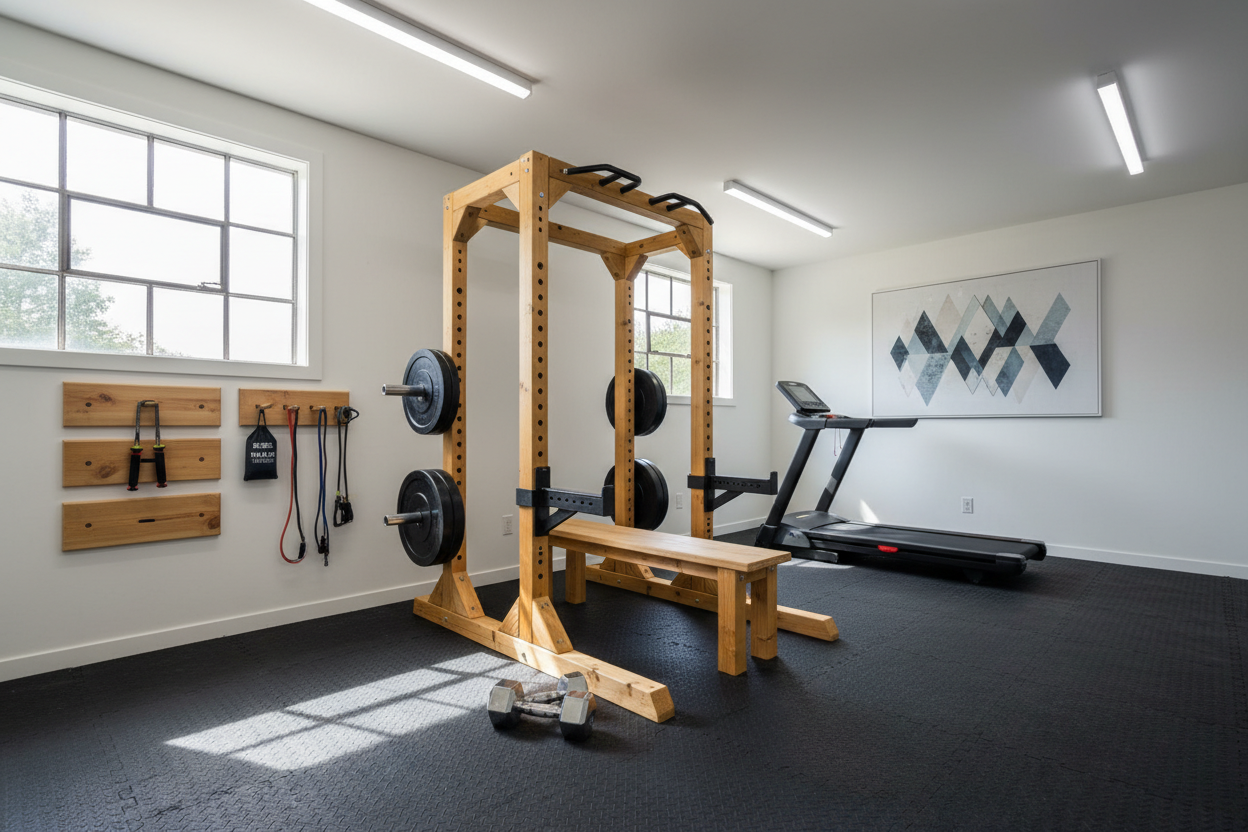
I remember staring at a $1,200 power rack online and thinking, 'I have a saw and some spare time, I can do that for fifty bucks.' I was half right. I could build something that looked like a rack, but I couldn't build something I trusted with my life. If you are looking into how to make gym equipment out of wood, you have to know where wood thrives and where it fails spectacularly.
Quick Takeaways
- Wood excels at compression (vertical weight) but fails at shear strength (side-to-side stress).
- Never build a wooden squat rack or bench if you plan on lifting heavy.
- DIY wood projects like jerk blocks and plyo boxes are often better than their metal counterparts.
- Always use 3/4-inch cabinet-grade plywood for equipment, never thin OSB or particle board.
The Harsh Truth About Your DIY Wood Gym Dreams
Wood is a phenomenal material for a diy wood home gym, but it is not a direct substitute for 11-gauge steel. The main issue is the grain. Wood is incredibly strong when you are pushing down on it—think of a 4x4 post holding up a deck. That is compressive strength. However, wood is notoriously weak when it comes to lateral shear and joint integrity.
When you bolt two pieces of steel together, they stay. When you drive a lag bolt into the end grain of a pine 4x4, you are essentially wedging the fibers apart. Over time, the vibration from racking a barbell causes those holes to widen. One day, you re-rack 300 lbs a little too hard, and the whole structure folds sideways. Framing lumber is also prone to warping and shrinking as the humidity in your garage changes, which is the last thing you want in a precision lifting environment.
3 Wood Home Gym Equipment Projects You Should Actually Build
There are places where wood home gym equipment is actually the superior choice. Wood absorbs shock and sound better than steel, making it ideal for certain high-impact accessories.
Heavy-Duty Jerk Blocks and Pulling Platforms
If you are into Olympic lifting, building your own jerk blocks is a rite of passage. You can stack layers of 2x4s and 2x6s to create massive, solid towers that handle 400-lb drops without flinching. A DIY platform is another essential. A layer of stall mats over two layers of 3/4-inch plywood gives you a rock-solid lifting surface that protects your concrete floor and your expensive plates. It is cheaper than a retail platform and arguably more durable.
A 3-in-1 Plyo Box That Won't Shatter
A diy wood gym isn't complete without a plyo box. I recommend the classic 20x24x30 inch design. Use 3/4-inch plywood and internal bracing. Do not just screw the edges together; use a puzzle-piece 'box joint' or at least heavy-duty wood glue and 2-inch screws. Most importantly, use a router or sandpaper to round off every single edge. Your shins will thank you the first time you miss a jump.
Custom Storage for Plates and Bars
Steel plate trees are fine, but a wooden 'toaster rack' is a better use of space for bumper plates. You can space the dividers specifically for your set—wider gaps for the 45s and narrow ones for the change plates. It keeps the floor clear and looks professional. You can also build a simple vertical bar holder by drilling 2-inch holes into a 4x4 block, saving you $50 on a metal version.
The 'Never Build This' List: Racks and Benches
I am going to be blunt: do not build a wooden squat rack. I have seen the 'Buffalo Racks' and the 4x4 cages on Pinterest. They look cool for a week. Then the wood dries out, the bolts loosen, and the wobbling starts. If you are training alone, a structural failure is a death sentence. If you are on a budget, you are much better off buying 2nd hand home gym equipment than risking a collapse.
The same goes for benches. A flat bench needs to handle your body weight plus whatever you are pressing. Wood joints under a heavy bench press are prone to 'racking'—that side-to-side sway that eventually leads to the wood splitting at the screw line. Steel doesn't split. Your safety is worth more than the $100 you save on lumber.
When to Put Down the Saw and Buy Real Steel
The best DIY gyms are hybrids. Use your woodworking skills to build the platform, the storage, and the blocks. These are the items that take up a lot of shipping volume and cost a fortune to buy retail. Then, take the money you saved and invest it in a high-quality, powder-coated steel rack and a bearing-loaded barbell.
When you are ready to build out a serious home gym, focus your DIY energy on the things that don't have a 'catastrophic failure' mode. Wood is for the floor and the walls; steel is for the weight.
My Personal Lesson Learned
I once built a 'temporary' squat stand out of 4x4s and buckets of concrete. It worked for about three months until I noticed a hairline split running down the main upright right where the J-cup notch was. I didn't even finish the workout. I stripped the bar and drove to a local equipment shop that afternoon. I still use the wooden plyo box I built ten years ago, but I will never trust my spine to a piece of pine again.
FAQ
Is pressure-treated wood better for gym equipment?
No. Pressure-treated wood is usually wet and heavy, and it will warp aggressively as it dries out in your garage. Stick to kiln-dried Douglas Fir or high-quality plywood.
What is the best glue for DIY gym projects?
Titebond II or III is the industry standard. For gym gear, the glue joint is actually stronger than the wood itself, so don't skip it.
How do I stop my DIY platform from sliding?
If your platform is on slick concrete, put a thin layer of rubberized shelf liner or a few strips of grip tape on the bottom layer of plywood. The weight of the rack and plates usually keeps it pinned down, though.
Share:
The 4 Most Effective Machines at the Gym (And 3 to Ignore)
Wait, How Much Does a Leg Press Weigh by Itself?