
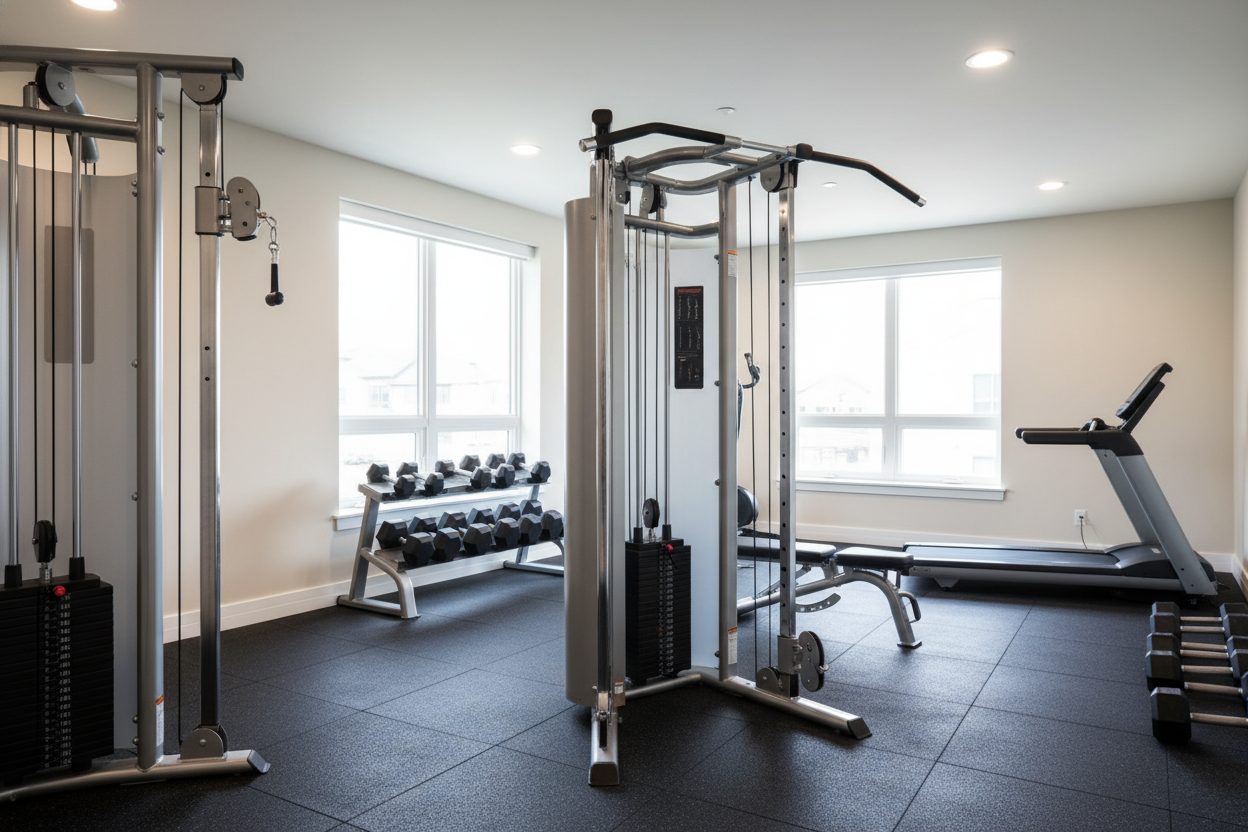
I remember my first time walking into a commercial gym, staring at a leg extension machine like it was a piece of alien technology. I spent years just guessing at the settings before I started building my own home gym and realized that these things are just basic physics hiding behind plastic shrouds. Understanding how gym machines work isn't just for gear nerds; it's how you actually get the most out of your sets without wrecking your joints.
- Pulley ratios change the actual weight you feel versus the number on the stack.
- Cams adjust resistance to match your natural strength curve.
- Assisted machines use counterweights to make movements easier.
- Alignment of your joints with the machine's pivot point is the key to safety.
The Secret Physics Hiding Inside the Weight Stack
Most people look at a weight stack and assume 100 lbs is 100 lbs. It’s not. When you ask how do gym machines work, you're really talking about mechanical advantage and friction. The primary gym machine benefits come from the fact that the weight follows a fixed path, which lets you isolate a specific muscle group without your stabilizers giving out first. Those guide rods are usually made of chromed steel; if they feel 'crunchy' or jerky, the gym isn't maintaining them with proper silicone spray.
Selectorized stacks use a pin to engage a specific number of plates. When you pull the pin, you're choosing the point where the lifting rod catches the stack. It's a simple, elegant system, but it relies on the cable being under constant tension. If there's slack in the line, you lose the eccentric (lowering) portion of the lift, which is where a lot of your muscle growth actually happens.
Why 100 Pounds Feels Completely Different on Every Unit
Pulley ratios are the big secret. A 1:1 ratio means if you pull one foot of cable, the weight stack moves one foot. A 2:1 ratio, which you'll find on almost every functional trainer, means you pull two feet of cable for every one foot the weight moves. This makes 100 lbs feel like 50 lbs, but it gives you a much smoother, longer cable travel. I’ve seen guys get an ego boost on a 2:1 lat pulldown only to be humbled when they switch to a 1:1 unit.
Then there are cams—those kidney-shaped wheels you see at the top of leg curls or chest presses. They are designed to alter the resistance curve. Humans are naturally stronger at certain points of a movement (the 'mid-range') and weaker at others (the 'start' or 'finish'). A well-designed cam changes the leverage as you move, making the weight feel heavier where you are strongest and lighter where you are weakest. This 'variable resistance' is why a high-end machine feels 'smooth' while a cheap one feels like it's sticking.
Workout Machines and How to Use Them (Without Looking Lost)
You don't need to know how to use all gym equipment to get a world-class workout. Most workout machines and how to use them come down to three basic adjustments: seat height, back pad depth, and the weight pin. If you're wondering how to pick a gym machine for upper body that doesn't feel cheap, look at the frame gauge and the pulley material. Nylon pulleys with ball bearings are the gold standard; if you see plastic pulleys on a thin 14-gauge steel frame, keep walking. Learning how to use common gym equipment is mostly about aligning your body so the machine's pivot point matches your joint's natural axis of rotation.
The Gym Machine Where You Pull Yourself Up
Let’s talk about the gym machine where you pull yourself up—the assisted pull-up and dip station. This is the only place in the gym where adding more weight to the stack actually makes the exercise easier. You're standing or kneeling on a platform connected to a counterweight. If you weigh 200 lbs and set the pin to 150 lbs, you only have to lift 50 lbs of your own body weight. It’s a brilliant way to build volume on a movement that usually crushes people after three reps.
Cable Crossovers and Functional Trainers
These are the kings of versatility. If I’m looking at an All In One Smith Machine With Cable Crossover S1 V4, I’m looking for the quality of the trolley system. These machines use dual pulleys that you can slide up or down a vertical rail. Because they typically use a 2:1 ratio, they are perfect for flyes, lateral raises, and tricep pushdowns where you need micro-adjustments in resistance. This is how to work gym machines to hit those weird angles that a standard barbell or dumbbell just can't reach in a cramped space.
Bringing the Commercial Feel to Your Garage
You don't need a 5,000-square-foot commercial space to get that 'big gym' feel. A Smith Machine Home Gym Station is the bridge between free weights and selectorized machines. It gives you that guided path of a machine, which is incredible for hypertrophy and training to failure safely, but it lets you use the Olympic plates you already own. When I moved my training to the garage, I missed the stability of a chest press machine until I realized a guided barbell system could replicate about 80% of those benefits in a much smaller footprint.
The Ultimate Pro Tip: Machine Gym Workouts Are All About Setup
The most common tip machine gym goers ignore is the 'active' setup. Don't just sit down and start hauling. Check where the pivot point is—usually marked with a bright red or yellow bolt. If you're doing a shoulder press and the handles start behind your ears, you're asking for an impingement. Adjust the seat so the handles are level with your upper chest. If the machine feels 'off,' it’s almost always because your body isn't aligned with the mechanics of the steel. Machines are fixed; you are the one who has to adapt to their path.
Personal Experience: The Craigslist Disaster
I once bought a cheap lat pulldown off a local listing that used plastic pulleys instead of nylon. Within three months, the steel cable had literally sawn a groove into the plastic. I was mid-set, pulling 180 lbs, when the pulley snapped and the handle whipped back and caught me right in the forehead. I learned the hard way: never skimp on the parts that actually move. If the pulleys aren't smooth and the cable is fraying, the machine isn't just bad—it's dangerous.
FAQ
Why does 50 lbs on a cable machine feel lighter than a 50 lb dumbbell?
It's usually the 2:1 pulley ratio. On many cable machines, the mechanical advantage literally cuts the weight in half. Plus, cables provide constant tension, whereas dumbbells lose tension at the top or bottom of certain movements.
Do I need to grease my home gym machines?
Yes. Every 3-6 months, wipe down the guide rods with a lint-free cloth and apply a thin layer of 100% silicone lubricant. Never use WD-40; it attracts dust and will eventually gum up the works.
Are machines better than free weights for building muscle?
For pure hypertrophy, machines are often superior because they eliminate the need for balance. This allows you to push the target muscle to absolute failure without your form breaking down or your stabilizers giving out first.
Share:
I Finally Made Room for a Resistance Exercise Machine (Here's Why)
The Only 3 Pieces of Gear You Need for a Beginner Home Gym