
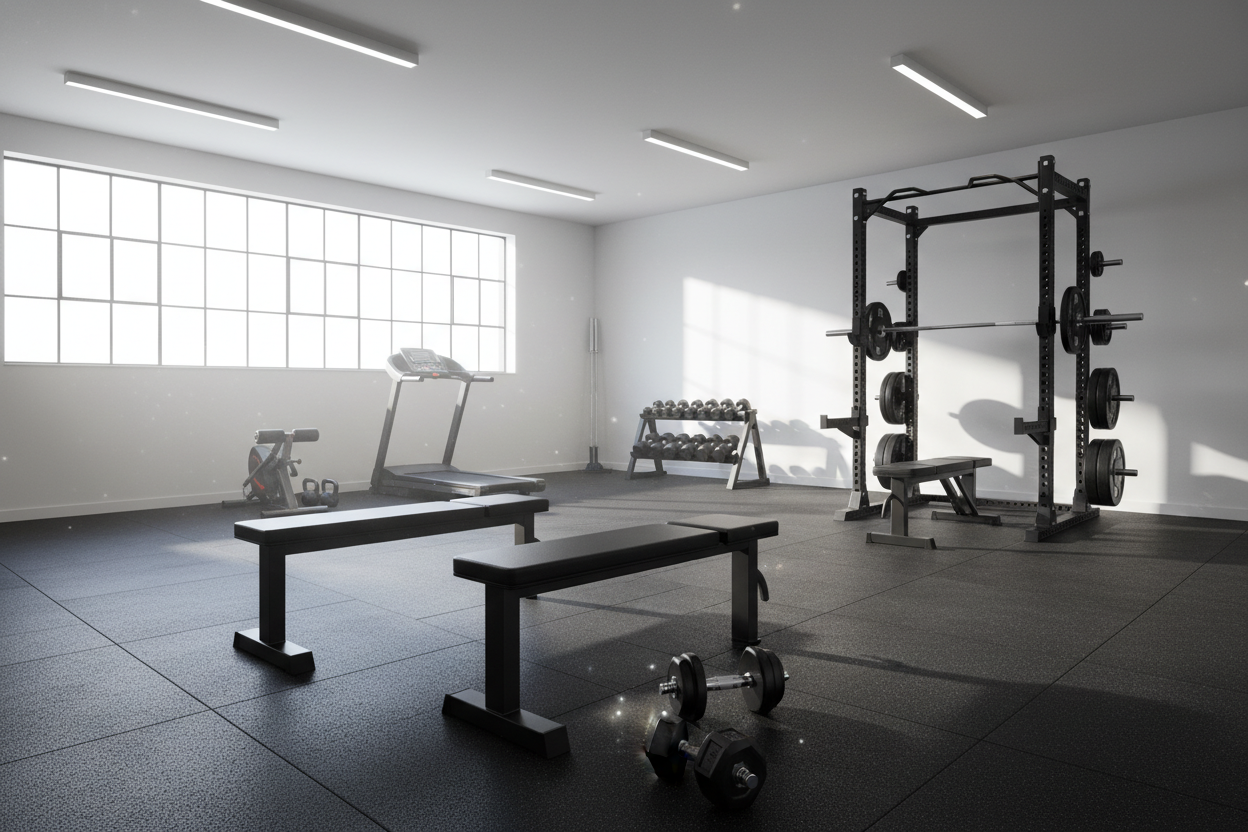
I remember the first time I tried to max out on a cheap adjustable bench I bought at a big-box sporting goods store. The hinges groaned, the pad shifted two inches to the left as I unracked 225, and I spent more energy trying to stay balanced than actually pushing the bar. It was terrifying. That was the day I realized that a rock-solid flat exercise bench is the foundation of any serious home setup.
We have all been there, scrolling through marketplace listings or Amazon at midnight, trying to find a piece of gear that does everything. But when you are under a heavy barbell, 'versatility' usually just means 'more moving parts that can fail.' I have spent a decade testing gear in my garage, and I keep coming back to the simplicity of a single-piece frame.
- Maximum Stability: No hinges or pop-pins mean zero side-to-side wobble during max effort sets.
- Proper Dimensions: A 12-inch pad width is the sweet spot for supporting your shoulder blades without restricting arm movement.
- Better Leg Drive: A tripod base design allows you to tuck your feet exactly where you need them for a powerful arch.
- Durability: 11-gauge steel frames will outlast your lifting career and probably your house.
The Wobbly Incline Trap (And Why Simple is Better)
Most home lifters fall into the trap of buying a cheap adjustable bench because they think they need to hit every possible angle for chest growth. The reality? Most of those budget adjustables are built with thin 14-gauge steel and have massive gaps between the seat and the back pad. When you lie down, your lower back falls right into that 'crevasse of despair,' and the whole unit shakes like a leaf in the wind. If you want to move real weight, you need a 12-gauge or 11-gauge flat weight bench that doesn't budge.
I have seen guys try to hit heavy triples on benches held together by a single 10mm bolt. It is a recipe for a shoulder injury. When you look at a reliable weight bench collection, you will notice the best ones are often the simplest. They are welded solid. There are no plastic adjustment knobs to snap off and no flimsy hinges to bend. A dedicated flat bench gives you a level of confidence that an adjustable simply cannot match, especially once you start pressing over your own body weight.
Think about the mechanics of a heavy press. You need to dig your traps into the vinyl and drive your feet into the floor. If the bench is shifting even a quarter of an inch, your power leak is massive. By choosing a single-piece frame, you are removing a variable of failure from your training. You can focus entirely on the bar path instead of wondering if the bench is going to tip over.
The Anatomy of a Perfect Flat Bench for Weight Lifting
Not all flat bench weight lifting surfaces are created equal. If you are shopping for a bench that will actually help you get stronger, you need to look at the specs, not just the price tag. First, the pad width. A lot of cheap benches use a 10-inch pad. That is too narrow for most adults; your shoulders will hang off the sides, leaving your rotator cuffs vulnerable. You want a 12-inch pad. It provides the 'shelf' your scapula needs to stay retracted and safe.
Next, look at the height. The IPF (International Powerlifting Federation) standard is roughly 17 inches from the floor to the top of the pad. This height is calculated to allow most humans to get their feet flat on the floor for optimal leg drive. If a bench is 20 inches high, your feet will be dangling, and you will lose all your stability. Conversely, if it is too low, you cannot get enough leverage to arch properly.
The base design is also critical. I always recommend a tripod base—one front post and two rear feet. This design is a lifesaver because it stays out of the way of your feet. On a standard four-legged bench, the front legs often end up exactly where you want to plant your heels. Finally, check the vinyl. You want high-density foam covered in 'grippy' vinyl. If the material is too slick, you will slide up the bench during the press, which kills your positioning and makes the lift twice as hard.
Navigating Flat Benches for Sale (Without Getting Scammed)
When you start looking at flat weight benches for sale, the marketing speak can be deceptive. You will see '1,000-lb weight capacity' on a bench that weighs 30 pounds. Use your head. A 1,000-lb static rating just means the metal won't collapse if you gently stack plates on it. It does not account for a 250-lb man dropping onto it with 315 lbs in his hands. That is dynamic load, and it is much more demanding.
Look for the shipping weight. A quality flat benches for sale should weigh at least 45 to 60 pounds. If it is light enough to pick up with one finger, it is probably made of thin-walled tubing that will flex under load. You should also demand 11-gauge steel. It is the gold standard for garage gym equipment. It feels substantial, the welds are usually cleaner, and it won't dent if you accidentally bang a dumbbell against it. Avoid anything that requires thirty different bolts to assemble; the more assembly required, the more points of failure you have to maintain.
Do You Really Need an Adjustable Bench Anyway?
I get it. You want to do incline presses for that 'upper chest' look. But ask yourself: how often do you actually use those angles? For 90% of your training, the flat bench is the king of horizontal pressing. It allows for the heaviest loads and the most consistent technique. If you are a beginner or intermediate lifter, you will get more mileage out of a rock-solid flat pad than a mediocre adjustable one.
Now, if you have reached a point where your flat press is stalled or you are transitioning into a pure bodybuilding block, you might find that you have traded my flat pad for an adjustable utility weight bench to get that specific incline stimulus. That is a fair move once you have the budget for a high-end adjustable that doesn't wobble. Alternatively, if you want to hit different angles without the stability trade-off of a cheap bench, you could look into an independent arms press machine. These machines allow you to isolate the chest from various angles while keeping your body in a fixed, safe position, which is often a better 'next step' than buying a flimsy incline bench.
Maximizing Your Flat Bench Home Gym Footprint
One of the best things about a flat bench home gym setup is the space efficiency. Unlike those massive multi-purpose stations, a flat bench can be tucked away easily. Many modern versions even come with wheels and a handle, or the ability to stand vertically on its end. This is a massive win if you are training in a single-car garage and still need to park the lawnmower inside.
When you pair a weight lifting bench flat with a set of adjustable dumbbells or a basic squat stand, you have essentially recreated the most important 90% of a commercial gym. You can do bench presses, rows, Bulgarian split squats (using the bench as a rear foot elevator), and even seated curls. It is the ultimate 'no excuses' piece of gear. It doesn't require a power outlet, it doesn't need a firmware update, and it won't break if you sweat on it. It just works.
My Personal Experience: The Folding Bench Disaster
I once bought a 'space-saving' bench that folded in half for storage. It seemed like a great idea for my cramped apartment. Six months in, while I was doing heavy dumbbell flyes, the locking pin sheared off. I ended up on the floor with 60-lb dumbbells pinned against my chest. It was a stupid mistake. I was prioritizing convenience over structural integrity. Since then, I have only used solid, non-folding frames. I would rather lose 4 square feet of floor space than lose a tooth because my equipment decided to fold while I was on it.
FAQ
What is the best height for a flat bench?
Standard height is 17 to 17.5 inches. This allows most lifters to get their feet flat on the floor, which is essential for generating leg drive and maintaining a stable arch during heavy presses.
Can I use a flat bench for other exercises?
Absolutely. I use mine for box squats, step-ups, dumbbell rows, and even as a seat for overhead presses. It is one of the most versatile pieces of 'dumb' equipment you can own.
How do I maintain the vinyl on my bench?
Stop using harsh chemicals. A simple mix of mild dish soap and water in a spray bottle is all you need. Wipe it down after every session to prevent salt from your sweat from drying out and cracking the material.
Share:
Why I Swapped My Straight Steel for a Barbell With Handles
Do You Really Need a $500 Bench for Working Out at Home?