
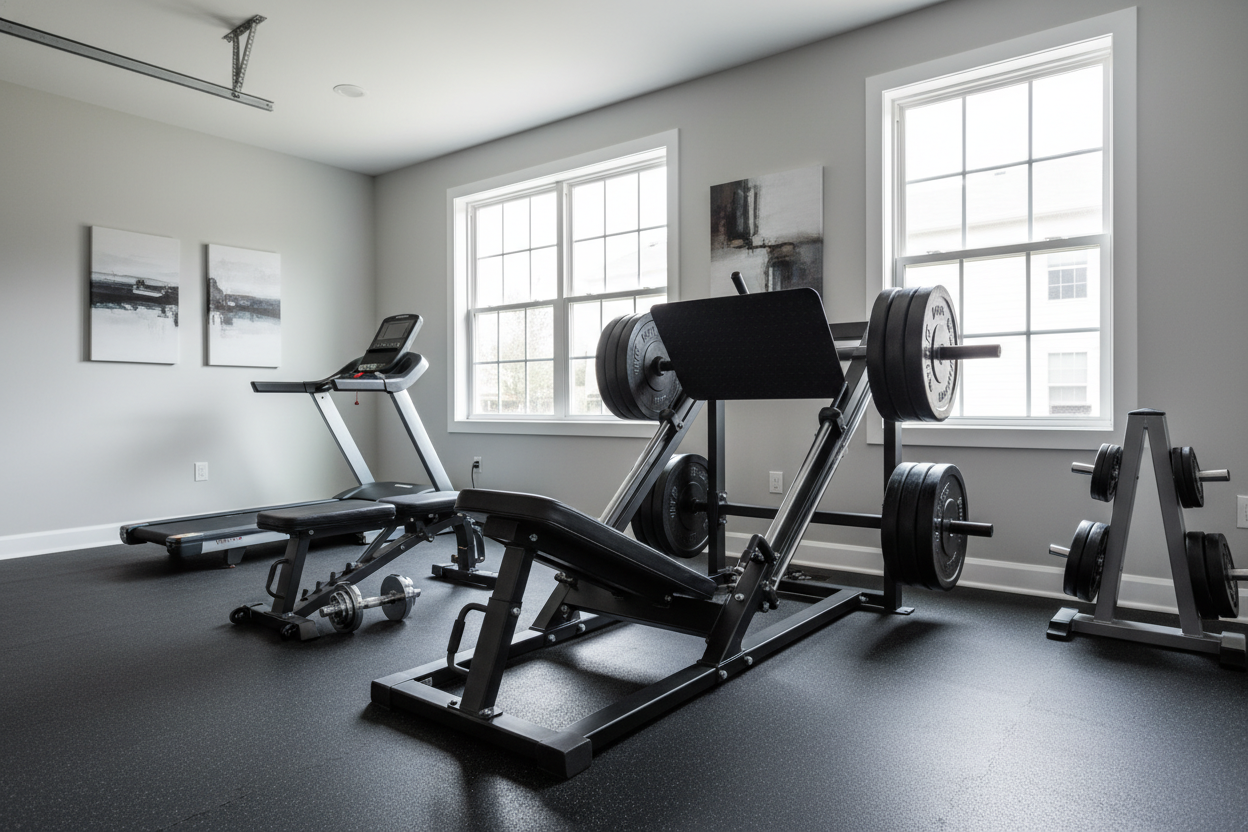
I remember the first time I tried to move a 400-pound commercial stack leg press in a big-box gym. It looked impressive, but the cable felt like it was dragging through peanut butter. When I started my garage gym, I knew I wanted a free weight leg press instead.
There is something visceral about sliding 45-pound iron plates onto a carriage. You aren't fighting a pulley system or a frayed cable; you are fighting gravity and friction. It is the most honest leg pump you can get without a barbell on your back.
- Cost-effective since you use the plates you already own.
- Zero cable maintenance or pulley alignment issues.
- Higher weight capacity for the price point.
- Direct force transfer with no mechanical drag.
The Illusion of the Commercial Weight Stack
Commercial gyms love weight stacks because they are idiot-proof. You move a pin, you push, you leave. But for a home gym owner, that convenience comes with a massive hidden tax. You are paying for hundreds of pounds of cast iron that can only be used on one specific machine.
Beyond the price, weight stacks are high-maintenance. If the cable fraying doesn't get you, the plastic pulleys eventually will. In a garage environment where dust and humidity are real factors, a stack is just waiting to seize up. I would rather spend my Saturday morning lifting than troubleshooting a guide rod alignment on a machine that cost me three grand.
Why a Free Weight Leg Press Feels So Different
When you perform a leg press with free weights, the carriage is the only thing between you and the load. Most high-end plate-loaded sleds run on linear bearings or high-density rollers. This creates a resistance curve that feels consistent from the bottom of the rep to the lockout.
Cables and pulleys introduce mechanical advantage that can make the weight feel lighter or heavier at different points. With a sled, 400 pounds is 400 pounds. You feel the weight pressing into your midfoot throughout the entire range of motion. It forces better technique because you can't rely on the springiness of a cable system to bounce out of the hole. I have found that my quad engagement is significantly higher when I am moving the actual mass rather than a tethered weight.
The Math Behind Doing a Leg Press With Free Weights
Let's talk money. A commercial-grade 400-lb stack machine can easily run you $3,000 to $5,000. For a fraction of that, you can get a heavy-duty plate-loaded rig. Since you likely already have a stack of 45s for your rack, you are essentially getting the resistance for free. You are paying for the steel and the bearings, not the weight itself.
However, don't go too cheap. I have seen plenty of budget sleds that use thin-walled steel and plastic bushings instead of bearings. These companies often list fake weight limits on home leg press machines to trick you into thinking a $400 unit can handle a thousand pounds. It can't. Look for 11-gauge steel and a carriage weight of at least 75-100 lbs empty to ensure the frame doesn't flex under a real load.
Will It Actually Fit (and Survive) in Your Garage?
The footprint is the only real downside. A solid plate-loaded sled is going to take up about 7 to 8 feet of length. You also need to account for the loading zone. If the machine is 4 feet wide, you need at least 6 feet of total width so you aren't hitting your rack or the wall while sliding plates on.
Then there is the floor. A heavy machine plus 600 lbs of iron plus your own body weight is a lot of concentrated pressure. If your slab is thin or cracked, a heavy weight leg press machine crack your garage floor is a genuine concern. I always recommend 3/4-inch stall mats as a minimum to distribute that load and protect the concrete from the inevitable vibration and impact.
The Final Verdict on Plate-Loaded Leg Rigs
If you have the floor space, the plate-loaded route is the only way to go. It is more durable, easier to move if you relocate, and holds its resale value significantly better than a stack machine. You want a unit with adjustable footplates and safety stops that actually catch the weight if you fail. I once bought a compact vertical sled to save space, and it was a disaster—the range of motion was terrible and it felt like a guillotine. Stick to a 45-degree sled and do it right the first time.
Stop overpaying for convenience that actually creates more work in the long run. Get a rig that lets you use the iron you already have. Your quads and your wallet will thank you.
Can I use bumper plates on a leg press?
You can, but you will run out of room on the horns fast. Bumpers are thick. For a leg press, I recommend iron or urethane plates so you can actually load enough weight to make the movement effective.
How often do I need to grease the sled?
I hit mine with a dry silicone spray every three months. Do not use WD-40; it attracts dust and turns into a sticky mess that will eventually ruin your linear bearings.
Is a 45-degree leg press better than a vertical one?
Absolutely. Vertical presses are notoriously hard on the lower back and awkward to load. The 45-degree angle is the industry standard for a reason—it's the best balance of safety and muscle recruitment.
Share:
I Tested a Classic Home Gym Weider Setup to See If It Still Holds Up
I Snapped 3 Cables Finding a Home Gym Pulley System That Works