
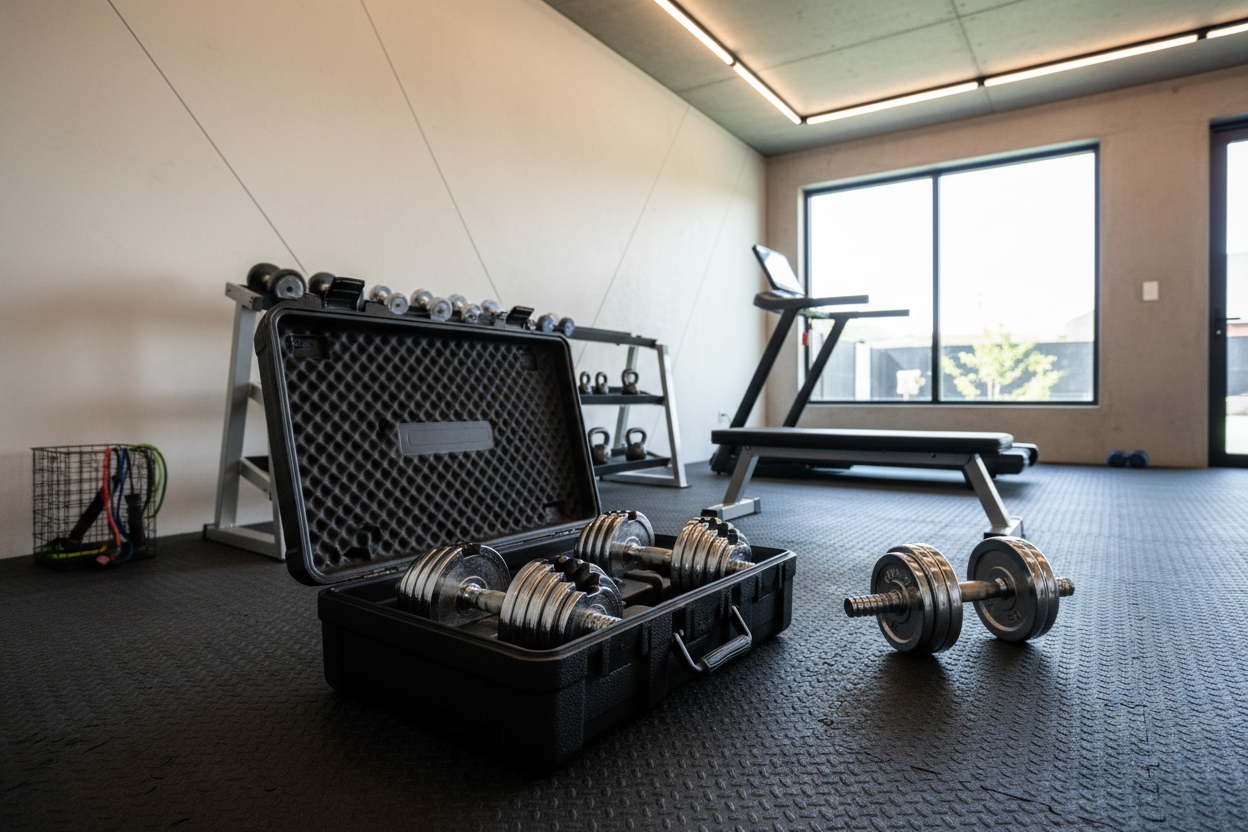
I remember the first time I scrolled past a shiny chrome dumbbell set and case on Amazon. It looked like the ultimate solution for my cramped apartment. It was sleek, organized, and promised to disappear under my bed the second I finished my last rep. I bought it, thinking I was being efficient with my 6x8 ft corner of space.
I was wrong. Within two weeks, that convenient dumbbell case was sitting open in the corner of my room, gathering dust, because the sheer friction of putting it away was killing my motivation to train. If you are looking for a weight set with case, you need to know what you are actually signing up for before you drop eighty bucks on plastic junk.
Quick Takeaways
- Plastic cases are notoriously brittle and usually arrive with cracked hinges or broken latches.
- Molded slots make it nearly impossible to grab weights quickly during a high-intensity superset.
- The portability is a myth; carrying 40 lbs of iron by a thin plastic handle is a recipe for a broken toe.
- Adjustable dumbbells or a small fixed rack offer a better footprint and significantly higher durability.
The Allure of the Briefcase Weight Kit
The marketing for a dumbbell set case is brilliant. They show a perfectly tidy living room where the weights are tucked away like a laptop. For a beginner, this feels like a smart way to start without turning your home into a commercial gym. You imagine yourself clicking the latches shut, sliding the box away, and regaining your floor space.
It appeals to the part of us that likes organization. But gym gear isn't office supplies. It’s heavy, it’s dirty, and it’s meant to be moved fast. A weight set with case treats your weights like fragile instruments, which is exactly the opposite of how you should be thinking about your tools. When I had one, I spent more time worrying about the plastic than my form.
Why Working Out With Hand Weights in Cases Actually Sucks
Ever tried to finish a heavy set of lateral raises and then precisely line up a 5-pound plate into a narrow, plastic-molded groove? It’s infuriating. When your heart rate is 160 and your hands are slick with sweat, the last thing you want is a dexterity test. Most dumbbells in case setups require you to fight the packaging just to change your load.
I spent more time wrestling with the plastic inserts than I did actually lifting. The tolerances are often so tight that if the plate isn't perfectly vertical, it won't seat. Eventually, you’ll realize that real, heavy-duty dumbbells are meant to be grabbed from a rack or the floor, not unboxed like a new smartphone every Tuesday. The friction of the case is a workout killer.
The Inevitable Cracked Hinge
Let’s talk build quality. These cases are almost always made of cheap, blow-molded plastic. They aren't Pelican cases. They are thin shells designed to survive shipping, not a five-day-a-week training program. I’ve seen the plastic latches snap off within the first month just from the weight of the plates shifting inside during a move.
Once those hinges go, the case is just a piece of trash. You’re left with loose plates and a broken box that won't stay shut. You aren't just buying weights; you're buying a future trip to the recycling bin. If you drop a 10-lb plate even two inches onto the edge of that case, it's game over for the plastic.
Better Alternatives to a Dumbbell Set With Case
If you're tight on space, don't buy a briefcase. Buy gear that actually scales. A single pair of high-quality Adjustable Dumbbells Ab01 will take up less floor space than that bulky plastic case and give you a much wider range of weight options. You can go from 5 lbs to 52.5 lbs in seconds without fighting a plastic latch or a 1-inch threaded collar.
If you prefer the feel of fixed weights, just grab a solid Rubber Hex Dumbbell Set Ds01. Even a small 3-tier rack takes up a tiny footprint and won't shatter if you drop a weight near it. Plus, rubber hex weights won't roll away or clang like the cheap iron plates found in most weight cases. My first set of hex dumbbells is still in my garage ten years later; the case set lasted six weeks.
If You Must Travel: The Only Weight Cases Worth Using
If you genuinely need to take your hand weights in case for travel—maybe you're a trainer on the road or a dedicated nomad—skip the plastic. Look for heavy-duty canvas bags or reinforced soft-sided weight cases. These allow for some flex and won't shatter when the airline baggage handler tosses them. I’ve used a reinforced tool bag for weights before; it’s uglier, but it actually holds the load without the bottom falling out.
Final Verdict on Keeping Dumbbells in Cases
Stop trying to hide your gym. If you want results, your equipment needs to be accessible, durable, and ready to go. A dumbbell set and case might look neat in a closet, but it’s a barrier to actually training. Invest in gear that lives on a rack or a mat. I've been through the cheap plastic phase, and I Finally Built a Weight and Dumbbell Set That Doesn't Suck by ditching the gimmicks and focusing on iron and rubber.
FAQ
Are plastic dumbbell cases waterproof?
No. They might keep a light splash off, but they aren't sealed. Moisture often gets trapped inside the molded slots, which can actually accelerate rust on cheap chrome plates if you store them damp.
Can I buy a replacement case?
Hardly ever. Manufacturers sell these as a kit. If the case breaks, you're better off buying a small A-frame rack or a dedicated heavy-duty gym bag.
Are the weights inside the case standard size?
Often they use 1-inch threaded holes, but the plate diameter is sometimes specific to the case's molded slots. This makes it hard to add more weight to the set later on compared to standard 1-inch or 2-inch Olympic plates.
Share:
Why Your Angled Smith Machine Squat Feels Weird (You're Backwards)
I Recreated a Pro Setup With Basic Bodybuilding Home Gym Equipment