
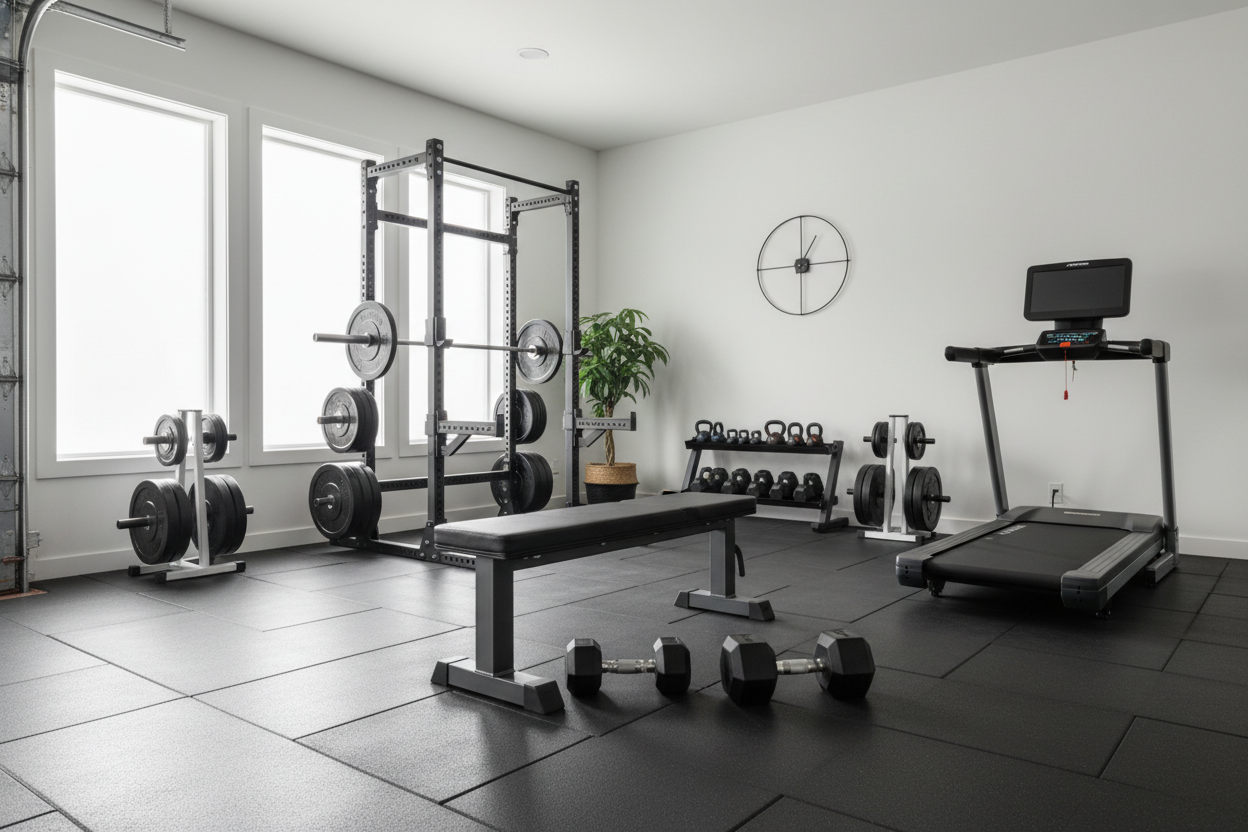
I remember the day my local commercial gym hiked their rates to $85 a month while half the racks were out of commission. I went home, opened a browser, and started scrolling through budget equipment with a vengeance. I fell for the trap—I bought a flashy, multi-position adjustable bench that promised 'total body versatility.' Within a week, the thing was creaking like a haunted house, and the gap between the seat and the back pad made me feel like I was benching over a canyon.
If you're starting a garage gym, you don't need a transformer. You need a foundation. The best flat bench is the one that stays completely out of your head while you're trying to grind out a heavy triple. You want something that feels like it's bolted to the earth, not a piece of lawn furniture that might fold under 225 pounds.
- Stability beats versatility every single time for heavy compound lifts.
- Look for a height of 17 to 17.5 inches to ensure your feet actually hit the floor.
- 11-gauge steel is the gold standard for home gym durability.
- A grippy, wide pad is the difference between a PR and a shoulder injury.
The Unsung Hero of the Garage Gym Floor
Most beginners make the same mistake I did. They look at a simple flat bench and think it's 'too basic.' They want the incline, the decline, and the leg attachment that they’ll honestly use twice before it starts collecting dust. But here is the truth: a cheap adjustable bench is a compromise in engineering. To make it move, manufacturers add hinges, pins, and gaps. Every one of those moving parts is a potential failure point or a source of 'slop'—that annoying side-to-side wiggle that happens just as you're unracking a heavy bar.
A dedicated flat bench is a different beast. Because it doesn't have to fold or tilt, the frame is usually a single, solid piece of steel. This simplicity is its greatest strength. When you lie down, there is no wobble. There is no gap digging into your lower back. You can focus entirely on your leg drive and your bar path. For anyone serious about strength, the best flat weight benches are the ones that provide a rock-solid pressing station that never moves, no matter how much weight you're moving.
Think about your floor space, too. A flat bench is lighter, easier to maneuver, and often takes up a smaller footprint than its bulky adjustable cousins. You can tip it up against a wall or tuck it under a rack when you're doing deadlifts. It’s the workhorse that does its job and stays out of the way when it’s not needed.
What Separates the Best Flat Weight Benches From the Junk?
Walk into a big-box sporting goods store and you'll see benches that look fine on the surface. They’ve got shiny paint and 'Pro' written on the side. But look closer at the specs. Most of these retail specials are made from thin 14-gauge steel and held together by tiny bolts and thin plates. They might claim a 300-pound weight capacity, but that includes the weight of the lifter. If you weigh 200 pounds, you’ve only got 100 pounds of 'safe' room for the bar. That’s a recipe for a collapsed frame.
A commercial-grade flat pad is built to take a beating. We’re talking about 11-gauge steel frames—the same stuff used in power racks. The welds should be clean and beefy. You want a tripod design or a wide-set rear base that prevents the bench from tipping if you happen to sit on the very edge. The difference in feel is immediate. When you sit on a high-quality bench, it doesn't compress or shift. It feels like an extension of the floor.
Then there’s the hardware. Quality benches use Grade 8 bolts or better, and the mounting points for the pad are reinforced. I’ve seen cheap benches where the wood inside the pad literally snaps because the screws weren't braced. You aren't just paying for the steel; you're paying for the peace of mind that the bench won't buckle while you've got a loaded barbell over your chest.
Steel Gauge and True Weight Capacity
Let's talk numbers. If a bench doesn't explicitly state it uses 11-gauge steel, it probably doesn't. 11-gauge is roughly 1/8-inch thick, which is the sweet spot for home gyms. It’s heavy enough to be stable but light enough to move around. Anything thinner, like 14-gauge, is for light-duty 'fitness' use, not strength training.
As for weight capacity, look for a rating of at least 1,000 pounds. You might think, 'I'll never bench 1,000 pounds,' and you're probably right. But that rating isn't about your max lift; it's about the factor of safety. A bench rated for a grand is built to handle the dynamic force of a 300-pound lifter dropping a 400-pound bar. It’s about rigidity. A high capacity means the frame won't flex or twist under load, which keeps your shoulders in a safe, stable position.
Pad Width, Foam Density, and Grippiness
The pad is where the rubber meets the road—or where your back meets the bench. Most cheap benches come with a 10-inch wide pad covered in slick, shiny vinyl. This is a nightmare for benching. Your shoulder blades need a wide enough surface to stay retracted and stable. A 12-inch wide pad is the standard for most powerlifting federations for a reason: it supports the joint properly.
Foam density is the next big factor. You want high-density rebond foam that doesn't bottom out. If you can feel the plywood base through the foam with your thumb, your shoulders will feel it during a heavy set. Finally, the cover material matters. Look for 'sticky' or textured vinyl. If the pad is too slick, you’ll slide right out of your arch the moment you start pushing with your legs. You want to be 'glued' to the bench so all your force goes into the bar.
When Does It Make Sense to Go Adjustable?
I’m not saying adjustable benches are useless. They are essential for accessory work like incline presses, seated curls, or chest-supported rows. However, a good adjustable bench that is actually stable enough for heavy lifting will cost you twice as much as a top-tier flat bench. If you're on a budget, buy the flat bench first. You can do 90% of your training on it.
Eventually, you might find that your programming requires more variety. Maybe you’re focused on upper chest development or you want to add seated overhead presses to your routine. That’s when you graduate. I Traded My Flat Pad for an Adjustable Utility Weight Bench after about two years of strictly flat pressing, and while I love the variety, I still miss the absolute 'dead' feel of my old flat pad on heavy days.
If you have the space and the budget, owning both is the dream. But if you’re just starting out, don't sacrifice quality for angles. A rock-solid flat bench will always be more valuable than a shaky adjustable one.
How to Pull the Trigger on Your First Pressing Station
Before you buy, grab a tape measure. Check the height of the bench from the floor to the top of the pad. The IPF standard is roughly 17 to 17.5 inches. If a bench is 20 inches tall, your feet might dangle, killing your leg drive. If it’s too short, you won't be able to get a proper arch. Measure your space, too. Ensure you have at least two feet of clearance on all sides of the bench for safety.
Check the shipping weight. A heavy bench is usually a good bench. If the shipping weight is only 30 pounds, it's made of tinfoil. Look for something in the 50 to 70-pound range for a flat bench. Once you know your specs, finding a high-quality weight bench becomes a matter of matching your budget to the best steel and foam you can find. Don't overthink it—just buy something overbuilt and get to work.
Personal Experience: My $60 Mistake
Early in my lifting career, I bought a 'deal' from a local marketplace. It was a no-name flat bench that looked fine in the photos. The first time I tried to bench 225 on it, the frame groaned so loud I thought the floor was giving way. The pad was so soft my spine was basically resting on the wood. I spent the whole set worried about the bench snapping instead of my technique. I sold it for $20 a week later and bought a real commercial flat pad. That bench is still in my garage ten years later, and it’s as solid as the day I unboxed it.
Frequently Asked Questions
What is the best height for a flat bench?
Between 17 and 17.5 inches is the sweet spot. This allows most lifters to keep their feet flat on the floor for maximum leg drive and stability.
Do I need a bench with wheels?
If you're in a tight garage gym where you have to move equipment to park a car or do deadlifts, wheels are a lifesaver. If the bench stays in the rack 24/7, you can skip them and save a few bucks.
Is a 12-inch pad too wide?
For most adults, 12 inches is perfect. It provides enough surface area to support the shoulders without being so wide that it interferes with your arm's range of motion during the descent.
Share:
I Finally Tested the Griffin Fitness FID Bench (The Brutal Truth)
How to Pick an Amazon Weight Bench Set That Won't Wobble