
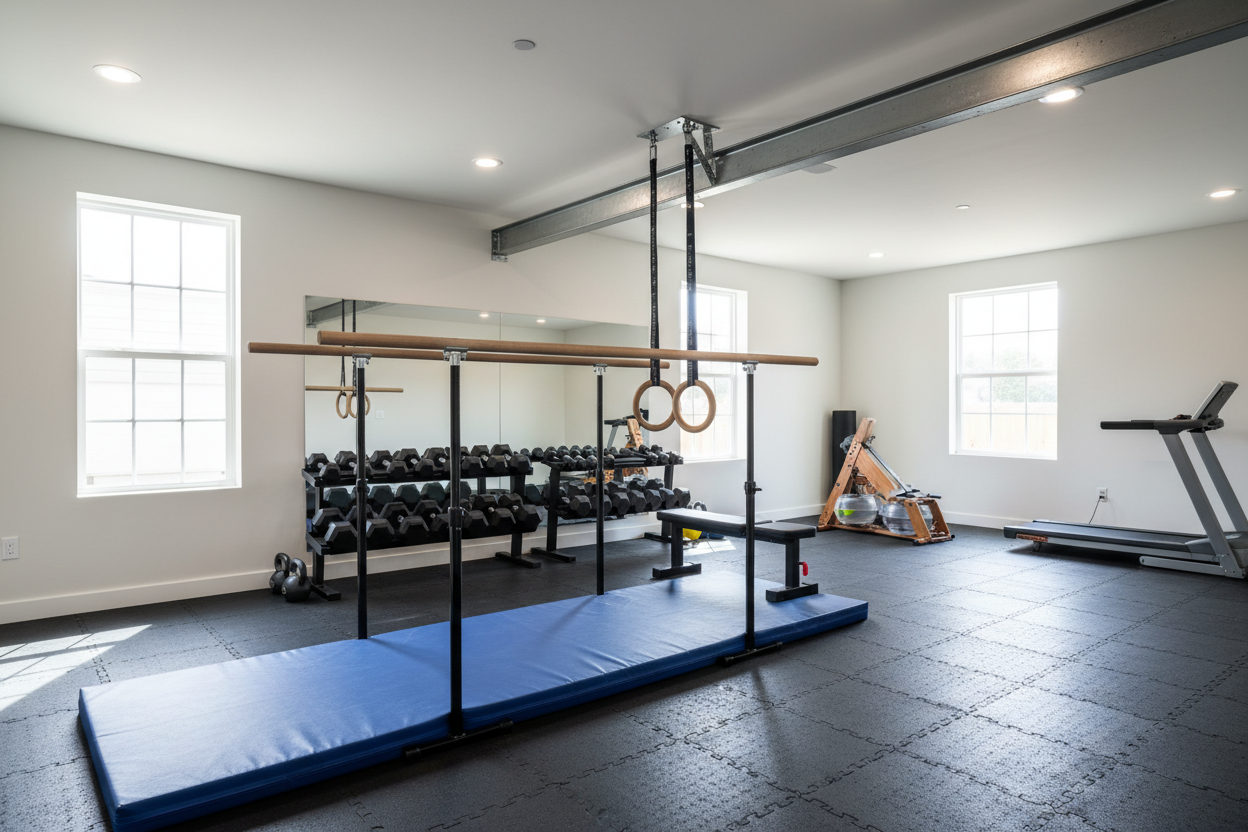
I remember the first time I tried to mount a pull-up bar in my rental. I followed the instructions, used the 'heavy-duty' screws provided, and felt like a pro—until my first weighted pull-up. The drywall crumbled, the screws pulled out, and I spent the afternoon at the hardware store buying patch kits. If you are looking for gymnastics equipment at home, you are likely finding two extremes: overpriced toys or professional rigs that require a 20-foot ceiling.
- Wood rings over plastic for better grip and longevity.
- Joist-mounted anchors are non-negotiable for overhead safety.
- High-density foam (4 inches+) is the minimum for any landing.
- Steel parallettes prevent wrist roll and floor sliding compared to PVC.
Please Stop Buying Flimsy Plastic Gear
The market is flooded with the 'ultimate' gymnastics set for home that looks like it belongs in a toddler's playroom. Avoid tubular steel bars that flex when you touch them and plastic rings that get slick the second your palms sweat. If you weigh more than 100 pounds, you need gear that doesn't vibrate when you're mid-transition.
I see people buy cheap gymnastic equipment for home thinking they are saving money. In reality, you are just buying a future hospital bill. I Wasted $1,000 on Home Gym Equipment for Beginners by chasing deals instead of durability. For adults and serious teens, stick to 1.25-inch birch wood rings and 11-gauge steel for any ground-based bars. Anything thinner feels like a wet noodle when you're trying to hold a solid iron cross or planche.
How to Hang Rings Without Tearing Down Your House
Rings are the centerpiece of any gymnastics gym at home, but they are also the most dangerous if installed poorly. You cannot just screw these into your ceiling's top layer of plaster. You must locate the center of your ceiling joists using a deep-scan stud finder to ensure you are hitting solid wood.
Use 3/8-inch lag bolts that penetrate at least 2.5 inches into the joist. If you have a finished ceiling, I highly recommend mounting a 'stringer'—a piece of 2x6 lumber bolted across two or three joists—to provide a secure mounting point for your hangers. This distributes the load and prevents your ceiling from cracking under the dynamic force of a muscle-up. If you hear the wood groaning, stop immediately; your lag bolts are likely off-center.
The Core Setup: What Beginners Actually Need
You don't need a massive freestanding rig to start. Most people overcomplicate their home gymnastics equipment set and end up with a cluttered garage. Focus on the bare minimum equipment for a home gym: a solid pair of rings, low parallettes, and a landing surface that won't bottom out.
Heavy-Duty Parallettes (Skip the PVC Pipes)
I’ve seen plenty of tutorials for DIY PVC parallettes. Don't do it. PVC flexes, and if the glue fails during a handstand, your wrists are going to take the full impact. Affordable home gymnastics equipment doesn't have to be homemade junk. Look for welded steel parallettes with a powder-coat finish. They provide the friction you need for sweaty hands and won't tip over when you're working on L-sits or planches. Beginners gymnastics equipment should inspire confidence, not fear of collapse.
Real Crash Mats (Your Yoga Mat Won't Cut It)
A yoga mat is for downward dog, not for falling out of a handstand. When sourcing gymnastics supplies for home, look for '4-inch landing mats' with a density of at least 1.8 lbs per cubic foot. Tumbling mats are fine for floor work, but if your feet are leaving the ground, you need a dedicated crash pad. This is the one area where gymnastics equipment cheap for home usually fails; low-density foam is just a decorated trip to the podiatrist.
Are Freestanding Bars Actually Safe for Kipping?
Physics is a jerk. When you perform a kipping pull-up or a giant, you are generating massive horizontal force. Most gymnastics equipment for the house is too light to stay grounded during these movements. If the rig isn't bolted to the floor, it’s going to walk across the room or tip over mid-rep.
If you can't bolt into your slab, consider a heavy-duty power rack. A solid home gym rack with a stabilizer bar can handle gymnastic equipment for beginners much better than a spindly 'beginner' bar. You want something with at least a 3x3-inch frame and a wide base to offset that momentum. If you're serious about a gymnastics home gym, skip the $200 'portable' bars and buy something that won't move when you jump on it.
My Experience: The 'Wobble' Lesson
Years ago, I bought a home gymnastics equipment for beginners kit that claimed a 400-lb capacity. On paper, it was perfect. In practice, the uprights were so thin they hummed like a tuning fork every time I jumped up. I eventually sold it for a loss and bought a wall-mounted pull-up bar. It was a pain to install, but I could finally focus on my form instead of wondering if the bar was about to fold under my weight. Don't let a low price tag trick you into buying gear you'll outgrow in three months.
FAQ
Can I use gymnastics equipment for beginners in an apartment?
Yes, but stick to floor-based gear like parallettes and thick mats. For rings, use a doorway bar only if it's rated for bodyweight and you aren't doing dynamic movements like muscle-ups.
What is the best material for rings?
Birch wood is the gold standard. It absorbs sweat better than plastic or metal, meaning you won't need nearly as much chalk to maintain a false grip during long sets.
How much ceiling height do I need for rings?
For basic pulls and dips, 8 feet is fine. For muscle-ups, you really need 9.5 to 10 feet so you don't headbutt the ceiling at the top of the movement.
Share:
Avoid Flimsy Plastic: Best Home Exercise Equipment for Seniors
The Safest Gym Equipment to Buy Online Without Seeing It