
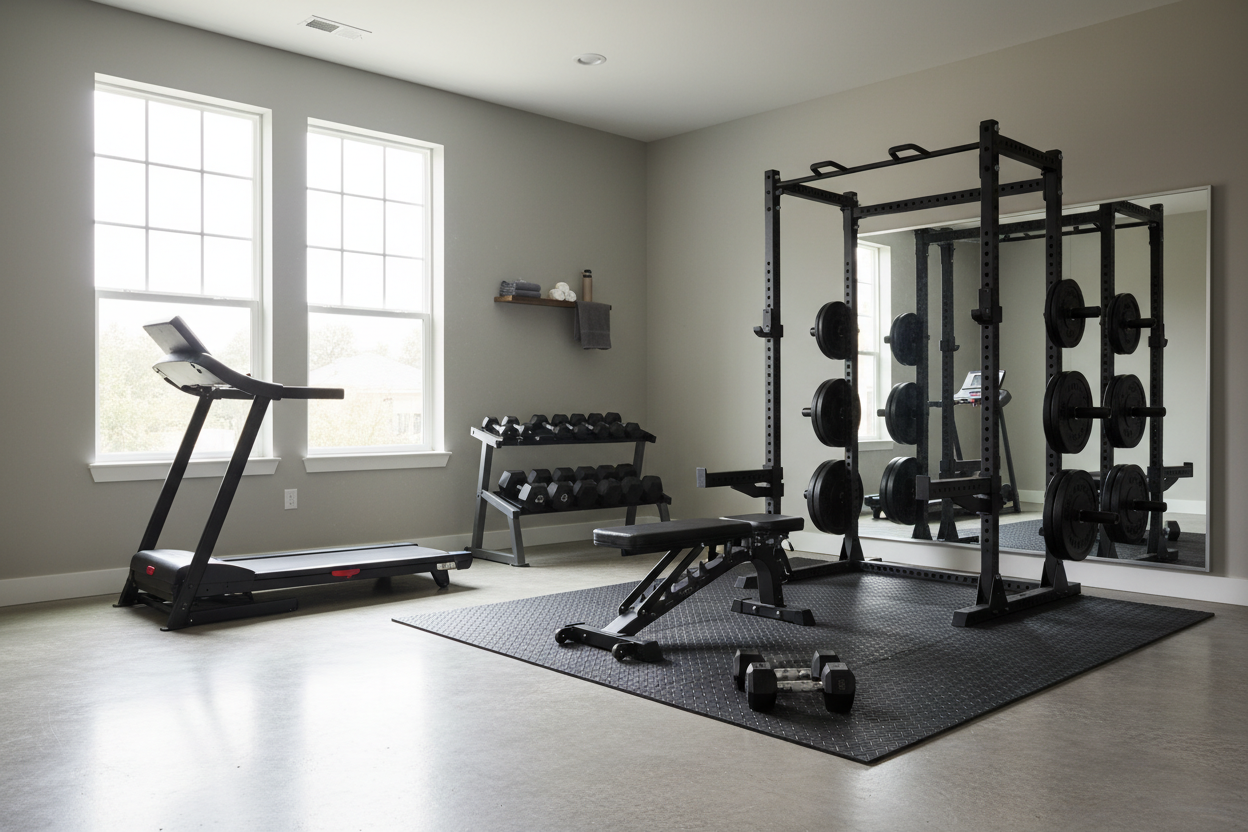
I remember staring at a spare bedroom filled with half-assembled boxes, wondering why I had just spent six hundred dollars on a leg extension machine I hadn't used in three weeks. The truth is, most lifters overcomplicate their space before they even hit their first PR. Building a minimal home gym isn't about being cheap; it's about being surgical with your square footage and your training time. When you stop worrying about having every attachment, you start worrying about the weight on the bar.
The Trap of Replicating a Commercial Weight Room
Most people start their home gym journey by trying to squeeze a 10,000-square-foot commercial facility into a 120-square-foot spare bedroom. You see it on Marketplace all the time: a room so packed with plate-loaded machines and cardio equipment that the owner has to sidestep like a crab just to reach their water bottle. This clutter doesn't just eat your space; it kills your momentum.
When you have twenty different ways to do a bicep curl, you spend more time adjusting pins and cables than actually moving heavy weight. Choice paralysis is real. In a cramped space, a cluttered environment leads to a cluttered program. You end up doing 'a little bit of everything' and a lot of nothing. Stripping it back to the basics forces you to stop exercising and start training.
What Actually Belongs in a Minimal Home Gym?
You need three things to get strong: a way to load your spine, a way to press, and a way to pull. For my money, that starts with a power rack—preferably something with 3x3-inch 11-gauge steel uprights. Don't skimp here. If you're planning on squatting 400 lbs, you don't want a rack that wobbles when you breathe on it. A solid rack is the anchor of any serious minimalist home gym setup.
Next is a 20kg Olympic barbell. Look for something with a decent knurl; I prefer a dual-knurl mark bar so I can switch between powerlifting and weightlifting without overthinking it. Then come the plates. You don't need fancy urethane-coated discs. Plain iron 45s work just as well, though a pair of 10lb or 15lb bumper plates is a smart move if you're doing any floor work. This is the bare minimum equipment for a home gym that actually allows for long-term progress. Throw in an adjustable bench that doesn't have a massive gap between the seat and the backrest, and you're 90% of the way there.
Why 'Minimal' Doesn't Mean Flimsy
There's a massive difference between a minimalist setup and a cheap one. I've seen those '100-in-1' machines sold on late-night TV that look like they're held together by coat hangers and prayers. If a piece of equipment claims to do everything, it usually does everything poorly. If you're truly tight on space, some high-end multi-functional machines are built to handle real loads, but they are the exception, not the rule. If the machine weighs less than you do, it probably isn't going to last through a year of heavy squats.
How Limited Equipment Forces Better Gains
When your options are limited, your effort isn't. I spent years doing 'accessory day' at a big box gym, spending 45 minutes on three different types of tricep extensions. My arms didn't grow. When I moved to a minimalist garage gym with just a rack and a bar, I was forced to bench, overhead press, and dip. My triceps finally blew up because I had nowhere to hide.
A minimalist gym eliminates the 'fuck-around-itis' that plagues most lifters. You can't avoid the squat rack when it's the only thing in the room. You stop worrying about 'hitting the muscle from a different angle' and start worrying about adding 5 lbs to the bar. That psychological shift is worth more than any fancy cable crossover machine. You become a specialist in the movements that provide the highest ROI.
Scaling Your Minimalist Workout Equipment Smartly
Once you've mastered the basics, you'll feel the itch to add more. Don't go buy a dedicated leg press. Instead, look for attachments. A landmine attachment costs $40 and opens up dozens of rowing and pressing variations without taking up a single square inch of floor space. Resistance bands and a set of gymnastic rings are other high-value, low-footprint additions that keep your minimalist workout equipment versatile.
As you look for home gym essentials to round out your space, prioritize versatility. Can this piece of gear be used for at least three different movements? If not, it better be something you absolutely love. Keep your floor clear. A clean gym is a gym you'll actually want to train in when it's 5 AM and freezing outside. Real strength doesn't require a warehouse; it just requires the right iron.
Personal Experience: The 'Space-Saver' Mistake
I once bought a 'space-saver' folding bench that felt like a wet noodle. Every time I tried to bench over 185, the thing would creak and shift. I was so worried about the bench collapsing that I couldn't focus on the lift. I eventually sold it for half what I paid and bought a heavy-duty flat bench that didn't move an inch. Lesson learned: in a small gym, every piece of gear needs to be overbuilt because you're going to use it for everything.
FAQ
Do I need special flooring for a minimalist gym?
Yes. Don't lift on bare concrete or carpet. Grab some 3/4-inch horse stall mats. They're cheap, indestructible, and protect both your floor and your plates from damage during deadlifts.
Can I get a full workout with just dumbbells?
You can, but you'll outgrow them fast. A barbell is easier to load heavy and offers more progression. If you must go the dumbbell route, get a high-quality adjustable set that goes up to at least 80 lbs per handle.
Is a minimalist home gym enough for powerlifting?
Absolutely. Most of the world's strongest people trained in 'dungeon' gyms with less equipment than you'll have. A rack, a bar, and enough plates are all you need to reach an elite total.
Share:
I Worked at One of the Biggest Gym Stores (Here's How We Priced Gear)
I Built the Best Home Gym Setup Under 1000 (And Didn't Buy Used)