
Walking into a commercial gym for the first time feels exactly like walking into a cockpit without a pilot's license. You see rows of chrome, black powder-coated steel, and enough pulleys to rig a sailboat, but no one actually tells you how gym equipment and what they do affects your muscle growth. I spent my first six months just copying the biggest guy in the room, which mostly led to a sore lower back and zero actual gains.
I’ve spent the last decade building out my own garage gym, testing everything from budget-tier Amazon racks to five-figure commercial setups. I’ve learned that most gear is just a fancy way to apply resistance to a muscle. Once you strip away the marketing jargon and the shiny paint, the intimidation factor disappears.
Quick Takeaways
- Free weights (barbells/dumbbells) are the foundation for stability and raw strength.
- Cable machines provide constant tension that gravity-based weights cannot match.
- Selectorized machines allow you to push to failure safely without a spotter.
- All-in-one units are the most efficient way to fit a full gym into a 6x8 foot corner.
Free Weights: The Bread and Butter of True Strength
If you aren't touching a barbell or a dumbbell, you aren't really training for strength. Free weights are 'unconstrained,' meaning nothing is holding the weight up except your own grip and your stabilizing muscles. When you squat with a barbell, your core has to fire like crazy just to keep you from tipping over. That is something a machine will never give you.
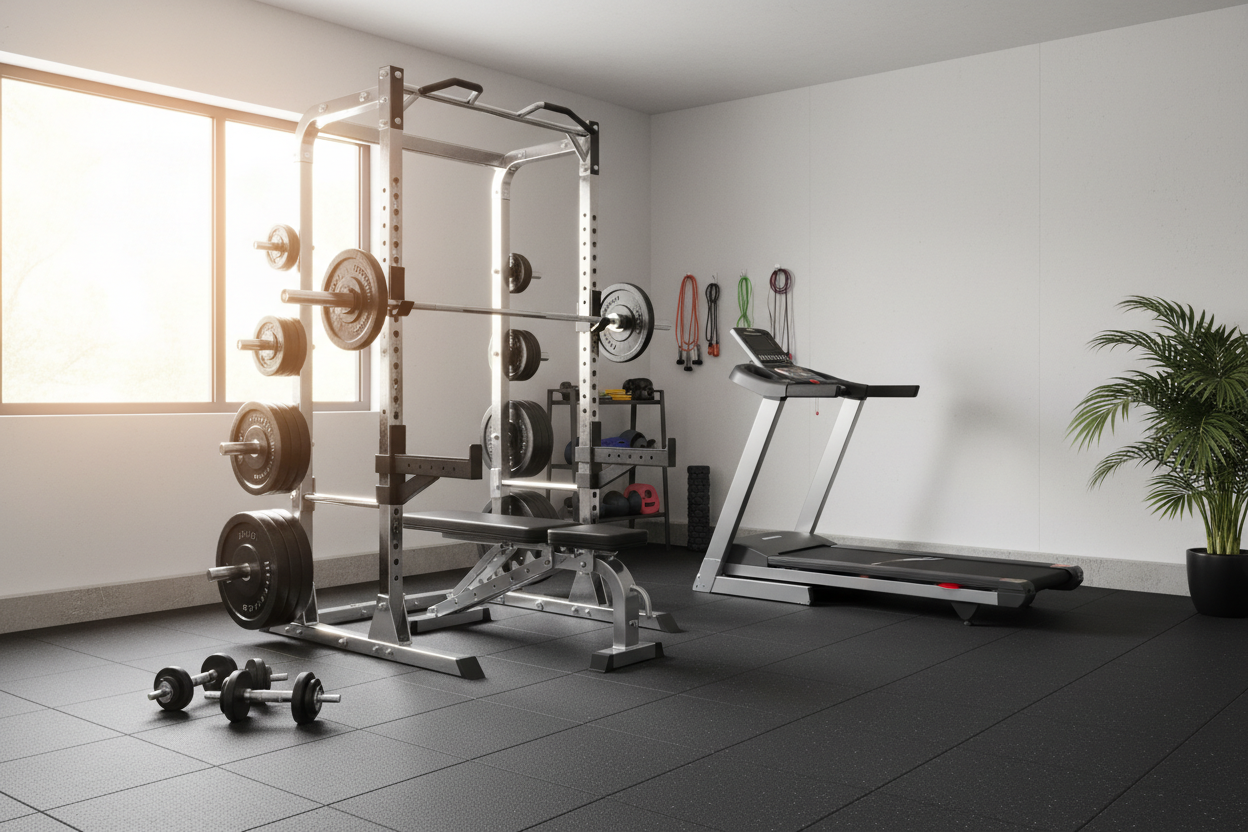
For most guys starting out, a solid weight bench with barbell rack is the North Star of the gym. It is where you will do your heavy presses and rows. I always tell people to look for a bench with at least a 600-lb total capacity. If it feels light enough to pick up with one hand, it is probably going to wobble when you are mid-set with 225 lbs over your throat.
Dumbbells are the next step. They fix the imbalances a barbell can hide. If your left arm is weaker than your right, a barbell lets the strong side take over. Dumbbells do not play those games. You either lift it with that specific arm, or you do not.
Cable Machines: The Secret to Constant Tension
Free weights are great, but they have a physics flaw: the resistance curve. In a bicep curl with a dumbbell, there is zero tension at the bottom and almost none at the top because gravity only pulls straight down. Cable machines use pulleys to redirect that force, so the weight is pulling against you through the entire arc of the movement.
This is why functional trainers are so popular. You can adjust the height of the pulley to hit muscles from angles that are physically impossible with a piece of iron. If you want to understand the mechanics of why some machines feel 'heavier' than others, check out this guide to gym machine types. It breaks down the 2:1 vs 1:1 pulley ratios that dictate how much work you are actually doing.
Selectorized vs. Plate-Loaded: The Heavy Machinery
Selectorized machines are those with the pin-loaded stacks. They are built for speed and convenience. You drop the pin in the 150-lb slot and go. These are fantastic for 'drop sets' where you want to reduce the weight quickly to keep the pump going. The downside is that you are stuck with the increments the manufacturer chose, usually 10 or 15 lbs.
Plate-loaded machines, like a leg press or a hack squat, require you to manually slide Olympic plates onto the pegs. These are the heavy hitters. Because they follow a fixed path, you do not have to worry about balance. This allows you to absolutely torch a specific muscle, like your quads, without your lower back giving out first. I use these at the end of a workout when my brain is too tired to safely balance a heavy barbell.
All-in-One Trainers: Condensing the Commercial Gym
If you are working with a standard two-car garage, you do not have room for fifteen different machines. This is where the hybrid units come in. A high-quality Smith machine home gym station usually packs a guided barbell, a pull-up bar, and often a cable system into one footprint.
The Smith machine gets a bad rap from purists, but it is a tool. It allows for a fixed vertical path that is perfect for shrugs, calf raises, or behind-the-neck presses if your shoulders can handle it. Modern versions even include half racks on the front so you can still do your free-weight squats when you are feeling fresh. It is about maximizing the utility of every square inch of your rubber flooring.
How to Actually Structure Your Workout Around This Gear
Knowing gym equipment what they do is only half the battle; you have to use them in the right order. A good rule of thumb is: Heavy Free Weights -> Plate-Loaded Machines -> Cables/Isolation. You want your biggest, most dangerous lifts like deadlifts or overhead presses to happen when your central nervous system is fresh.
Once you have done the heavy lifting, move to machines to safely push the volume. Finish with cables to get that constant tension and blood flow. If you are tired of paying a monthly fee just to wait in line for a rack, you might consider building a complete home gym. It is an investment, but the first time you lift in your own space at 11 PM without some teenager filming a TikTok in the squat rack, you will realize it is worth every penny.
My Biggest Gear Mistake
When I first started, I bought a '5-in-1' machine from a big-box store. It tried to do everything but did nothing well. The cables were jumpy, the bench was narrow, and the 'lat pulldown' hit me in the head if I leaned back too far. I learned the hard way that it is better to buy one high-quality barbell than five mediocre pieces of plastic. Buy once, cry once.
FAQ
Is a Smith machine better than a power rack?
Neither is better; they are different. A power rack is for raw strength and stability. A Smith machine is for high-volume isolation and safety when training alone. If you have to choose one for a home gym, get the rack first.
What equipment should I use for fat loss?
The equipment that helps you build muscle. Muscle is metabolically expensive, meaning it burns more calories at rest. Stick to barbells and dumbbells for the biggest bang for your buck.
Do I really need a 7-foot Olympic bar?
Unless you are training in a literal closet, yes. Standard 1-inch bars are flimsy and will not hold enough weight once you get past the beginner stage. Get a 2-inch sleeve Olympic bar and never look back.
Share:
I Wasted $400 on a Barbell Starter Set (Here's What I Learned)
I Traded My Power Rack for a Max Workout Machine (Big Mistake)