
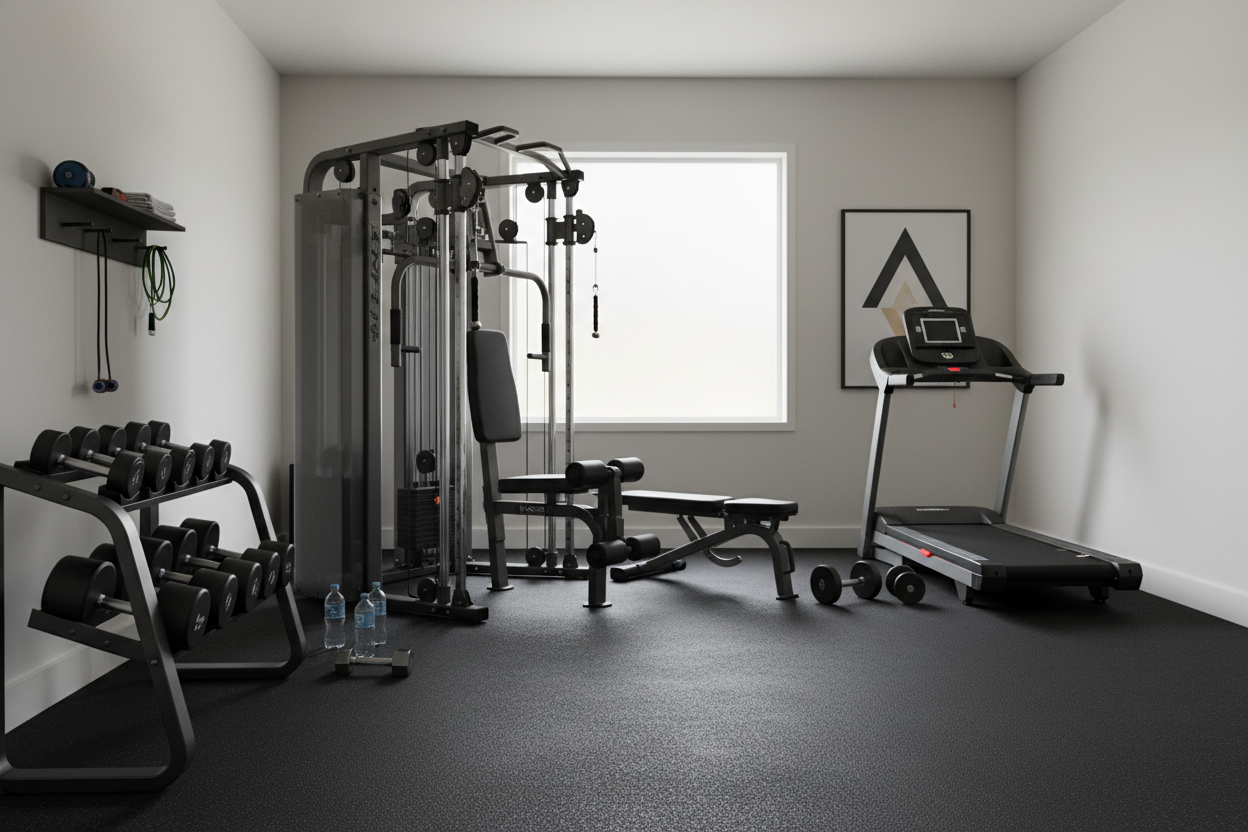
I remember the night I finally hit my limit with the local commercial gym. The membership dues had crept up to nearly $90, and I was tired of waiting 15 minutes for a cable station while some teenager scrolled through TikTok. I spent that night deep in a rabbit hole of home weight lifting machines, trying to figure out if I could actually fit a pro-level workout into my cramped garage without it feeling like a cheap hotel gym.
- Prioritize 11-gauge or 12-gauge steel; anything thinner will wobble during heavy presses.
- Pay attention to pulley ratios—a 2:1 ratio offers a smoother travel but effectively halves the weight on the stack.
- Plate-loaded machines are usually more affordable and allow for micro-loading with 1.25-lb plates.
- Ensure the machine has adjustable starting positions to accommodate your specific limb length and joint mobility.
The All-In-One Dream vs. The Wobbly Reality
We've all seen the ads for a single home weight lifting machine that claims to replace an entire gym. While the dream of a small footprint is real, the reality is often built on plastic pulleys and cables that feel like they're grinding through gravel. When you're shopping for home weight training machines, the first thing you need to check is the weight of the unit itself. If the machine weighs 150 lbs and you're trying to row 200 lbs, you're going to end up pulling the machine over on top of yourself.
Cheap units use thin 14-gauge steel that flexes under load. This isn't just a matter of durability; it's a matter of biomechanics. If the frame is twisting while you're pushing, your stabilizer muscles are working to keep the machine steady instead of focusing on the prime movers. I've tested rigs that felt like they were held together by hope and wood glue—stay away from those.
Free Weights vs. Machines for Strength Training at Home
The old-school purists will tell you that a barbell is all you need. They aren't entirely wrong, but they're ignoring how effective machines for strength training are for hypertrophy. When you're training alone in a garage, you don't have a spotter to bail you out. A fixed-path system allows you to push to absolute muscular failure on a chest press or hack squat without the fear of getting pinned. It's about safety and isolation.
Modern home gym equipment with weights has bridged the gap between 'commercial feel' and 'residential size.' For instance, a Smith machine home gym station gives you that fixed-path security for heavy overhead presses while still allowing for the versatility of cable work. You get the stability of a machine with the freedom to move through different planes of motion if the unit includes a functional trainer component.
The 3 Specs You Cannot Ignore
Don't get distracted by the shiny paint job. First, look at the pulley ratio. A 1:1 ratio means if the stack says 100 lbs, you are moving 100 lbs. A 2:1 ratio is common in functional trainers because it allows for longer cable travel, but it makes the weight feel 50% lighter. If you're a heavy hitter, a 2:1 ratio on a light weight stack will leave you maxing out the machine in six months.
Second, check the cable rating. You want aircraft-grade cables with a 2,000-lb tensile strength. Third, look at the bearings. Cheap machines use bushings; high-end weight training machine models use sealed ball bearings. If the movement isn't buttery smooth from the first rep, it's only going to get jerkier as dust and sweat build up over time.
How I Finally Built a Functional Home Gym for Weight Training
My first attempt at a home gym was a disaster. I bought a massive power rack that took up 70% of my floor space. I quickly realized why I traded my full rack for a compact weight training home gym—it wasn't about the amount of iron I had, but how efficiently I could use the space. I needed a setup that allowed me to transition from a heavy compound lift to a high-volume isolation move without moving three different benches.
I eventually landed on a hybrid approach. I ditched the oversized rack for a more streamlined home gym for weight training that focused on lever arms. My favorite piece is the weight bench chest press machine independent arms Z1 Pro. The independent arms mean my stronger right side can't take over for my weaker left, which was a huge issue I had with standard barbells. It fits in a corner and gives me that deep, converging stretch you usually only find in a Hammer Strength machine at a pro-bodybuilding gym.
The Final Verdict: Who Should Actually Buy One?
If you're a competitive powerlifter, you'll always need a squat stand and a straight bar. But for the 90% of us who want to look better and stay strong without destroying our joints, a dedicated machine is a smarter investment. It saves time, reduces the risk of injury when training solo, and makes it much easier to stick to a consistent program. Plus, you never have to wipe down someone else's sweat.
If you're just starting out and aren't ready to drop thousands on a selectorized stack, look for a hybrid setup. A weight bench with barbell rack and biceps and leg extension curl station Z3 is a fantastic entry point. It gives you the barbell basics but adds the leg extension and curl stations that are crucial for building well-rounded legs. It’s better to buy a high-quality hybrid than a cheap, full-size machine that you'll hate using after a week.
FAQ
Do home machines build as much muscle as free weights?
Yes. Your muscles don't know the difference between a 45-lb plate and 45 lbs of cable tension. The mechanical tension and metabolic stress are what drive growth. Machines actually make it easier to reach that 'growth' threshold because you don't have to worry about balance.
How much floor space do I really need?
Most all-in-one machines require at least an 8x8 foot area. You need to account for the 'working area' around the machine—space to load plates, pull the bench out, or extend your legs. Always measure twice before clicking buy.
Are plate-loaded machines better than selectorized ones?
Plate-loaded machines are usually cheaper and have a higher weight ceiling since you can just keep adding plates. Selectorized machines (with the pin) are faster for supersets and dropsets but are significantly more expensive to ship and move.
Share:
Most Exercise Equipment Full Body Rigs Are a Massive Trap
Are Adjustable 100 lbs Dumbbells Actually Safe for Heavy Presses?