
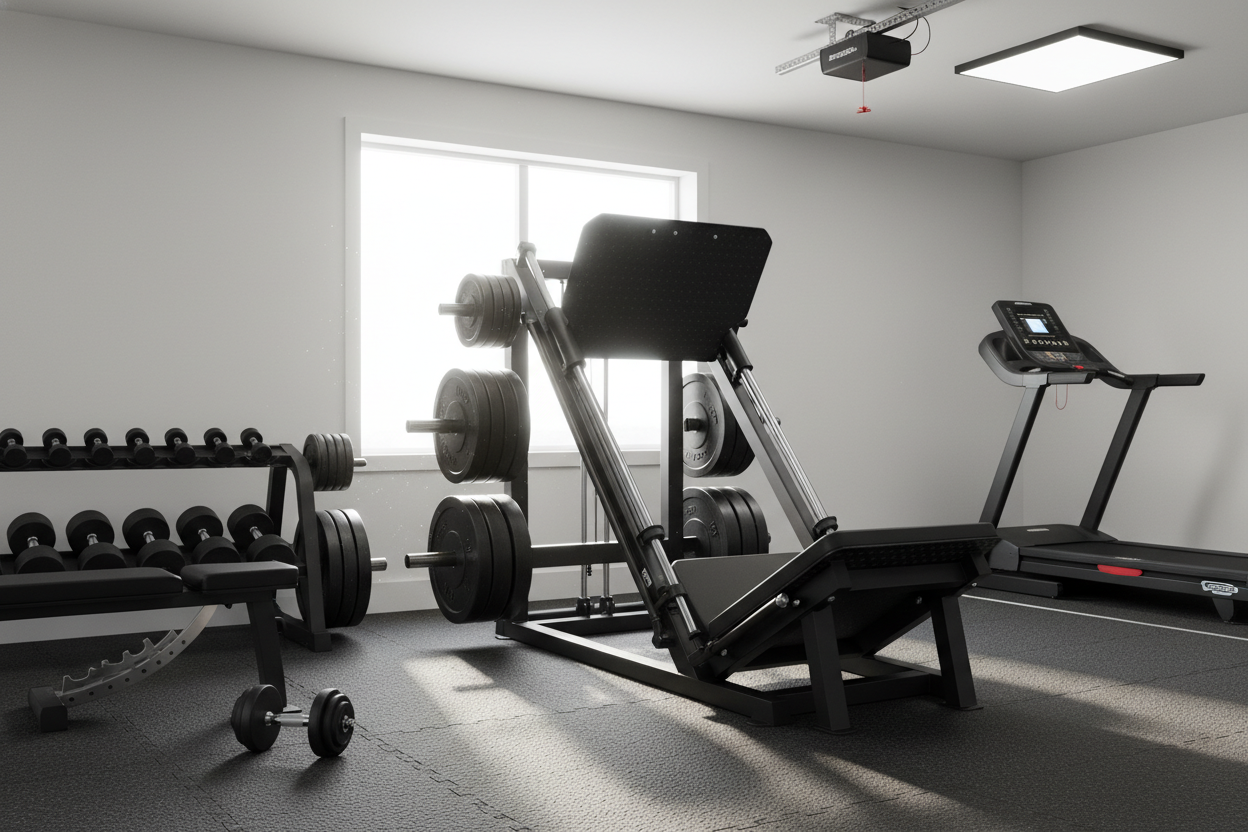
I remember the first time I saw a vertical leg press in the corner of a dusty powerlifting gym. It looked like a medieval torture device designed specifically to crush a human spine under a stack of iron plates. But when you are fighting for every square inch in a one-car garage, vertical leg press machines start looking less like death traps and more like the only way to get a heavy leg day in without a massive sled taking over your life.
Quick Takeaways
- Space-saver: Takes up about 1/3 the floor space of a standard 45-degree sled.
- Spinal Support: Forces a flat-back position that can reduce lower back shear.
- True Weight: You are fighting 100% of gravity, making 200 lbs feel like 400 lbs.
- Safety First: Dual-locking pins are the difference between a good pump and a hospital visit.
Why Pushing Weight Straight Up Feels So Sketchy
It is the visual of lying flat on your back while 400 pounds hovers over your chest that stops most people. We are biologically wired not to want heavy things suspended over our vital organs. In a standard gym, you are used to the 45-degree sled where gravity is working at an angle, but with a vertical setup, the resistance is 1:1.
Old-school bodybuilders swear by these because there is zero room for momentum. You cannot 'bounce' the weight at the bottom without risking a serious mishap. It forces a slow, controlled eccentric that torches the quads in a way a horizontal machine just can't match.
The Real Impact on Your Spine and Knees
People assume this machine is a one-way ticket to a herniated disc, but the biomechanics tell a different story. Because you are lying completely flat, your spine is pinned against a stable pad, which prevents the 'butt wink' or pelvic tilt that often causes injury on a standard leg press. It is actually a more stable environment for many lifters than leg press Smith machine setups where the fixed bar path might not align with your natural hip tracking.
The 90-degree hip angle is the key. As long as you do not let your glutes roll off the pad at the bottom of the rep, the force is distributed through your hips and the machine's frame, not your vertebrae. It is a pure piston-style movement that isolates the lower body with surgical precision.
How to Spot the Best Vertical Leg Press (And Avoid the Junk)
If you are hunting for the best vertical leg press, do not get distracted by fancy powder coating. You need three things: thick steel guide rods, linear bearings that do not grit, and a massive, textured footplate. When you are adding dedicated lower body machines to a home gym, the footprint is usually the deciding factor, but never sacrifice safety for a few extra inches of floor space.
Check the safety catches. A quality machine should have multiple lockout heights that you can reach easily with your hands while under load. If the safety pins look like they belong on a curtain rod, walk away. You want solid steel pins that can catch a falling sled without shearing.
Navigating the Sketchy World of a Vertical Leg Press Sale
You will often see a vertical leg press for sale on Facebook Marketplace for a hundred bucks. Be careful. If the guide rods are even slightly bent or rusted, the sled will catch. That is a nightmare scenario when you are at the bottom of a rep and the weight gets stuck or drops unevenly. I have seen plenty of used leg press machines for sale that were basically scrap metal because they were left in damp garages.
When you see a vertical leg press machine for sale, always test the movement without plates first. It should feel like it is sliding on ice. If there is any 'chatter' or friction, the bearings are shot. Also, check the welds on the weight pegs; if those snap, that iron is coming straight down.
Commercial Vertical Leg Press Rigs vs. Garage Footprints
A commercial vertical leg press is a beast, often weighing 300+ lbs itself with a frame made of 11-gauge steel. These are overbuilt for 24/7 abuse. For a garage gym, you can find lighter variants that still offer a 400-600 lb capacity, which is more than enough for most humans given the vertical resistance. Just ensure your floor can handle the concentrated point-load of a vertical leg press sale find once it is fully loaded with plates.
The Verdict: Does It Deserve Your Floor Space?
If you have a 20x20 garage, buy a 45-degree sled. But if you are in a basement or a cramped shed, the vertical press is a legitimate tool. It provides a brutal leg workout in a space no bigger than a doorway. If the idea of weight over your face still keeps you up at night, you might prefer a compact leg press hack squat combo which offers a more traditional feel while still respecting your limited floor real estate.
Personal Experience: My Close Call
I once owned a cheap no-name vertical press I found at a local equipment auction. The safety pins were thin, and the back pad felt like plywood covered in cheap vinyl. One afternoon, I misloaded one side by just ten pounds, and the sled tilted enough to bind on the rails. I spent five minutes trapped under 200 lbs until I could wiggle out sideways. I sold it the next day and bought a model with heavy-duty, dual-locking stops. Don't cheap out on your life.
FAQ
Is a vertical leg press harder than a regular one?
Yes. On a 45-degree press, you are only moving about 70% of the actual weight due to the angle. On a vertical press, you are moving 100% of the load against gravity.
Will a vertical leg press fit in a basement?
Usually, yes. Most models are between 48 and 60 inches tall, making them much shorter than a power rack or a standard leg press sled.
Are vertical leg presses safe for seniors?
They can be, but the entry and exit require some mobility. Getting down onto the floor-level pad and back up again is often the hardest part of the exercise.
Share:
I Bought the 'Best Gym Equipment' and Sold Half of It
Why the Life Fitness vs Matrix Debate Only Matters for Two Machines