
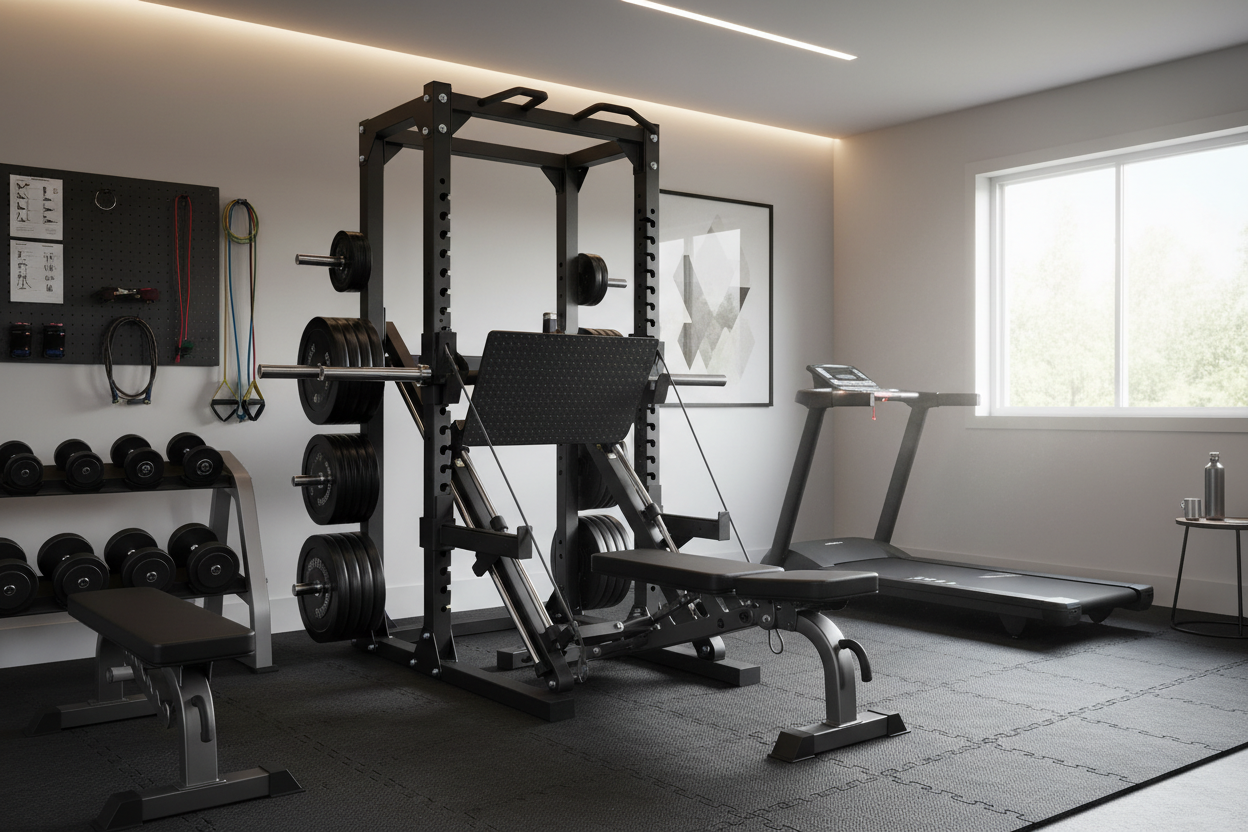
I have spent years in garage gyms where every square inch is a battleground. You see a viral video of someone doing a leg press smith machine setup and think, 'Hey, I can save $800 and four feet of floor space.' It looks like a clever engineering hack until you are staring up at a 45-pound bar loaded with plates, praying your grip tape holds and your spine stays in one piece.
Quick Takeaways
- The setup mimics a vertical leg press, which offers high quad isolation but puts extreme pressure on the lumbar spine.
- Safety catches are the only thing standing between you and a trip to the hospital—never skip them.
- Foot friction is the biggest variable; sweaty sneakers on a steel bar are a recipe for disaster.
- It is a viable 'accessory' movement, but it should never replace your primary heavy lifting.
The Garage Gym Hack That Refuses to Die
Most of us started our home gym journey with a basic rack and a dream. Eventually, the itch for a leg press hits, but most dedicated units have the footprint of a small sedan. That is when the smith machine vertical leg press enters the chat. It is the 'poor man’s vertical press'—a way to use existing hardware to hit a muscle group that usually requires a massive, expensive machine.
While I love a good budget-friendly solution, this specific hack raises immediate red flags. When you are performing a leg press on smith machine, you are removing the stability of a backrest and a fixed seat. You are essentially the structural support for the weight. For anyone who has ever felt a bar 'walk' or slip during a heavy set, the idea of doing this with 200+ pounds over your chest is enough to make your skin crawl.
The Biomechanics: Are You Actually Building Quads?
Lying flat on your back creates a 90-degree hip angle right out of the gate. On a traditional 45-degree leg press, you have some breathing room and an angled seat that helps keep your pelvis neutral. With the vertical leg press on smith machine, your hamstrings act like a tension wire. If you don't have the mobility of a gymnast, your pelvis is going to tilt as the bar descends.
This 'butt wink' on the floor is much more dangerous than a butt wink in a squat because the floor provides zero give. You are effectively crushing your lower back into the concrete. Before you commit to lying on the floor, you might want to try an underrated leg exercise on smith machine for quads like a high-foot-placement split squat. It hits the same muscle groups without the spinal risk.
How to Set Up a Leg Press on Smith Machine Without Getting Crushed
If you have weighed the risks and still want to try it, do not just wing it. First, you need a quality Smith machine with butter-smooth linear bearings. If the bar hitches or sticks, it can shift your center of gravity and cause a slip. Set your safety catches about two inches above where the bar would touch your feet at the bottom of the rep. This is your 'life insurance' policy.
Use a high-density rubber mat, not a soft yoga mat. You want your hips to stay glued to the floor, not sliding around like you're on an air hockey table. When you unrack the bar, do not use your toes. Center the bar on the middle of your foot (the arch/mid-foot area) to ensure the weight is balanced over your center of gravity. Never unrack a leg press for smith machine setup with your arms—keep them at your sides, gripping the base of the machine for stability.
Why Foot Placement Makes or Breaks This Lift
The bar on a Smith machine is usually knurled steel. While that is great for your hands, it is surprisingly slick against the rubber soles of a cross-trainer once you start sweating. I recommend wearing flat-soled shoes like Vans or Chuck Taylors, or even going barefoot if the knurling isn't too sharp. A wider stance will engage more of the adductors and glutes, while a narrow stance keeps the focus on the outer quad sweep of the smith leg press.
The Glaring Risks of the Smith Machine Vertical Leg Press
Let's talk about spinal flexion. When you drive heavy weight vertically, that force has to go somewhere. In a standard leg press, the padded seat absorbs and distributes that force. On the floor, that force goes directly into your lumbar discs. If your hips lift even an inch off the ground at the bottom of the rep, you are asking for a herniated disc.
The margin for error is razor-thin. If you lose your footing, the bar doesn't just fall—it falls directly toward your torso. Unlike a squat where you can dump the bar behind you, in a vertical setup, you are the landing pad. This is why I rarely recommend this movement for anyone lifting more than 50% of their body weight.
Better Alternatives If You Actually Want Huge Legs
I get it—you want the leg press feel without the $2,000 price tag. But your spine is worth more than a saved couple of hundred bucks. If you have a tight garage, a compact 30 degree leg press hack squat combo machine is a much smarter play. It gives you the mechanical advantage and the safety of a backrest while keeping a small footprint.
If you have a bit more room and want to train like a pro, the 3 in 1 hack squat leg press combo is the gold standard. It eliminates the sketchy floor setup entirely and allows you to move real weight without the 'will I survive this set' anxiety. Leg day is hard enough without adding life-threatening variables to the mix.
Personal Experience: My One and Only Mistake
I tried the Smith machine hack back in 2020 when the local gyms were closed. I thought I was being innovative. I loaded up three plates a side, felt great for about four reps, and then my left shoe slipped just a fraction of an inch. The bar caught the safety catch, but the sudden jolt sent a 'zing' down my sciatic nerve that kept me out of the gym for a week. I learned that day that some hacks just aren't worth the risk. Now, if I'm using the Smith machine for legs, I'm standing up.
FAQ
Is the Smith machine leg press effective for muscle growth?
Yes, it isolates the quads effectively because of the vertical path, but the risk-to-reward ratio is poor compared to traditional movements.
Do I need a spotter for this?
A spotter is highly recommended to help you unrack and re-rack the bar, as doing it with your feet alone is the most dangerous part of the lift.
Can I use a bench instead of the floor?
No. Putting a bench under the bar makes the setup even more unstable and increases the height the bar can fall if a safety fails.
Share:
Is the Best Exercise Machine Actually Built for Your Body?
Is There Actually a Best Brand in Gym Equipment?