
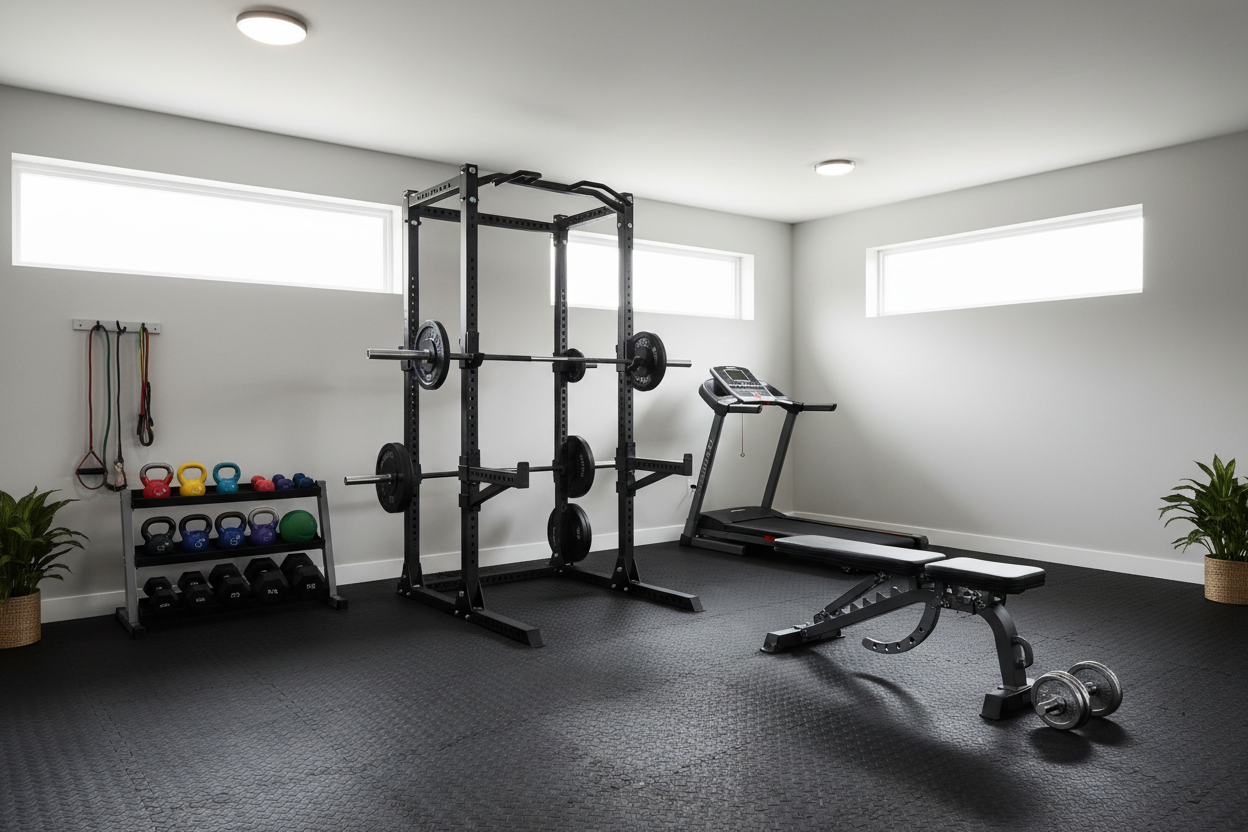
I remember staring at my 1-car garage, looking at my lawnmower and some old plastic bins, thinking there was no way a real lat pulldown would ever fit. I was tired of the $80 monthly membership at the local powerhouse gym where I spent half my workout waiting for a cable stack to open up. You have probably been there—scrolling through equipment sites at midnight, measuring your floor with a tape measure while trying to convince yourself that strength training machines are only for people with 2,000-square-foot basements.
- Footprint is king; measure your 'working area,' not just the machine base.
- Prioritize height over width to save precious floor space.
- Cables offer more exercise variety per square foot than any single-lever machine.
- Mobility is your secret weapon—put your bench and smaller units on wheels.
The 'I Don't Have Enough Space' Myth
Most people think you need a massive pole barn to get away from a barbell-only setup. That is old-school thinking. Modern weight training machines are being designed for the 'garage gym revolution,' which means they are narrower and taller than the bulky stuff you saw in the 90s. You do not need a dedicated leg press, a hack squat, and a chest press taking up three different corners. Modern engineering allows us to consolidate these movements into a single footprint.
I have seen guys fit a full functional trainer and a half-rack into a space no bigger than a king-sized bed. The math changes when you stop looking at machines as 'extra' and start looking at them as the centerpiece. If you choose the right gear, you can actually save space by replacing a cluttered dumbbell rack with a single, versatile cable column.
Choosing Weight Training Machines That Pull Double Duty
If a machine only does one thing, it does not belong in a 1-car garage. You have to be ruthless with your floor plan. I look for pieces that combine a power rack with a functional trainer. Using a full body multifunctional training station allows you to hit heavy squats and then immediately pivot to cable flies without taking another step. It is about density.
When you are shopping, look for 'integrated' features. Can the seat be removed? Does it have band pegs? Can you attach a dip bar? Every square inch has to earn its keep. I would rather spend more on one high-quality multi-unit than buy four cheap, single-use pieces that turn my garage into an obstacle course.
Why Cable Towers Are Your Best Friend
Cable-driven resistance training machines gym setups are the ultimate space hack. A single column functional trainer takes up about 3x3 feet of floor space but gives you access to hundreds of movements. I have found that high-quality aluminum pulleys make a huge difference in how 'commercial' the movement feels. Do not settle for plastic pulleys that drag; they will ruin your mind-muscle connection during slow eccentrics.
Layout Hacks for a Cramped Space
You need to map out your 'dead zones.' The space where your car door opens or where the garage door track sits is prime real estate for wall-mounted storage. When you are setting up your main station, leave at least 24 inches of clearance on the sides for plate loading. You do not want to be shimmying against a wall every time you want to add a 45-lb plate.
I also recommend an easily maneuverable weight bench that you can tilt up and roll out of the way when you need to do standing cable work. Even specialty items like a compact glute bench design can work in a tight room if they have a vertical storage footprint or can double as a utility seat.
Replicating a Commercial Strength Training Machines Gym at Home
To get that smooth, heavy feel of a strength training machines gym at home, focus on the guide rods and the bearing type. If the rods are chrome-plated and the bearings are linear, it is going to feel like the stuff at the pro clubs. Don't waste time obsessing over Smith machine starting weight and instead look at the cable ratio. A 2:1 ratio is standard for functional trainers, but 1:1 is better if you plan on doing heavy lat pulldowns and rows.
I once bought a used leg extension machine that was a 'steal'—$200 on Facebook. It was a beast, but it was six feet long. I literally could not walk around it to get to my squat rack without hitting my shins. I ended up selling it two weeks later. Now, I only buy gear that fits my '3-foot rule': if it is a standalone machine, it better have a footprint smaller than a standard floor mat or it stays at the store.
FAQ
Can I put heavy machines on horse stall mats?
Yes, and you should. It levels the floor and dampens the noise when you are dropping stacks. It also protects your concrete from cracking over time.
How much ceiling height do I actually need?
Most home towers are 80-84 inches. Always check your garage door opener height and the 'swing' of the door before you buy a tall rack.
Are plate-loaded machines better than selectorized for small gyms?
Plate-loaded is usually cheaper and easier to move if you rearrange your gym. However, selectorized stacks are faster for drop sets and keep the floor cleaner since you aren't leaving plates everywhere.
Share:
Is There Actually a Best Brand in Gym Equipment?
I Ignored Exercise Equipment Dimensions and Ruined My Garage Gym