
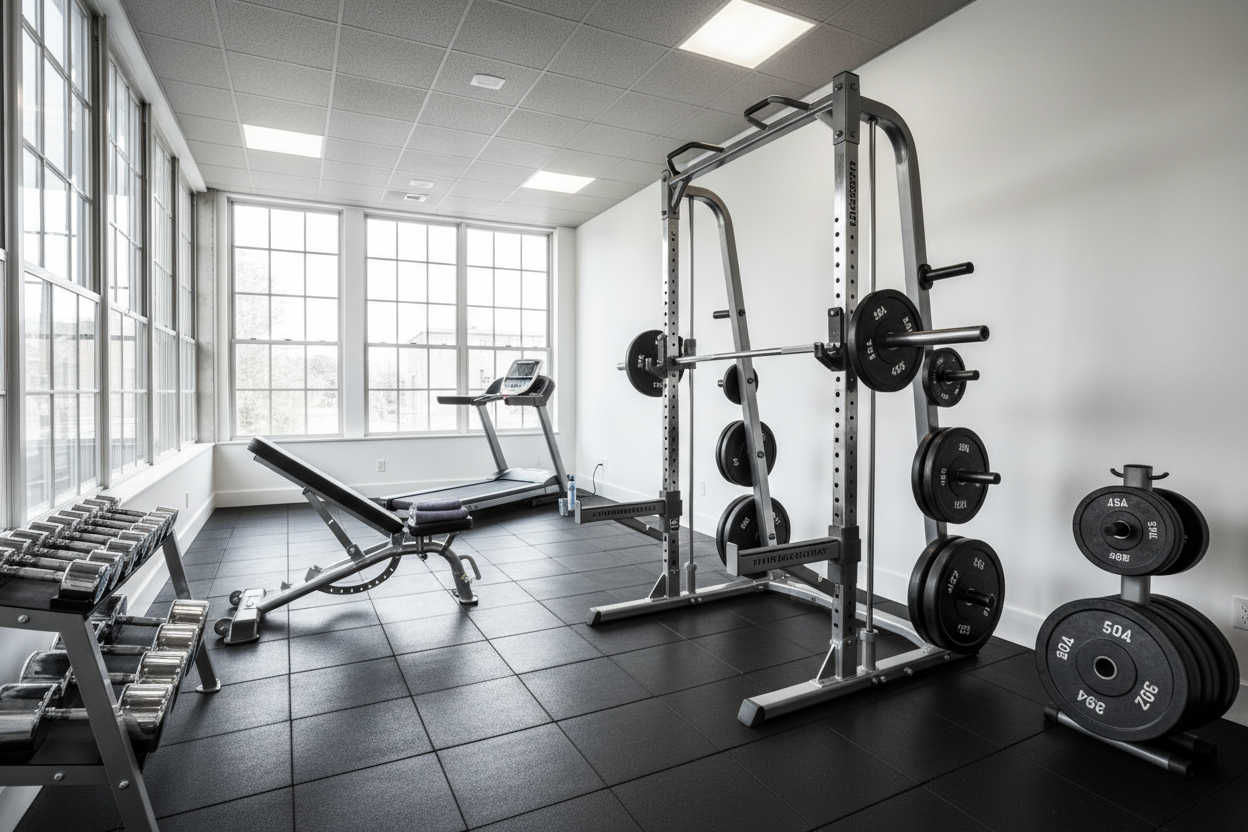
I have stood in the middle of a crowded commercial gym, staring at a plate-loaded rack with a calculator app open on my phone more times than I care to admit. It is a specific kind of madness. You are trying to track your progress, but the hammer strength smith machine barbell weight feels nothing like the 45-pound Rogue bar you use for deadlifts. One day the weight flies; the next day, at a different gym, 225 pounds feels like a house.
The truth is, most lifters are doing the math wrong because they treat a Smith machine like a free-weight rack. It is not. Between the counterbalance systems, the linear bearings, and the angle of the rails, the number stamped on the side of the machine is often a suggestion, not a law. If you are obsessed with knowing the smith machine bar weight hammer strength uses, you are chasing a ghost that does not actually matter for your gains.
Quick Takeaways
- Most modern Hammer Strength Smith Machines have a starting resistance of 20 lbs or 25 lbs.
- The counterbalance system uses weights and pulleys to offset the actual 45-80 lb weight of the steel bar.
- Friction in the guide rods can add 5-10 lbs of 'phantom' resistance if the machine is not lubed.
- The 7-degree slant on Hammer Strength rigs changes the bar path, making it feel different than vertical models.
The Problem With Chasing the Exact Number
The frustration is real. You go from a local black-iron basement gym to a shiny Life Fitness-equipped club, and suddenly your incline press numbers are all over the place. Trying to pin down the exact hammer strength smith machine barbell weight is a recipe for logbook confusion. Commercial gym equipment is built for durability and 'feel,' not for calibration like a competition powerlifting bar.
I have seen guys argue for twenty minutes about whether a specific rack was 15 or 25 pounds. In the end, they both lifted the same plates. The variance between machines—even the same model from different years—can be enough to throw off your ego, but it should not throw off your training. The 'math' of the bar is secondary to the tension on your chest or quads.
So, What Is the Actual Starting Resistance?
If you absolutely need a number to put in your app, here is the industry standard. For the classic Hammer Strength Linear Counter-Balanced Smith Machine, the starting resistance is usually 20 lbs (9 kg). Some older or heavy-duty industrial models might sit at 30 lbs. When people ask how much does a hammer strength smith machine bar weigh, they are usually surprised to learn the physical bar is quite heavy—often 60+ lbs—but the internal counterweights pull it upward, leaving you with that light 20-lb 'starting' feel.
This is why investing in a home Smith machine can be such a relief for data nerds. In a home gym, you control the maintenance and you know the exact specs every single day. You aren't at the mercy of whatever the franchise owner decided to buy in 2014. In most commercial settings, the hammer strength smith machine starting weight is designed to be accessible for everyone, which is why it feels significantly lighter than an Olympic bar.
How the Counterbalance System Messes With Your Brain
The physics here are a bit of a mind-game. Hammer Strength uses a system of pulleys and weights hidden inside the frame. This counterbalance is designed to make the bar feel nearly weightless at the top. However, as you descend, you are fighting the inertia of that system. This is why the hammer strength smith machine weight can feel 'floaty' during the setup but surprisingly heavy when you are trying to drive out of the hole on a squat.
Then there is the friction factor. Those linear bearings are smooth, but if the gym staff hasn't hit the guide rods with silicone spray in six months, you are fighting mechanical drag. That drag doesn't show up on a spec sheet, but it sure shows up in your central nervous system. This friction is why the hammer strength smith bar weight never feels consistent across different gym locations.
Hammer Strength vs. Other Commercial Gym Rigs
Hammer Strength is famous for its 7-degree angled track. This is meant to mimic the natural path of a bench press or squat, but it adds another layer of complexity to the weight. Because you are pushing at an angle, a portion of the force is directed into the rails rather than straight up. This makes it feel entirely different from a standard 45-pound Olympic bar or a vertical Smith machine.
When you compare this to the Freemotion Smith machine bar weight, which often uses a different pulley ratio, the discrepancy becomes even more obvious. I have tested racks where the 'real' weight felt like 10 lbs and others where it felt like 40 lbs. You can read more about the real bar weight in Smith machine racks across various brands to see just how much the industry varies. Hammer Strength usually sits right in the middle—sturdy, predictable, but not 'zeroed out' like some cheap consumer models.
The Only Logbook Rule You Actually Need
Stop asking how much does hammer strength smith machine bar weigh every time you hit a new gym. It is a waste of mental energy. Here is the veteran move: count the plates and ignore the bar. If you did two plates and a ten last week, and you do two plates and a twenty this week, you got stronger. Period.
If the lack of precision still drives you crazy, consider switching to an independent arm chest press machine for your heavy accessory work. Plate-loaded machines with independent arms eliminate the 'balancing' act of the Smith bar and the friction of the tracks. But if you are sticking with the Smith, just pick a number—20 lbs is the safest bet—and stick with it. Consistency in your tracking is way more important than the actual physics of the counterbalance.
Personal Experience: The Day I 'Lost' 20 Pounds
I remember moving from a corporate gym to a hardcore powerlifting warehouse. I hopped on their Hammer Strength Smith machine to finish off my quads with some high-foot-placement squats. I loaded my usual four plates per side, thinking I was the man. I could barely move it. I felt like a total fraud until I realized their machine wasn't counterbalanced at all. The bar was a raw, 55-lb beast with no pulleys to help. I learned that day that 'Smith machine' is a category, not a specific weight. Now, I always do a couple of 'empty' reps first to feel the drag before I start stacking plates.
FAQ
How much does a Hammer Strength Smith bar weigh?
The physical steel bar usually weighs between 55 and 75 lbs, but because of the counterbalance system, the starting resistance you actually feel is typically 20 lbs or 25 lbs.
Is a Smith machine bar lighter than a standard barbell?
In terms of 'effective weight' or starting resistance, yes. Most Smith machines feel like 15-30 lbs, whereas a standard Olympic barbell is a true 45 lbs.
Why does the weight feel different at different gyms?
It usually comes down to maintenance. Dirty guide rods create friction, making the bar feel heavier. Also, different models of Hammer Strength machines have different counterbalance calibrations.
Share:
Power Rack or Smith Machine for Home Gym? I Tried Both.
I Put Commercial Gym Machines in My Garage (And Made Huge Mistakes)