
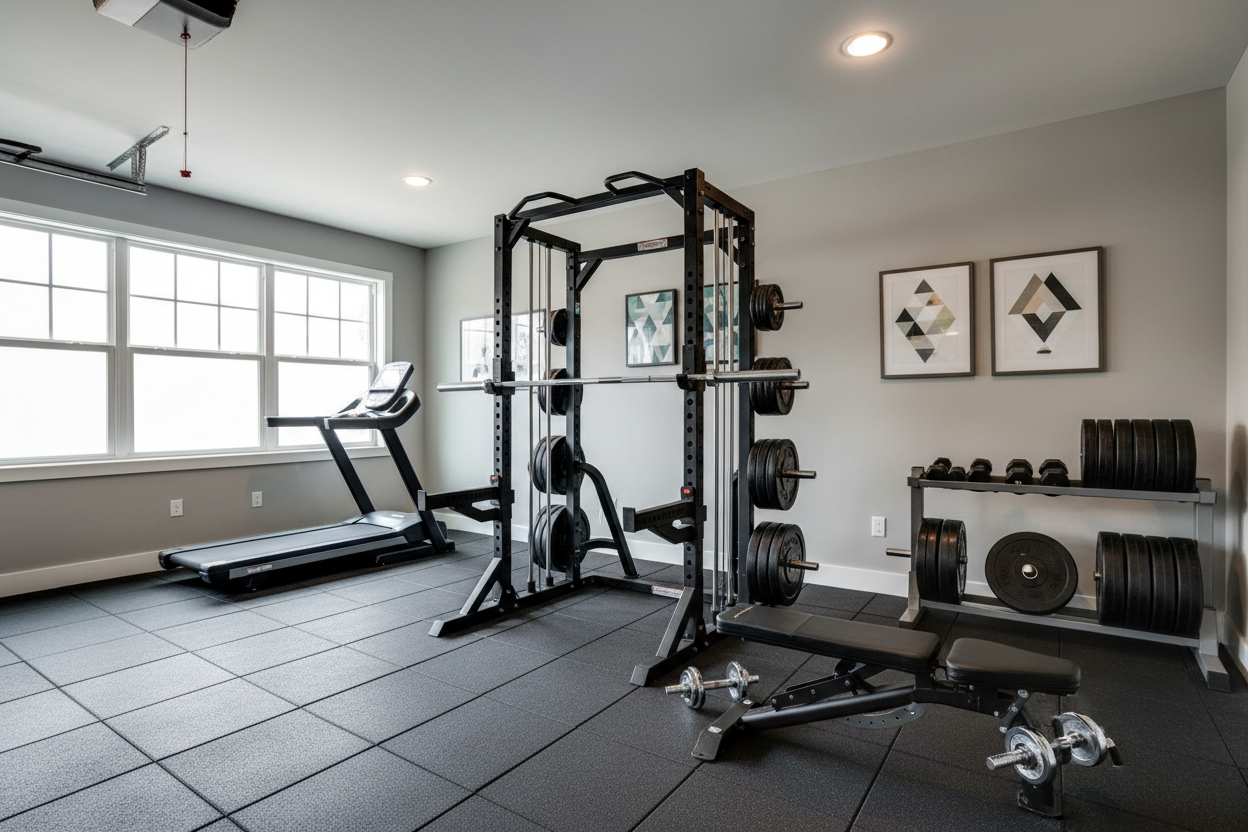
I remember staring at my 7-foot Olympic barbell and realizing I couldn't actually do a lateral lunge without hitting my water heater. That is the reality of the garage gym life. You want the big weights, but you also want to be able to park your car occasionally. I spent years as a barbell purist, but after a few close calls benching alone at 6 AM, I started looking at a smith machine for home gym setups.
- Hybrid units save about 30 square feet compared to separate racks and cable towers.
- Built-in safeties are a literal lifesaver for solo lifters who train to failure.
- Linear bearings are non-negotiable if you want a smooth, friction-free bar path.
- Cable ratios (2:1 vs 1:1) change how heavy those weight stacks actually feel in practice.
The Free Weight Purist Problem (And Why I Caved)
I used to be the guy who talked trash about fixed-path machines. I thought if you weren't stabilizing a shaky barbell, you weren't really working. Then I started training in a 10x10 spare bedroom. Balancing a 300-lb squat while worrying about falling into a drywall corner isn't 'functional training'—it is just dangerous.
After testing multiple garage gym rigs, I realized my ego was costing me gains. When you are lifting alone, the fear of getting pinned under a bar limits your intensity. A Smith machine lets you redline your effort because a simple flick of the wrist catches the weight. I found myself pushing harder on chest day than I ever did in a standard rack.
Does a Fixed-Track Rig Actually Save Garage Space?
If you buy a power rack, you also eventually want a cable machine. That is two separate footprints. In a tight garage, that is a death sentence for floor space. A consolidated Smith machine home gym station takes the footprint of a single rack and packs in the barbell, the safeties, and usually a pull-up bar.
Most of these units sit around 48 inches wide and 60 inches deep. When you compare that to a standalone cage plus a functional trainer, you are saving roughly 25 to 30 square feet. In a garage, that is the difference between having room for a deadlift platform or tripping over your own feet every time you change a plate.
The Cable Crossover Cheat Code
The real secret to these modern machines isn't the Smith bar itself; it is the integrated pulleys. Buying an all-in-one Smith machine with cable crossover effectively replaces three different pieces of equipment. You get your heavy compounds, your flyes, and your lat pulldowns in one spot.
I use the cables for 70% of my accessory work now. Because the pulleys are built into the frame, the unit is incredibly stable. No more bolting things into the concrete or worrying about a light cable tower tipping over when you try to do heavy face pulls.
Can You Still Go Heavy Without a Power Rack?
The biggest myth is that home Smith machines are flimsy. While they aren't quite the massive commercial rigs like a used Cybex that weigh a thousand pounds, modern 12-gauge or 14-gauge steel frames are rated for 400+ lbs on the bar. That is more than enough for most of us.
The safety catches are the real MVP here. On a standard rack, you have to set your spotter arms perfectly. On a Smith machine, the lockout points are every few inches. I have failed on the bottom of a squat more times than I care to admit, and every single time, the machine caught the weight exactly where I needed it to. No loud crashes, no broken floorboards.
What to Look for When Buying One (No Marketing BS)
Don't get distracted by shiny paint jobs. The first thing you check is the bearing system. If it uses plastic bushings, it will feel like dragging a stick through sand within six months. You want high-quality linear bearings. They are quieter and feel significantly more like a 'real' barbell.
Check the cable ratio too. A 2:1 ratio means 100 lbs on the stack feels like 50 lbs at the handle, giving you more cable travel for lunges or crossovers. Before you pull the trigger on a compact home gym setup, measure your ceiling height twice. Most of these units stand 82 to 84 inches tall, and you need extra clearance if you plan on doing pull-ups without hitting your head on the rafters.
FAQ
Is the bar on a Smith machine 45 lbs?
Usually no. Most home units have counterbalanced or lighter bars, often weighing between 15 and 35 lbs. Check the manual so you know exactly what you are loading.
Can I do squats safely?
Yes, but your foot placement will be slightly different than a free weight squat. You usually want your feet a few inches further forward to keep your spine neutral against the fixed path.
Do I need to bolt it to the floor?
Most hybrid Smith machines are heavy enough to stay put, but if you are doing heavy cable work or kipping pull-ups, bolting it down is always the safer bet.
Share:
Budget vs Premium Exercise Equipment: Where I Actually Spend My Money
Why You Should Ignore the Hammer Strength Smith Machine Barbell Weight