
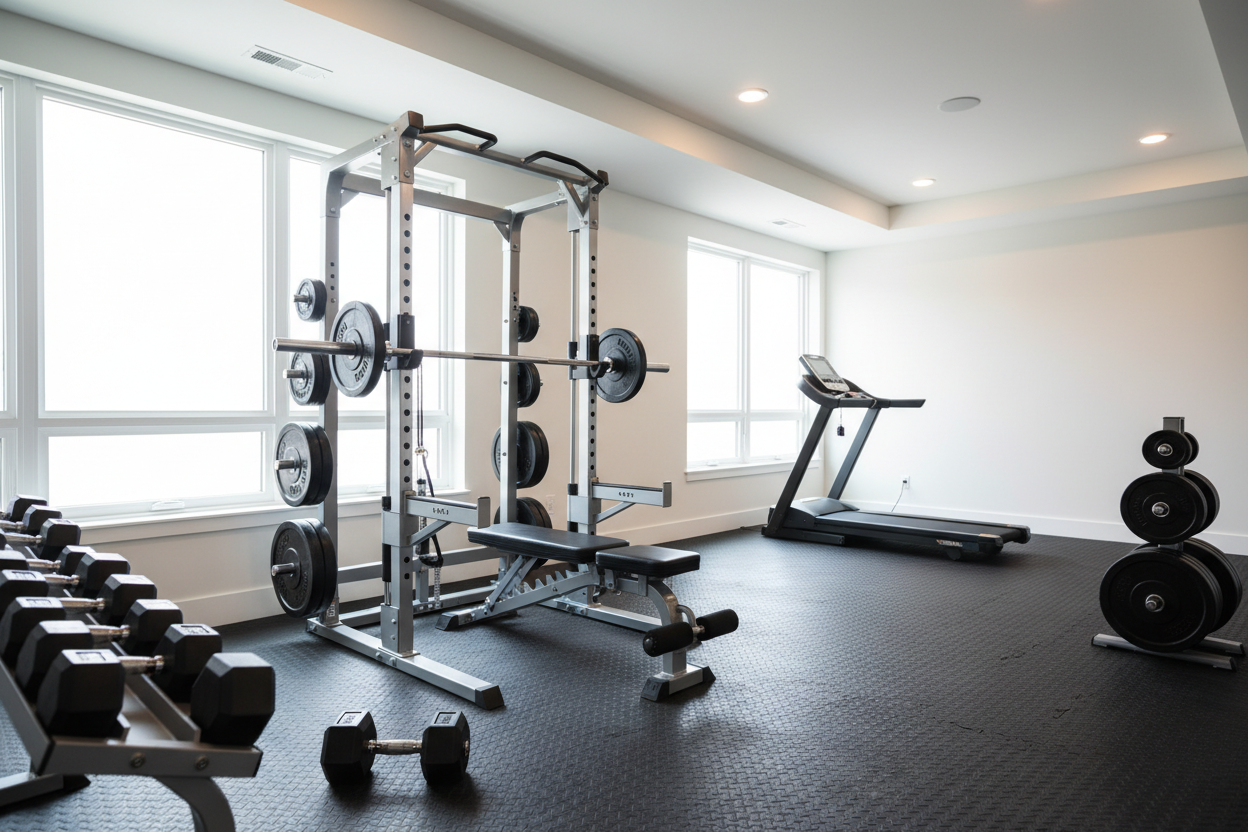
I was alone in my garage, testing a high-end rack with a built-in Smith attachment. I figured I'd knock out a few sets of 225 lbs—a weight I usually handle for easy reps on a standard flat bench. I unhooked the bar, lowered it to my chest, and suddenly felt like I was trying to press a refrigerator through a mail slot. I barely locked out the third rep before my triceps screamed for mercy.
It’s a common ego-check. You walk into a commercial gym or start is smith machine bench harder than a free barbell? The short answer is yes, but not for the reasons you might think. It isn't just about the weight on the bar; it's about the physics of the path you're forced to take.
Quick Takeaways
- The Smith machine forces a perfectly vertical (or fixed-angle) path, while a barbell follows a natural J-curve.
- Lateral friction on the guide rods adds 'ghost weight' that isn't reflected on the plates.
- Fighting the machine's fixed groove drains energy that should be going into the lift.
- Setup and bench positioning are 10x more critical on a Smith machine to avoid shoulder impingement.
The Day My Ego Got Crushed on a Fixed Track
There I was, convinced that my years of powerlifting would make testing new home gym Smith machines a walk in the park. I’ve spent a decade obsessing over bar paths and leg drive. Yet, the moment I moved from my Rogue power rack to the fixed track, my strength seemingly evaporated. It’s a humbling experience to struggle with 70% of your max.
The problem is that we treat the Smith machine like a barbell with training wheels. We assume that because the machine balances the weight for us, it should be easier. In reality, that rigid steel track is a double-edged sword. It removes the need for stabilization, but it also removes your ability to move the bar where your body actually wants it to go.
The 'Forced Groove' (And Why Your Shoulders Hate It)
When you bench with a free barbell, the bar doesn't move in a straight line. It starts over your shoulders, descends to your mid-chest, and presses back up in a slight 'J' curve. This arc keeps your joints stacked and your pecs in the strongest mechanical position. The Smith machine kills this arc. It forces a 100% linear path.
So, why is smith machine bench harder? Because you are constantly fighting the machine to find your natural groove. If you aren't positioned perfectly, your shoulders and elbows are forced to compensate for the lack of horizontal movement. This 'power leak' is why many lifters notice they are dropping numbers on fixed-path presses compared to their traditional barbell PRs.
Friction, Drag, and the Invisible Resistance
We need to talk about the guide rods. Even the best linear bearings have a coefficient of friction. On a standard barbell, 225 lbs is 225 lbs. On a Smith machine, if you push slightly more with your dominant hand or apply any lateral pressure, the bearings can bind or create drag. This makes the weight feel 'sticky.'
This is why is smith machine harder when you start loading it heavy. Any slight imbalance in your press translates into friction against the rods. You’re not just lifting the iron; you’re fighting the resistance of the machine itself. If you haven't greased your guide rods with silicone spray lately, that resistance becomes even more pronounced.
Wait, What About Angled vs. Straight Tracks?
Not all Smith machines are built the same. Some have a vertical 0-degree track, while others use a 7-degree pitch to better mimic a natural press. However, if you face the wrong way on an angled machine, you’re pushing the bar 'away' from your face or 'down' toward your hips, creating a leverage nightmare. This completely ruins any Smith machine bench press conversion math you might have tried to do.
On a 7-degree track, you want the bar to move slightly toward your face as you press up. If you set the bench up backward, the bar moves away from your center of gravity. You'll feel like you're doing a weird incline-decline hybrid that torches your front delts and leaves your chest untouched.
How to Stop Fighting the Machine (And Start Growing)
To make the Smith machine work for you, positioning is everything. You have to find the 'sweet spot' where the bar touches your chest at the exact point where your elbows are tucked at roughly 45 degrees. Since the bar won't move horizontally, you have to move your body to match its path. Take the time to do 3-4 'empty bar' reps just to check your alignment.
If you find that the fixed track still causes shoulder pain no matter how you adjust, it might be time to look at independent arm chest press machines. These allow for a more natural converging path while still offering the safety of a machine. But if you're stuck with the Smith, focus on a vertical forearm and a controlled eccentric to minimize that bearing drag.
FAQ
Is the Smith machine bar lighter than a standard barbell?
Usually, yes. A standard Olympic bar is 45 lbs, while most Smith machine bars are counterbalanced to weigh between 15 and 25 lbs. Always check the sticker on the frame; some commercial units are surprisingly heavy.
Why do my shoulders hurt more on Smith machine bench?
It's likely because the fixed path is forcing your shoulders into a position they don't want to be in. Without the natural J-curve, your rotator cuffs often have to work harder to stabilize a joint that's being forced into a rigid track.
Should I tuck my elbows on the Smith machine?
Yes, but be careful. You still want about a 45-degree angle. If you tuck too much or flare too much on a fixed track, you'll increase the friction on the guide rods and put massive stress on your connective tissue.
Share:
Why the Best At Home Exercise Machine Weighs Over 300 Pounds
I Tested Every Dick's Weight Bench on the Showroom Floor