
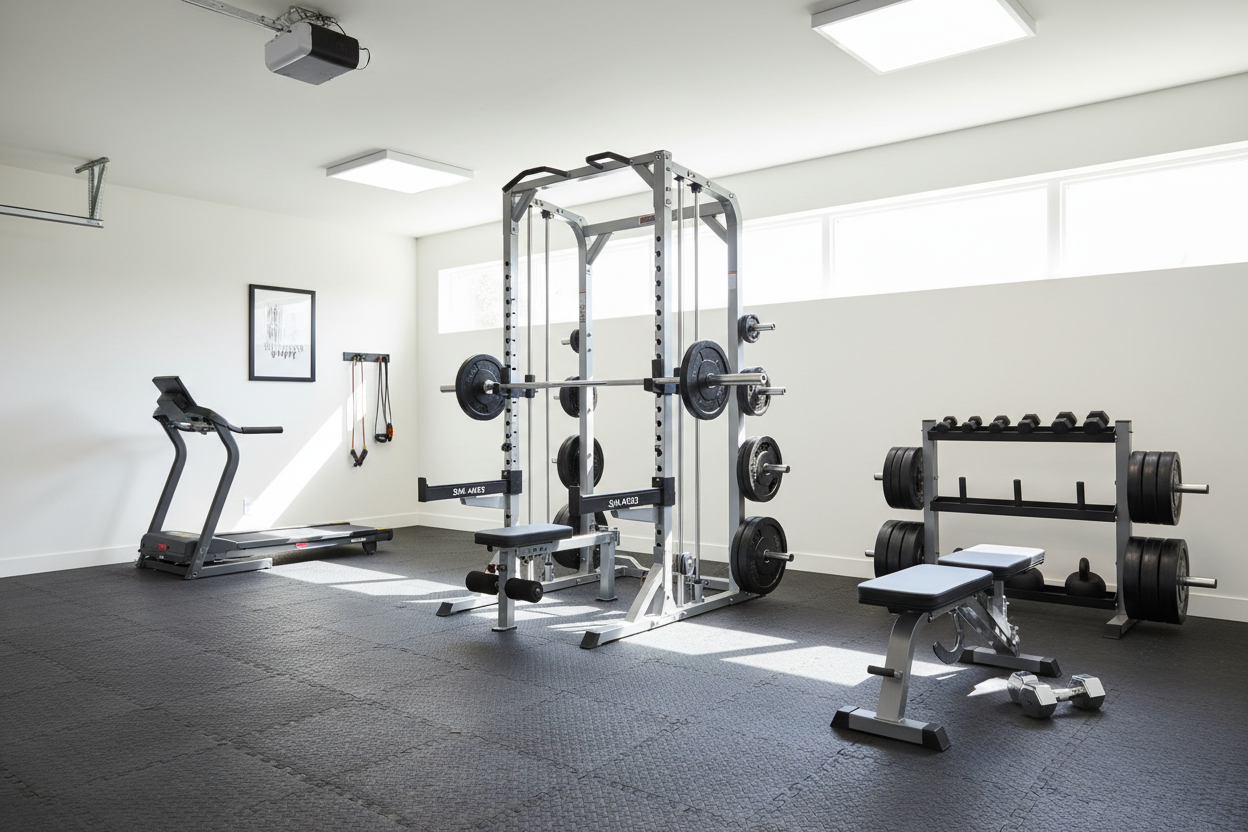
I remember staring at my local gym membership bill—$80 a month just to wait in line for a squat rack that smelled like old pennies. I spent a late night scrolling through budget options and kept coming back to the same name. My marcy smith machine review comes from a place of skepticism and a lot of sweat; I wanted to know if a rig that costs less than a decent set of tires could actually hold up to real training.
- Best for beginners and accessory-heavy hypertrophy work.
- Requires a socket wrench set for assembly; do not use the included tools.
- 14-gauge steel frame is sturdy but has a lower weight ceiling than commercial rigs.
- The Smith bar uses nylon bushings rather than linear bearings, which adds slight friction.
The Real Reason I Decided to Test This Budget Rig
The Marcy is the most popular home gym on the market for one reason: it's accessible. For the price of a few months at a boutique club, you get a cage, a bench, and a pulley system. I bought this because I wanted to see if a regular person could realistically replace a commercial gym setup without spending five figures.
It appeals to the lifter who wants to stay active without the commute. You aren't getting 11-gauge structural steel here, but for 90% of the population, 14-gauge is enough to get the job done. I went into this test expecting it to feel like a toy, but I was surprised by the footprint and the general stability once the bolts were torqued down.
Building the Beast (Grab Your Own Tools)
If you use the flat, stamped-metal wrenches included in the box, you will hate your life. Those tools are made of soft cheese and will strip your bolts before you finish the base frame. When I was building the SM-4008, I grabbed my own 17mm and 19mm sockets, which shaved at least an hour off the build time.
Expect to spend about four to five hours on assembly. The instructions are mostly diagrams with very little text, so pay close attention to the pulley orientations. If you thread the cables backward, you'll be tearing the whole top carriage apart by step 30. It’s a rite of passage for home gym owners, but one you’d rather avoid.
How the Track Feels When You Actually Load It Up
Here is the honest truth about the bar path: it is not frictionless. Higher-end machines use linear ball bearings that glide on polished rods. Marcy uses nylon bushings. At 135 pounds, you won't notice much of a difference. Once I loaded the bar to 225 pounds for squats, I felt that slight 'grab' on the ascent.
It’s not a dealbreaker, but it changes the lift. You have to be more intentional with your bar path. I found that applying a thin layer of silicone spray to the guide rods every few weeks makes a massive difference. It smooths out the 'stutter' and makes the machine feel twice as expensive as it actually is.
The Cable Attachments: Functional or Just Fluff?
The high and low pulleys are the workhorses of this machine. For face pulls, lat pulldowns, and curls, they work perfectly fine. However, the weight capacity is where you hit a wall. When I tried to max out the low row with heavy plates, I noticed the uprights flexing slightly toward me. It’s a clear sign that this isn't a multi-training station designed for elite powerlifting.
The cable drag is also noticeable on slow eccentrics. If you’re used to the buttery smooth feel of a commercial cable crossover, this will feel a bit 'crunchy.' It’s great for high-rep hypertrophy work, but don't expect it to feel like a dedicated functional trainer. It’s functional fluff—it gets the job done for 20-rep sets of cable flies, but it won't handle 200-pound single-arm rows without some complaints.
Final Verdict: Should You Buy It or Save Your Money?
If you are a beginner or someone looking to supplement their cardio with some resistance training, the Marcy is a steal. It provides a safe environment to lift alone without a spotter. However, if you're already benching 315 for reps, you’re going to outgrow this frame in a month. You should look into heavy-duty Smith machine options that use thicker steel and better bearings.
For the average garage gym, it’s a solid B+. It’s not a forever machine, but it’s a fantastic 'right now' machine. If you find yourself hitting the 300-pound limit regularly, then it’s time to start upgrading to an all-in-one that can grow with your strength. For everyone else, buy the Marcy, buy some silicone spray, and get to work.
Is the Marcy Smith Machine safe for solo lifting?
Yes, that is the main selling point. The safety catches allow you to rack the bar with a quick flick of the wrist, making it much safer than a traditional squat rack if you don't have a spotter.
What is the actual weight capacity?
Most Marcy models are rated for 300 pounds on the bar and 200 pounds on the pulleys. I’ve pushed those limits, and while the machine didn't break, it definitely started to flex and lose its smoothness.
Does it come with weights?
No, almost all Marcy Smith machines are sold as the frame and bench only. You will need to buy your own Olympic or standard weight plates separately.
Share:
How Much Does a Smith Machine Cost? The $500 vs $2,500 Breakdown
Don't Get Pinned: How to Use Smith Machine Safety Stops