
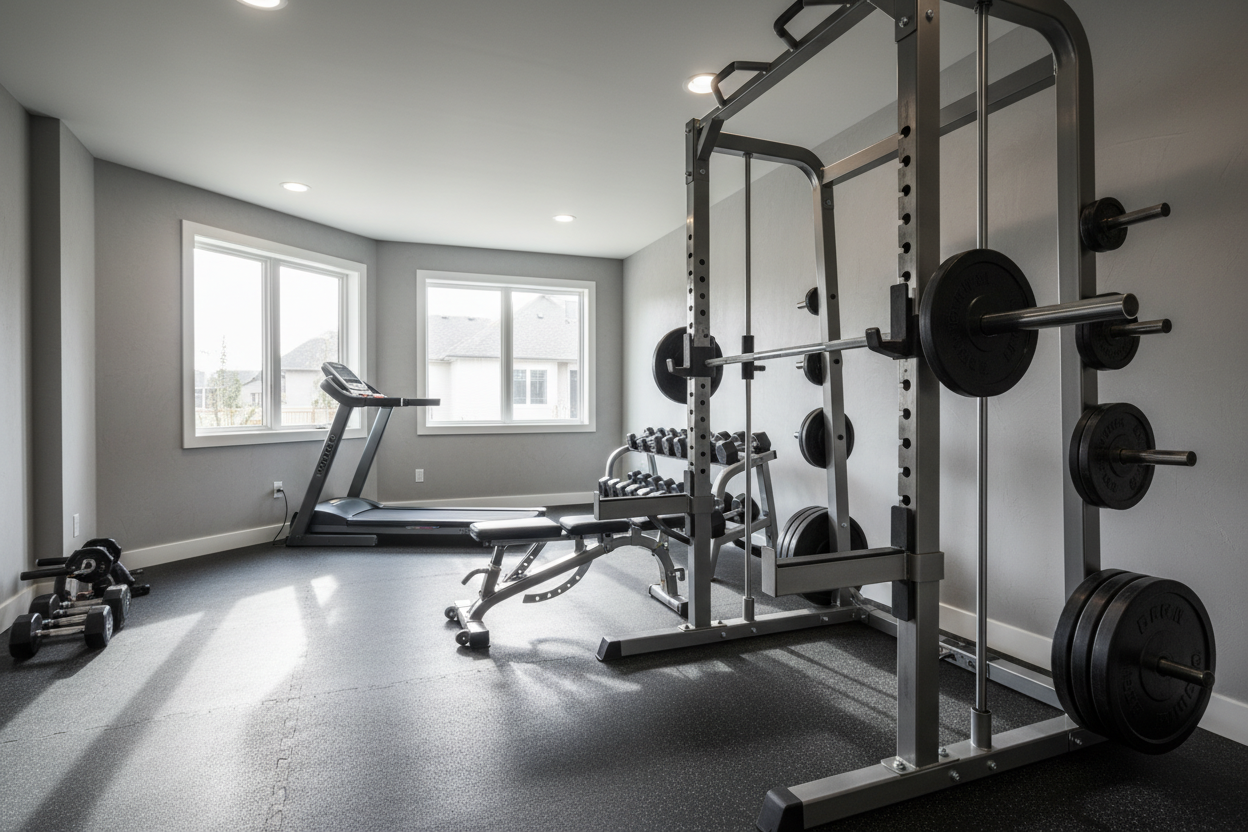
I remember the first time I almost pinned myself in my garage. It was late, I was chasing a PR on a Tuesday night, and the silence of the suburbs was the only thing watching me struggle. No spotter, no backup plan. That was the night I realized smith machine safety stops aren't just optional accessories—they are the literal line between a productive session and a very expensive 911 call.
Quick Takeaways
- Always test your safety height with an empty bar before adding plates.
- The wrist-flick lock is your primary control, but the adjustable stopper is your actual life insurance.
- Set stops 1-2 inches below your active range of motion to avoid 'clanking' during reps.
- Inspect spring-loaded pins weekly for rust or mechanical fatigue.
The Solo Lifter's Ultimate Safety Net
Lifting alone is a psychological game. When you know you have a fail-safe, you actually lift heavier because that 'fear of the pin' disappears. Most people think they know how to handle the rig, but they confuse the primary locking mechanism with the secondary safety. You need to understand how to unlock smith machine hooks properly: it is a simple wrist rotation. But if your grip slips or your wrists fatigue, that rotation won't happen. That is where the secondary stops come in.
The secondary safety is a physical block on the guide rod. It doesn't care if you're unconscious or just gassed; it stops the bar from descending past a specific point. I’ve seen guys rely solely on the hooks, only to have the bar slide right past the catch because they couldn't rotate the bar far enough while failing. Don't be that guy. Use the hardware as it was intended.
Anatomy of a Bailout: Understanding Your Hardware
Not all stoppers are created equal. On a modern smith machine, you usually see two types of safety systems: the rotating bar catches that line the frame and the heavy-duty adjustable stoppers that sit on the guide rods. The stoppers are usually thick steel collars with a spring-loaded pin or a heavy-duty bolt.
I prefer the spring-loaded versions because they’re faster to move between sets. However, you need to look for solid steel smith machine safety hooks that have a decent 'lip' on them. If the metal looks thin or the welding is sloppy, it’s a hard pass from me. A smith machine stopper needs to be able to handle a dynamic drop, not just a static load. If you drop 300 lbs from six inches up, that force is significantly higher than the weight itself. You want hardware that looks like it belongs on a bridge, not a toy.
How to Adjust Smith Machine Heights for the Big Lifts
The biggest mistake I see is people loading the bar first. Stop doing that. You need to learn how to adjust smith machine settings while the bar is empty. Get into your lifting position, find your 'bottom'—where the muscle is fully stretched but before your form breaks—and set the stops exactly two inches below that point. This gives you a 'buffer zone' so you don't hit the steel on every rep, which ruins your momentum and kills the eccentric phase of the lift.
Squats: Protecting the Hole
When you're deep in the hole on a squat, the last thing you want is to be wondering if you can get back up. I set my stops so that if I have to bail, I only have to drop another inch or two to find the steel. Rigs like the full body multi training station are great for this because they have densely spaced track holes. This allows for micro-adjustments. If your holes are spaced 4 inches apart, you’re often stuck choosing between a safety that’s too high or one that’s too low to actually help.
Bench Press: Saving Your Sternum
Bench pressing on a Smith is notorious for 'guillotine' accidents. To prevent this, use the 'exhale rule.' Set the smith machine safety stops so the bar touches the safeties when your chest is flat (exhaled), but clears them when your chest is puffed out (inhaled). This way, if you fail, you just exhale, flatten your ribs, and the bar rests on the machine instead of your throat. It’s a simple trick that has saved my skin more than once.
The Sweet Spot: Safety vs. Range of Motion
I hear people complain that safeties limit their depth. That’s usually a sign they haven't figured out how to adjust smith machine stoppers correctly. You want the perfect millimeter of clearance. If you're doing lunges or RDLs, you need a system like the all in one smith machine with cable crossover which features low-profile stoppers. These don't get in the way of your feet or the bottom of the movement, but they’re still there if the cable or your grip gives out. Don't sacrifice your gains for safety, but don't sacrifice your teeth for an extra inch of depth either.
Red Flags: Inspecting Your Safeties Before Going Heavy
If you're buying a second hand smith machine, the safety system is the first thing you check. I once bought a used rack where the internal springs in the stoppers were so rusted they wouldn't actually lock into the holes. I didn't notice until I put 225 on the bar and the stopper slid down the rod like it was greased. Check for bent pins, cracked welds, or any 'slop' in the fit. If the stopper wobbles more than a few millimeters, it’s a liability. Lube your guide rods with silicone spray every few weeks to ensure the stoppers actually move when you need them to, rather than seizing up when you're trying to change heights between sets.
Personal Experience: The Night I Got Lazy
A few years back, I was rushing a workout and didn't bother to move the stoppers from my squat height down to my bench height. I figured, 'I'm only doing 185, I won't fail.' On the third set, a sudden cramp in my shoulder made me lose my grip. The bar didn't fall far, but because the stoppers were way too low, I had to do a weird, panicked roll-of-shame to get out from under it. I ended up bruising my ribs and feeling like an idiot. Now, I don't care if I'm just warming up with the bar—the stoppers move every single time the exercise changes. It takes ten seconds. Just do it.
FAQ
How do I know if my safety stops are rated for heavy weight?
Check the manual for 'dynamic load' ratings. Most home units are rated for 300-500 lbs, but heavy-duty commercial units can handle 1,000 lbs+. If there is no rating, look at the pin diameter; you want at least a 1/2 inch solid steel pin.
Can I use the safety stops as a starting point for rack pulls?
Yes, but be careful. Repeatedly slamming a heavy bar onto the stoppers can fatigue the metal or bend the guide rods over time. If you're doing heavy rack pulls, use a dedicated power rack with flip-down safeties instead.
Why won't my smith machine stoppers slide smoothly?
It's usually a build-up of old grease and dust. Clean the guide rods with a degreaser, then apply a thin coat of dry silicone lubricant. Never use WD-40; it attracts gunk and makes the problem worse.
Share:
Can a Budget Rig Survive Heavy Lifting? My Marcy Smith Machine Review
Why Commercial Benches for Gym Chains Ruin You for Home Workouts