
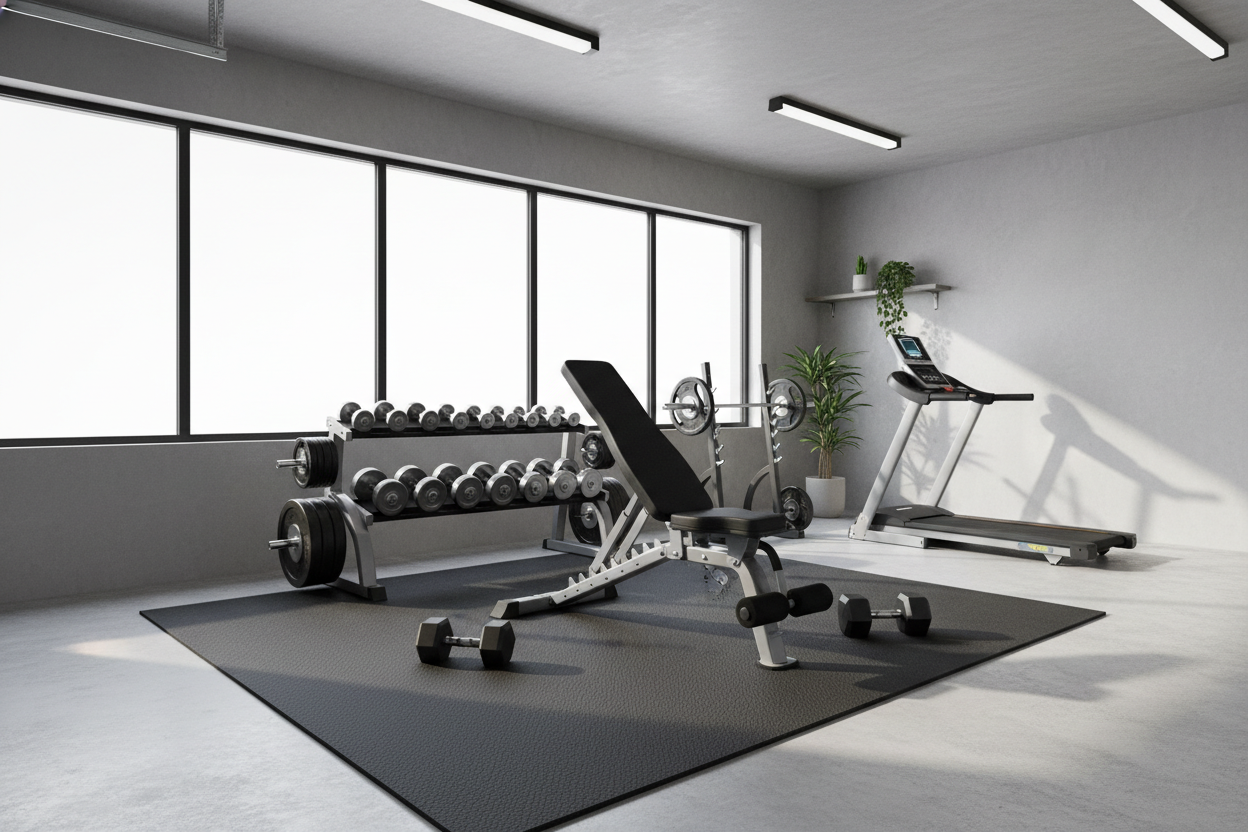
I remember the day I tried to squeeze a full-sized power rack into my 10x12 spare bedroom. I had about six inches of clearance to load plates on the left side, which meant I was basically doing a tactical crawl every time I wanted to change weight. It was miserable. I spent more time maneuvering around steel uprights than I did actually lifting. That is when I started looking for a smarter bench for workout sessions that didn't require me to sacrifice every square inch of floor space.
- Space Efficiency: Saves roughly 40% more floor space compared to a standalone rack and bench.
- Solo Safety: Integrated lever arms act as built-in spotters for heavy pressing.
- Versatility: Replaces the need for separate leg extension and preacher curl machines.
- Build Quality: Look for 14-gauge steel and a tripod or wide-base design for stability.
Why I Started Looking Past the Standard Power Rack
Let’s be real: we all want the massive power cage we see in professional gyms. But unless you have a three-car garage or a dedicated basement, that cage is a space hog. The traditional approach to barbell bench press equipment usually involves a rack that’s four feet wide and four feet deep, plus the six feet of clearance you need for the bar. By the time you add a bench, you’ve eaten up half a room. For those of us training in tight quarters, it’s just not practical.
I shifted my focus toward an integrated bench weight gym setup because I needed functionality without the footprint. When you are looking for a bench to workout, you realize that most 'standard' setups leave huge gaps in your training. You can press and squat, sure, but what about isolated leg work or focused arm volume? A power rack is a skeleton; you have to buy a dozen attachments to make it a complete gym. A high-quality gym weight lifting bench with integrated features fills those gaps from day one.
The biggest hurdle for me was the mental shift. I grew up believing that if it wasn’t a free-standing barbell, it wasn't 'real' lifting. But after a few months of hitting my shins on rack pins in my cramped room, the appeal of a streamlined bench for exercise became undeniable. You start to value the flow of your workout more than the aesthetic of a massive cage. If you can't move around your equipment, you're going to stop using it. That is the cold, hard truth of home gym ownership.
Anatomy of a True All-in-One Lifting Station
Don't confuse a heavy-duty station with the flimsy, $99 department store bench for exercise you see in holiday circulars. Those things have the structural integrity of a lawn chair. A real gym bench press equipment setup needs to be built with thick-walled steel tubing—usually 2x2 or 3x3 inches. I look for units that use high-density foam padding that doesn't bottom out when you're holding a pair of 80-pound dumbbells. If the vinyl feels like a plastic grocery bag, walk away.
Modern gym bench press stations have evolved. We are seeing modular designs where the bench isn't just a flat surface, but a hub. While a resistance weight bench setup is a decent option for high-rep toning or travel, it usually lacks the raw loading potential needed for serious hypertrophy. A plate-loaded combo unit, however, allows you to stack real iron. This is where the 'all-in-one' label actually starts to mean something.
When you buy fitness bench setups, you’re looking for a marriage of a bench press workout equipment and a functional trainer. The best units feature adjustable backrests that go from a true decline to a 90-degree incline. This allows you to hit every angle of the chest and shoulders without moving to a different station. I’ve found that the hinge points on these benches are the first thing to fail, so I always check for oversized bolts and reinforced plating at the adjustment joints. If it rattles when it’s empty, it’s going to scream when it’s loaded.
Independent Press Arms: A Solo Lifter's Best Friend
If you train alone like I do, the fear of getting pinned under a heavy bar is real. I’ve done the 'roll of shame' more times than I care to admit. This is where independent lever arms change the game for benches for lifting. Instead of a free-floating barbell, you’re using arms that follow a fixed, yet natural, arc. It gives you the feel of a chest press machine but with the stabilization requirements of a bench press.
I’ve been using a weight bench chest press machine for my heavy volume days, and the safety benefit is massive. You can push to absolute failure without a spotter because you can simply let the arms down into their starting notches. You don't have to worry about a lopsided bar or a failed lockout. Plus, independent arms mean you can do unilateral work—pressing one arm at a time—to fix those strength imbalances we all have.
From a biomechanical standpoint, these arms often feel better on the shoulders than a straight bar. A barbell forces your wrists and elbows into a fixed path. Lever arms on high-end gym bench press equipment allow for a slight convergence, which mimics the natural way your muscles contract. It’s the difference between fighting the equipment and working with it. For anyone over 30 with 'cranky' shoulders, this is a massive win.
Leg Extensions and Preacher Attachments That Don't Suck
Most 'all-in-one' benches fail at the leg developer. They usually have these tiny foam rollers that dig into your shins and a pivot point that makes the movement feel jerky. When I'm looking at a workout benches with weights, I check the length of the lever arm for the leg extension. If it's too short, the weight feels heavier at the bottom and falls off at the top. You want a consistent tension throughout the whole rep.
If you want to hit your quads and biceps without buying two separate machines, a weight bench with barbell rack that includes a dedicated preacher pad and leg station is the move. I’ve tested the Z3, and the key is the stability of the attachment post. If there’s too much play in the sleeve, the preacher curl pad will wobble every time you reach for the bar. A quality unit will have a tightening knob to lock that attachment in place, giving you a rock-solid platform for curls.
Don't overlook the pad density on the leg rollers either. Cheap ones use open-cell foam that compresses to nothing after three weeks. You want closed-cell foam that keeps its shape. This is what separates a professional gym weight lifting bench from a piece of junk. If you're going to spend 45 minutes on leg day, you don't want to leave the gym with bruises on your ankles from a poorly designed roller.
The Real-World Stability Test: Can It Handle Heavy Iron?
Let's talk about the 'wobble factor.' Nothing kills a workout faster than feeling the bench tilt when you’re mid-press. When you buy a workout bench, you need to look at the footprint. A tripod design (three points of contact) is surprisingly stable on uneven garage floors, but a wide H-frame at the rear is better for heavy loading. I usually look for a weight capacity of at least 600 pounds. Remember, that's not just the weights—that's the weights plus your body.
One thing people always get wrong is the 'lever math.' Pushing 100 pounds on a lever arm isn't the same as pushing a 100-pound barbell. Friction and the pivot point location change the resistance profile. I recommend checking out this guide on matrix bench press bar weight to understand how machine weights differ from free weights. It helped me realize why my 'max' on a lever system felt different than my max on a rack.
In my experience, the stability of these combo units depends entirely on the floor they sit on. If you're on thick carpet, you're going to have a bad time. I always recommend placing your bench on at least 3/4-inch rubber stall mats. It prevents the frame from sliding and absorbs the vibration when you're re-racking the press arms. If the bench stays still, your focus stays on the muscle. If the bench moves, your focus goes to not falling over.
My Verdict: Who Should Actually Buy These Combo Units?
So, can an all-in-one station replace a power cage? If you are a competitive powerlifter looking to squat 600 pounds, probably not. You need the safety of a full cage. But for 90% of home lifters—the ones trying to build muscle, stay fit, and save space—a high-quality combo bench is actually the better choice. It offers more variety in a smaller footprint and provides a safer environment for solo training.
When you are ready to buy a workout bench, don't just look at the price tag. Look at the steel gauge, the attachment options, and the footprint dimensions. I made the mistake of buying for price once and ended up with a bench that felt like it was made of soda cans. It sat in my garage for two months before I sold it for half what I paid. Buy once, cry once. Get a unit that grows with you as you add more plates to your collection.
If you're tight on space but don't want to compromise on your leg or arm days, these all-in-one units are the solution. They turn a corner of your bedroom into a legitimate strength center. Just make sure you measure your space—and your ceiling height—before you pull the trigger. You don't want to find out your overhead press hits the ceiling fan after you've already bolted the thing together.
FAQ
Is an all-in-one bench stable enough for heavy lifting?
Yes, provided you choose one with a high-gauge steel frame (14-gauge or better) and a wide base. Most quality combo units are rated for 600-1,000 lbs, which is more than enough for the vast majority of home lifters.
Can I use a standard Olympic bar with these benches?
Many all-in-one benches are designed with their own lever arms or specific widths. Always check the upright width; some require a 7-foot Olympic bar, while others are 'mid-width' and work better with 6-foot bars or have integrated arms that don't require a bar at all.
How much space do I really need?
For most combo benches, you should plan for an 8x8 foot area. This gives you enough room to load plates on the sides and move around the bench for leg extensions or preacher curls without hitting the walls.
Share:
I Missed the Weight Machines at the Gym (So I Built My Own)
Ignore Half the List of Leg Machines at the Gym (Do This Instead)