
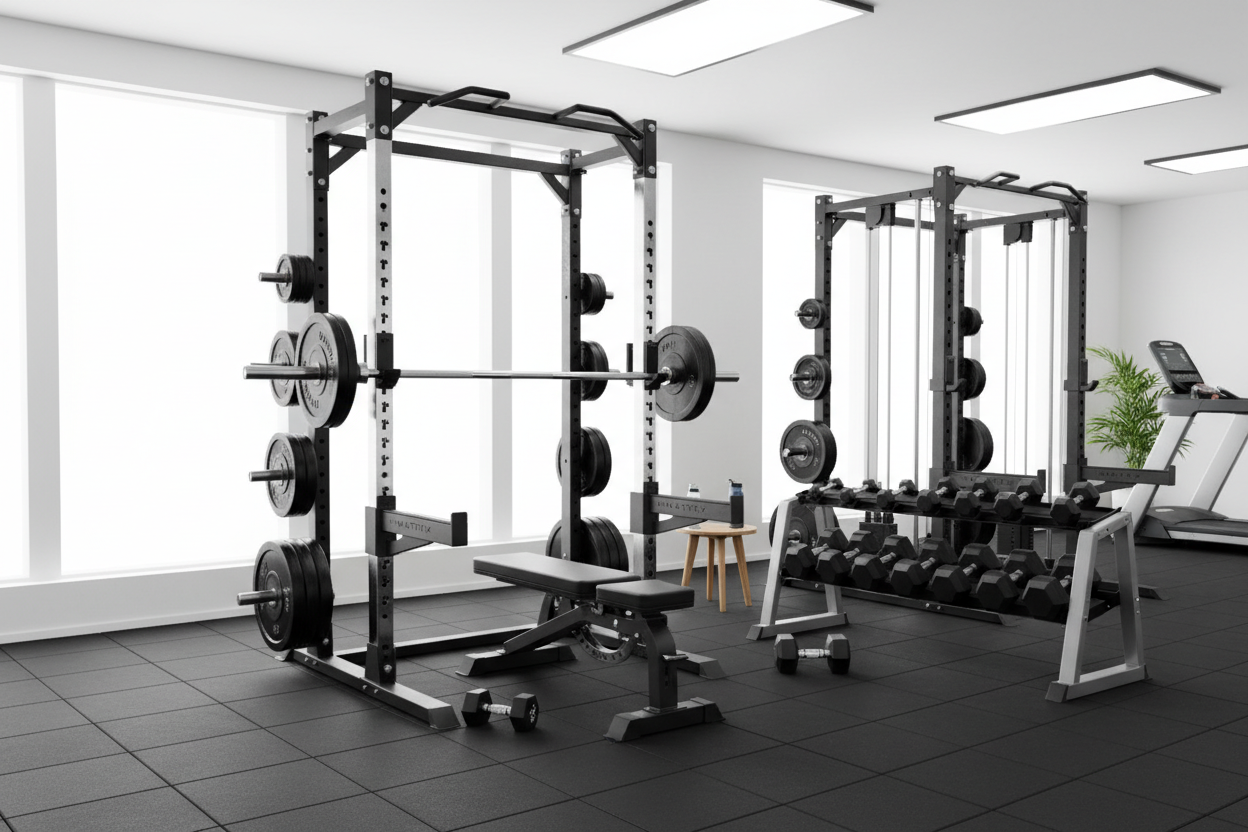
I have spent a decade in commercial dungeons, and nothing kills the vibe of a heavy chest day faster than a math debate. You’re at a high-end club, you’ve loaded three plates on each side of the Matrix rig, and you’re feeling like a beast. Then your training partner asks the dreaded question: Is that bar 45 pounds, or is it one of those light ones?
Getting the matrix bench press bar weight wrong might not seem like a big deal, but if you’re tracking your progressive overload, a 20-pound discrepancy is the difference between a PR and a plateau. Most people default to the standard 45-pound Olympic bar logic, but Matrix plays by different rules, especially when it comes to their Smith machines and plate-loaded lines.
Quick Takeaways
- Standard Matrix Smith Machine bars usually have a starting resistance of 25 lbs (11.3 kg).
- Matrix Breaker Benches (free weight) use standard 45 lb Olympic bars.
- The Matrix Magnum Smith Machine uses a counterbalance system that significantly reduces the bar's effective weight.
- Always look for the small decal on the machine frame; Matrix usually lists the starting weight there.
The Most Annoying Math Problem in the Gym
You’ve just finished a grueling set of eight. You’re sweating, your chest is on fire, and you go to open your tracking app. You count the plates: 135 plus 135 plus... what? If you’re using a Matrix Smith machine, you can’t just add 45 and call it a day. I’ve seen guys get into heated arguments over this while resting between sets.
The problem is that Matrix builds equipment for commercial durability and user accessibility. A standard Olympic bar is heavy and intimidating for beginners. By using counterweights and lighter alloys in their guided machines, Matrix makes the entry point easier, but they also make the math a headache for the rest of us. If you’re logging 225 lbs but the bar only weighs 25, you’re lying to your logbook by 20 pounds.
So, What Is the Actual Matrix Bench Press Bar Weight?
For the vast majority of Matrix Smith machines you’ll find in a commercial gym, the starting resistance is 25 lbs (11.3 kg). This is the industry standard for their high-end lines. It’s not a 45-pound bar, and it’s definitely not a 15-pound aluminum bar like you might find in a budget home gym setup. It’s a solid steel bar that has been physically lightened through mechanical assistance.
Why do people get this wrong? Because it looks like a standard bar. It has the same diameter and the same knurling, so your brain expects that 45-pound thud. But because the bar is attached to a carriage system with bearings, the friction is minimized, and the physical weight is offset. If you are using a Matrix Breaker Bench (the one where the bar isn't attached to a track), you’re back to a standard 45-pound bar. Know which one you’re on before you start counting.
Inside the Matrix Magnum Smith Machine Counterbalance
The Matrix Magnum series is a beast of a machine, but it’s a bit of a magician. Behind those sleek shrouds are cables and counterweights designed to make the bar travel as smoothly as possible. This system is what brings that starting resistance down to 25 lbs. It’s a similar engineering philosophy to the freemotion smith machine bar weight, where the goal is to eliminate the 'clunky' feel of raw steel.
The counterbalance doesn't just make the bar lighter; it makes the movement consistent. On a cheap Smith machine, the bar might feel heavier at the bottom than the top due to friction. Matrix uses a high-quality linear bearing system that keeps that 25-pound resistance uniform throughout the entire range of motion. It’s great for hypertrophy, but it’s exactly why your 'Matrix Max' won't translate to a raw barbell.
Does This Track Mean Your Lift Is Fake?
Let’s address the ego in the room. If you’re benching on a guided track, you aren't using your stabilizer muscles. Your rotator cuffs are basically taking a nap while your pecs and triceps do the work. Because the path is fixed, you don’t have to worry about the bar drifting over your face or down to your stomach. This lack of stabilization, combined with the lighter bar weight, usually means you can move about 10-15% more weight on a Matrix machine than on a rack.
Is it a fake lift? No, weight is weight. But it is a different stimulus. If your goal is pure muscle growth, the Smith machine is actually superior in some ways because it allows you to push to absolute failure without dying under a bar. However, if you want to know how you’d perform in a powerlifting meet, you need to understand the smith machine bench press vs barbell bench press nuances. One is a tool for isolation; the other is a test of total body tension.
Should You Ditch the Track for Free Weights?
I’m a big fan of using the Matrix Smith for high-volume accessory work. After I’ve done my heavy work in a power rack, I’ll move over to the Magnum to burn out my chest with incline presses. The fixed path lets me focus entirely on the squeeze. But if you’re trying to build foundational strength, you eventually need to drag a traditional weight bench over to a squat rack and grab a real 45-pound bar.
The Matrix machines are fantastic for what they are: smooth, safe, and reliable. But don't let the counterbalance fool you into thinking you're stronger than you are. Use the machine for the pump, use the rack for the power, and for heaven's sake, stop counting that bar as a 45. Your logbook deserves the truth.
Personal Experience: The 315 Lie
A few years ago, I was training at a gym that only had Matrix Smith machines for pressing. I spent three months 'building' my bench press until I was comfortably repping three plates. I felt like a monster. Then, I traveled to a gym with a standard power rack and an old-school Texas Power Bar. I loaded up 315, and it felt like a house falling on my chest. I couldn't even get one rep. That was the day I learned the hard way that a 25-pound counterbalanced bar and a lack of stabilizers creates a very different reality than raw lifting. I felt like a fraud, but it taught me to respect the specs of the machine I'm using.
FAQ
How can I be 100% sure of the bar weight?
Look at the very bottom of the machine’s frame, near the floor. Most Matrix units have a small sticker that says 'Starting Resistance: 11.3 kg / 25 lbs.' If it’s been peeled off, assume it’s 25 lbs, as that is the standard for the Magnum line.
Does the 7-degree slant on Matrix Smith machines change the weight?
The angle doesn't change the physical weight of the bar, but it changes the force curve. Because you are pushing at a slight incline or decline depending on which way you face, it can feel slightly 'lighter' or 'heavier' due to the mechanical advantage of your joints.
Why doesn't Matrix just use a 45-pound bar?
Commercial gyms want equipment that everyone can use. A 45-pound bar is too heavy for some rehab patients or absolute beginners. By counterbalancing it to 25 lbs, Matrix makes the machine accessible to a wider range of members while still allowing meatheads to stack plenty of plates on the sleeves.
Share:
Is a Hack Squat on Leg Press Machine Rigs Actually Any Good?
I Pushed a Cheap Exercise Machine Until It Broke (Here's Why)