
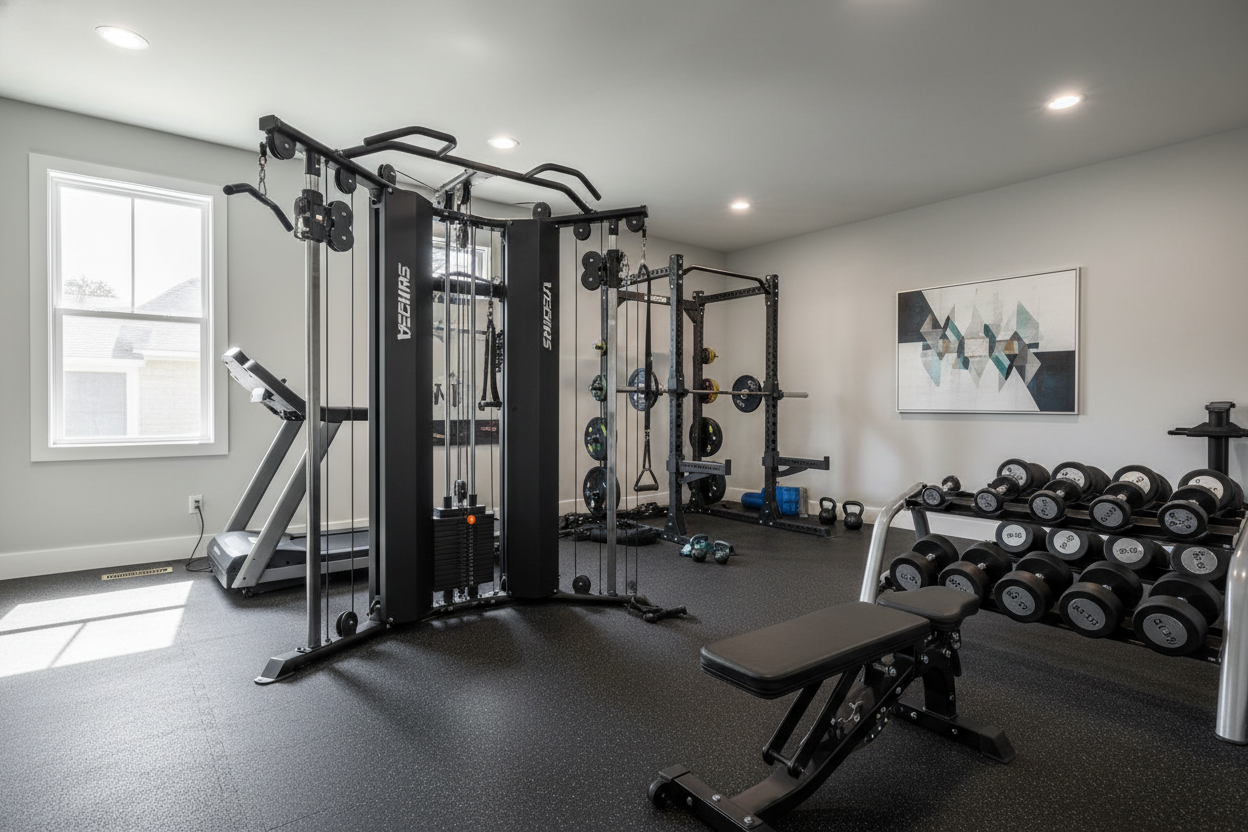
I remember the day I realized my garage gym was officially out of floor space. I was staring at a pile of bumper plates, a standalone lat pulldown I barely used, and a squat rack that took up half the room. I wanted the variety of a commercial gym, but I only had 144 square feet to work with. That frustration is usually what leads people to consider an all in one trainer machine.
Quick Takeaways
- Space Efficiency: You can consolidate a rack, functional trainer, and Smith machine into roughly a 6x5 foot area.
- Safety: Integrated Smith bars and adjustable spotter arms make solo heavy lifting much less sketchy.
- Cable Versatility: Most units offer dual 200lb or 300lb stacks, which are essential for hypertrophy work that a barbell can't touch.
- The Catch: You lose the 'infinite' expansion of a standard 3x3 power rack and often deal with a 2:1 pulley ratio.
The Barbell Purist's Dilemma
If you have spent any time in a serious black-iron gym, you probably have a healthy skepticism for multi-function gear. We are taught that a 'Swiss Army Knife' usually does ten things poorly instead of one thing well. The fear is real: you worry the uprights will wobble during a heavy re-rack, or the cables will feel like they are grinding through sand. I felt the same way before I made the swap.
For most of us, the power rack is the altar. It is where the heavy work happens. Giving that up for a machine feels like a betrayal of the basic compound lifts. However, the modern reality of home gym engineering has caught up. We are no longer looking at the flimsy plastic-and-bolt rigs from the 90s. We are talking about heavy-gauge steel that can actually handle a 500-lb squat without breaking a sweat.
The hesitation usually boils down to the 'feel' of the lift. A dedicated rack gives you total freedom. A combo machine forces you to work within its footprint. But as I found out, that footprint is often more capable than I gave it credit for. If you can't fit a dedicated cable crossover and a rack, you have to decide if you want to be a specialist or a well-rounded athlete.
What You Actually Get With a Multi-Station Rig
Let's strip away the marketing fluff. A high-quality all-in-one is essentially a three-headed beast. First, you have the front uprights. These function like a standard half-rack. You get J-cups and spotter arms for your traditional squats and presses. If the steel is 11-gauge or 14-gauge, it is going to feel plenty stable for 99% of home lifters.
Second, you have the guided barbell system. This isn't just a standard Smith machine tucked into the back. Most modern designs integrate the Smith bar so it stays out of the way when you are using free weights but is ready for high-volume calf raises or shoulder presses when you need that fixed path. It is about adding layers to your training, not replacing the barbell entirely.
Finally, there is the functional trainer component. This is the part that usually justifies the price tag. You get dual height-adjustable pulleys connected to weight stacks. This allows for everything from cable crossovers to face pulls and lat pulldowns. Instead of a single-purpose cable tower, you get a system that mirrors your body's natural range of motion.
Where the Combo Setup Actually Shines
The biggest win is the mental load of your workout. When I was training in a cramped space with separate pieces of gear, my workouts felt disjointed. I spent half my time moving benches and clearing floor space. When I replaced 5 pieces of gear with one central hub, my training flow improved overnight. You can go from a heavy set of back squats to cable flyes in about ten seconds.
Think about the sheer amount of equipment you are eliminating. You no longer need a standalone lat pulldown, a low row station, a pull-up bar, or a dedicated Smith machine. This opens up room for other things—like a cardio piece or just more space to breathe. For a garage gym owner, square footage is the most valuable currency you have.
There is also the safety factor. If you lift alone at 5:00 AM like I do, having a built-in Smith machine for those high-rep burnout sets is a lifesaver. You can push to failure on a bench press without the nagging fear of getting pinned under a bar. It gives you the confidence to train harder when there is no one around to spot you.
The Compromises Nobody Talks About
I am not going to sit here and tell you it is all perfect. There are real trade-offs. The first is the pulley ratio. Most of these machines use a 2:1 ratio, meaning 100 lbs on the stack feels like 50 lbs in your hand. This is great for functional movements and high-speed work, but if you are a beast who needs 200 lbs of actual resistance for heavy rows, you might max out the stacks sooner than you think.
Then there is the working depth. A full power cage gives you a lot of 'room to roam' inside the steel. A multi-station rig is often more compact. If you have a massive wingspan or a very wide squat stance, you might feel a bit more boxed in. You have to be more precise with your bar path and your foot placement.
Finally, check your ceiling. These rigs are tall. Most sit between 82 and 86 inches. If you are building this in a basement with low-hanging ductwork, you are going to have a bad time. I once spent four hours assembling a unit only to realize I couldn't use the pull-up bar because my head would hit a joist. Measure twice, buy once.
The Final Verdict: Who Should Make the Swap?
If you are a competitive powerlifter whose entire life revolves around the 'Big Three' and nothing else, stick with a heavy-duty 4-post rack. You want the attachment ecosystem and the tank-like stability of a dedicated cage. You probably don't care about cable crossovers anyway.
However, for the bodybuilder, the general strength enthusiast, or the person who just wants to look good and feel strong, the swap is a no-brainer. The All In One Smith Machine With Cable Crossover S1 V4 is a prime example of a unit that handles heavy free weights while giving you the cable variety that builds real muscle. It bridges the gap between 'hardcore' and 'functional' perfectly.
The bottom line? If you are tired of a cluttered garage and want a gym that actually flows, the all-in-one is the way to go. You aren't losing your barbell roots; you are just giving them a better support system.
FAQ
Is an all-in-one machine as stable as a squat rack?
If you buy a unit with a heavy base and quality steel (at least 14-gauge), yes. It won't move during squats. However, very cheap units under 300 lbs total weight can feel a bit 'walky' during pull-ups or heavy re-racks.
Can I use my own Olympic plates?
Yes, almost all of these machines use standard 2-inch Olympic sleeves for the Smith bar and any plate-loaded cable options. Just make sure you have enough clearance on the sides to actually load the plates.
How long does assembly take?
Be honest with yourself: it's a project. Expect to spend 4 to 6 hours if you are handy, and definitely grab a buddy. There are a lot of cables to route and pulleys to align, and doing it alone is a recipe for a headache.
Share:
The Only 6 Exercises on a Smith Machine Worth Your Time
Trying to Buy Used Gear Forced Me to Learn Workout Machines Names