
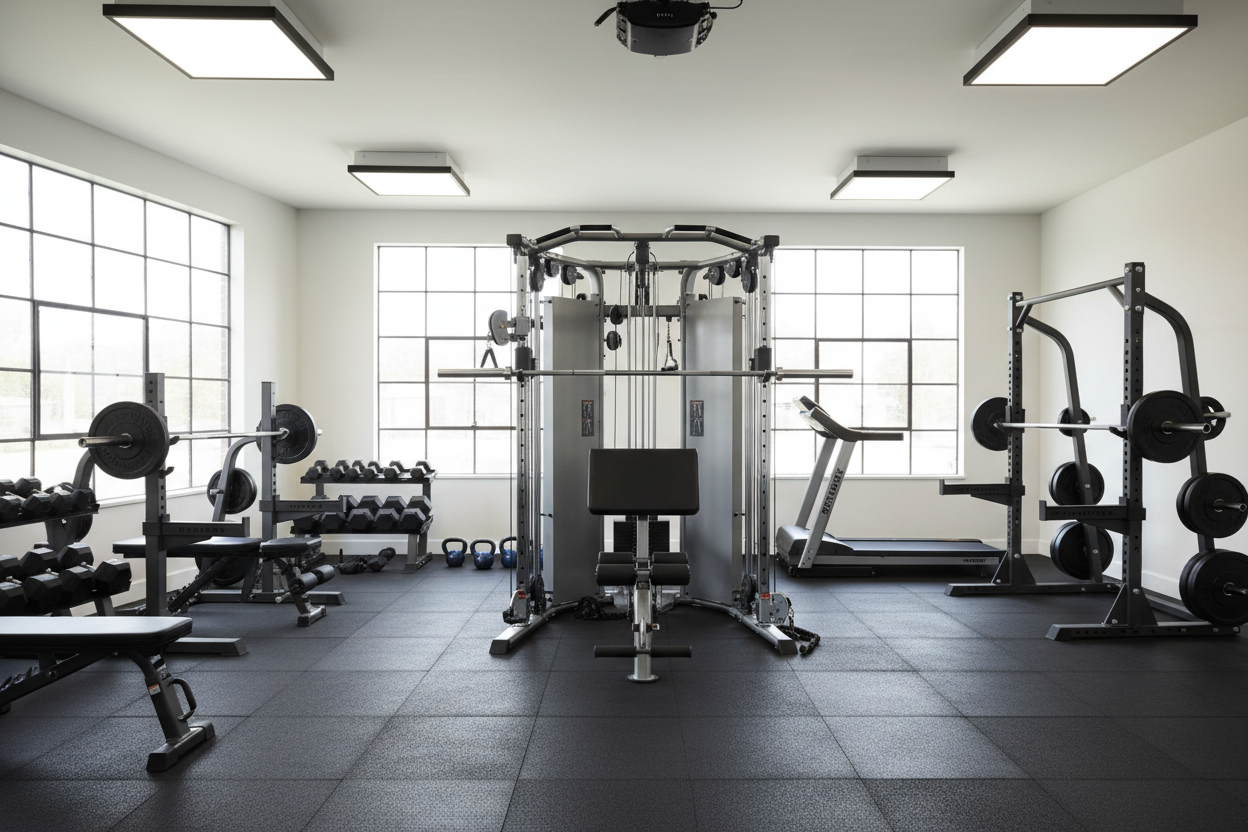
I remember the morning I finally snapped. I was trying to navigate a set of heavy dumbbell rows and ended up kicking a rogue 25lb plate directly into my shin because my 'gym' had become a metal scrapyard. My garage wasn't a place to train; it was a Tetris puzzle of mismatched racks and dusty cable towers. That is when I decided to sell the clutter and invest in a all in one smith machine to actually reclaim my floor space.
Quick Takeaways
- Reclaims roughly 30-50 square feet of floor space by consolidating gear.
- The integrated Smith bar acts as a built-in spotter for solo heavy lifting.
- Modern units use 11-gauge steel, making them just as stable as standalone power racks.
- Ideal for hypertrophy and general fitness, though elite powerlifters may still prefer a dedicated squat rack.
The Cluttered Garage Problem (And Why I Snapped)
Floor space is the only currency that matters in a home gym. I spent years collecting 'deals'—a standalone squat stand here, a DIY pulley system there, and a Facebook Marketplace bench that wobbled if you breathed on it too hard. Before I knew it, my two-car garage couldn't even fit a bicycle, let alone a sedan.
The clutter wasn't just an eyesore; it was a motivation killer. Tripping over kettlebells to get to your pull-up bar makes you want to skip the workout entirely. I realized that having five separate pieces of 'okay' gear was significantly worse than having one high-quality, centralized hub. I needed a solution that didn't require me to park on the street in the winter.
What Exactly Makes a Rig 'All-In-One'?
There is a lot of noise in the equipment market, but a true all in one home gym smith machine isn't just a guided bar on a track. It is a functional hybrid. We are talking about a unit that mashes a professional power rack, a dual-pulley functional trainer, a Smith machine, and a chin-up station into a single footprint.
When you transition to a complete home gym station setup, you are looking for synergy. The best models allow you to use the front uprights for free-weight barbell work while keeping the Smith bar tucked away for accessory movements. It should feel like a commercial gym condensed into a 4x6 foot rectangle.
The 'Jack of All Trades' Myth Tested
The biggest fear I had was that by trying to do everything, the machine would do everything poorly. I have spent years testing multiple rigs to find the best builds, and I can tell you the 'Jack of all trades' stigma is fading. High-end residential units now use 2x3 or 3x3 inch steel tubing that doesn't budge when you rack 315 lbs.
The durability comes down to the bearings and the gauge of the steel. If you buy a unit that weighs 400+ lbs, it is going to feel planted. The cheap, lightweight stuff you find at big-box retailers is what gave this category a bad name. If you go for a heavy-duty frame, you aren't sacrificing stability for versatility.
Squatting and Pressing on a Guided Bar
The Smith component is a masterpiece for hypertrophy. Because the bar path is fixed, you don't have to waste energy on stabilization. This is a massive win when you are training to failure without a human spotter. I have pushed my incline presses and hack squats further than I ever could on a free rack because the safety catches are always an inch away.
Some purists hate the fixed path, but justifying the floor space in your garage becomes easy when you realize you no longer need a bulky cage with 4-foot safety arms sticking out. The linear bearings on a quality unit feel like glass—no stuttering, just smooth vertical travel.
The Dual Pulley System Experience
A functional trainer is usually the most expensive 'extra' in a gym. Having it integrated into the Smith frame is what actually saves the most money. I look for a 2:1 pulley ratio, which gives you more cable travel for movements like flyes and crossovers. The smoothness of a cable crossover system is non-negotiable; if it hitches or catches, your mind-muscle connection is gone.
I use the pulleys for everything from face pulls to heavy lat pulldowns. Most of these units come with 200lb+ weight stacks or plate-loaded carriages. As long as the guide rods are kept lubed with a bit of silicone spray, they perform exactly like the Life Fitness machines at the local club.
Did I Actually Save Any Real Floor Space?
Let's do the hard math. A standard power rack needs about 16 square feet. A functional trainer needs another 12. A Smith machine usually takes up 20. Throw in a plate tree and a chin-up station, and you have eaten half a garage. A full body multi training station setup occupies roughly 25 to 30 square feet total.
By consolidating, I cleared enough room to actually lay down a yoga mat and do some mobility work without hitting my head on a barbell. I also stopped losing my 10mm wrench because all my attachments now live on the integrated storage pegs on the back of the unit. It is organized chaos instead of just... chaos.
The Final Verdict: Who Should Buy One?
If you are a competitive powerlifter trying to break a world record squat, you probably want a monolithic, bolted-down competition rack. But for the rest of us—the garage bodybuilders, the busy parents, and the solo lifters—the all-in-one unit is the smartest play. It gives you the variety of a commercial gym with the footprint of a closet. I haven't looked back once, and my shins are finally bruise-free.
FAQ
Is it hard to assemble an all-in-one machine?
It is a project. Expect to spend 4 to 6 hours on it. You will need a socket set and potentially a second person to help hold the uprights while you bolt the crossmembers. Do not rely on the tiny wrenches they include in the box.
Can I do heavy squats with the Smith bar?
Absolutely. Most Smith bars are rated for at least 500 lbs. Just ensure your feet are positioned slightly forward of the bar to maintain proper biomechanics, as the vertical path is different than a natural free-weight squat.
What kind of maintenance do these machines need?
Very little. Wipe down the guide rods every few months and apply a dry silicone lubricant. Check the cable tension annually to make sure nothing has stretched or frayed. If you keep the dust off the bearings, it will last a decade.
Share:
I Switched Racks: Is Smith Machine Easier Than Free Weights?
I Ditched 6-Day Workout Splits for 4 Basic Barbell Exercises