
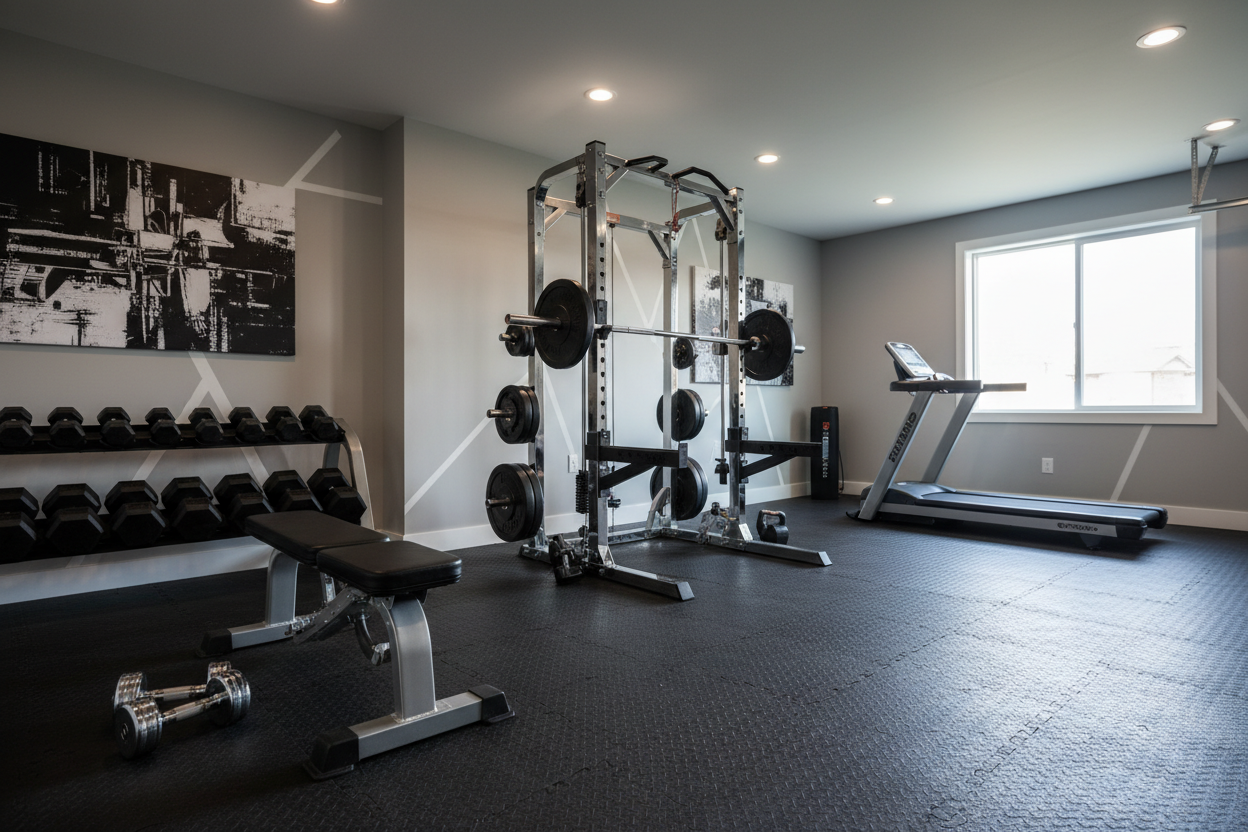
Last month, I found myself stuck in a hotel gym in the middle of nowhere. My home gym—a 3x3 steel beast with a knurled barbell that could sand a floor— was 500 miles away. All I had was a commercial rig with a fixed track and a cable crossover. I spent 30 days asking myself: is smith machine easier than free weights? I went in expecting a deload month, but I came out with a different perspective.
Quick Takeaways
- Stabilization: The machine handles the balance, letting your prime movers push more weight.
- Bar Path: Fixed tracks can be unforgiving on joints if your setup is slightly off.
- Starting Weight: Most Smith bars weigh 15-25 lbs, not the standard 45 lbs of a barbell.
- Safety: Built-in safety catches make training to absolute failure possible without a spotter.
My Forced Hiatus from the Barbell
I’ve spent the last decade being a barbell purist. If it wasn’t a free-standing rack and a piece of iron, I didn't think it counted. But when you're traveling and the only option is a Smith machine, you either adapt or you lose your gains. I decided to treat it like a month-long experiment. I loaded the carriage, clicked the safety hooks, and got to work.
The first thing I noticed wasn't the weight; it was the mental shift. I didn't have to worry about the bar drifting over my face during a bench press or tipping forward on a squat. That lack of 'fear' changed how I approached my sets. I wasn't just lifting; I was targeting.
The Core Debate: Is Smith Machine Easier Than Free Weights?
The short answer is yes, but not for the reason most people think. It’s not that the gravity is different; it’s the removal of the stabilization requirement. When you squat with a barbell, your core, glute medius, and a dozen tiny stabilizers are screaming to keep you from falling over. On a fixed track, that energy is redirected.
Because the machine balances the load for you, your prime movers—the quads in a squat or the pecs in a press—can theoretically push more weight to failure without stabilizer fatigue. Free Weight Snobs Are Missing Out On These Smith Machine Squat Benefits because they ignore this hypertrophy hack. If you want to absolutely annihilate a specific muscle group without your lower back giving out first, the machine is objectively 'easier' to manage at high intensities.
Why Is a Smith Machine Harder Than Free Weight Sometimes?
Here is the twist: there are times when a smith machine harder than free weight movements. This usually happens because of the forced bar path. A natural bench press or overhead press follows a slight arc. A Smith machine is a straight line (or a fixed angle). If you don't line your body up perfectly, you end up fighting the machine's friction and your own joint mechanics.
I found this out the hard way on incline press. I was half an inch too far forward, and my shoulders felt like they were being put through a meat grinder. Using a high-quality Adjustable Weight Bench Owb01 is non-negotiable here. You need to be able to micro-adjust your seat position to match the track. If you’re fighting the machine, the friction makes the lift feel 20% heavier than the plates suggest.
The Illusion of the Counterweight
One reason people think they are suddenly 'stronger' on a Smith machine is the starting resistance. A standard Olympic barbell is 45 lbs. Most Smith machine carriages are counterbalanced to weigh between 15 and 25 lbs. If you just count the plates, you're already doing 20-30 lbs less work than you think.
People always ask, Is There Actually a Reliable Smith Machine to Free Weight Ratio?. There isn't. Between the pulley friction and the counterbalance, the math never quite adds up. My advice? Stop trying to convert the numbers. Treat the Smith machine as its own separate lift in your logbook. If you're hitting 225 for 10 on the machine, that's your machine PR. Don't expect it to translate 1:1 to the rack.
How to Actually Use Both for Maximum Gains
After my month of 'forced' machine training, I didn't go back to just barbells. I realized that the best way to train is to stop treating these as rivals. I now use free weights for my primary strength movements—the heavy triples and fives where I need my CNS and stabilizers to stay sharp. It’s the foundation of my strength.
Then, I move to the fixed track for the 'finishers.' I use the Smith machine to take my muscles to absolute, soul-crushing failure safely. You can’t safely do a drop-set to failure on a barbell squat without a team of spotters, but you can do it alone on a Smith machine with a simple flick of the wrist. Use the barbell to get strong; use the machine to get big.
FAQ
Can I build as much muscle on a Smith machine?
Absolutely. Your muscles don't have eyes; they only feel tension. If you provide enough mechanical tension and metabolic stress, they will grow, regardless of whether the bar is on a track or not.
Is the Smith machine bad for your joints?
Only if you set up poorly. Because the path is fixed, you can't 'adjust' mid-rep like you can with a barbell. Spend the extra 30 seconds getting your bench or feet positioned perfectly before you start your set.
Why does the bar feel so light on some machines?
Many commercial Smith machines use a series of pulleys and counterweights to make the heavy steel carriage feel almost weightless. Always check the sticker on the side of the machine to see what the 'starting weight' actually is.
Share:
Don't Reply to That Universal Weight Machine for Sale Ad Yet
Why I Replaced 5 Pieces of Gear With an All In One Smith Machine