
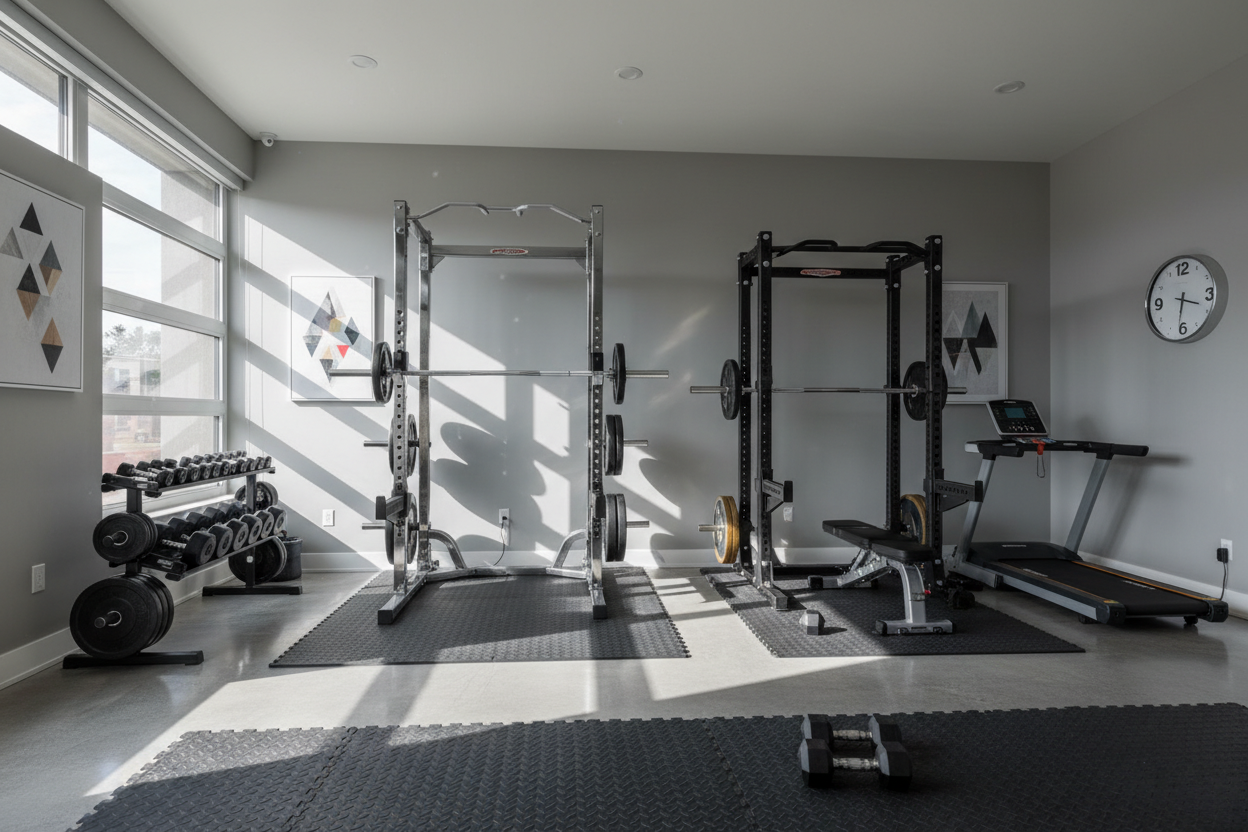
I remember the first time I moved my training from the local big-box gym to my damp, unheated garage. I’d been 'benching' 225 for reps on the Smith machine and figured I was ready to show the neighborhood what was up. I loaded two plates on my new Ohio bar, lay back, and nearly pinned myself on the first rep. It wasn't just heavy; it felt like the bar was trying to escape me. That's the cold reality of the smith machine to free weight ratio—the numbers on the plates rarely tell the whole story.
- Expect a 10-20% strength drop when moving to a barbell.
- The Smith machine removes the need for lateral stabilization.
- Friction and counterweights can make the 'bar' feel lighter than it is.
- Squats usually see a bigger performance gap than benching.
The Illusion of Fixed-Path Strength
A Smith machine is basically a barbell on training wheels. The linear bearings and guide rods dictate exactly where the weight goes: straight up and straight down. This sounds efficient, but it's a mechanical lie. In the real world, gravity doesn't just pull things down; it tests your ability to keep them from drifting sideways, forward, or backward.
When you use a Smith machine, you aren't using your rotator cuffs to stabilize the weight or your lats to pull the bar into a tight path. The machine handles all the 'micro-adjustments' for you. Plus, many commercial Smith machines have a 15-pound starting weight or use a pulley system that offsets the bar's mass, making 200 pounds feel more like 160. You aren't just fighting gravity; you're fighting the friction of the rails, which can actually help you on the way up.
So, What's the Actual Smith Machine vs Free Weights Conversion?
If you're looking for a perfect mathematical smith machine vs free weights conversion, I have bad news: it doesn't exist. Every machine is built differently. Some have a 7-degree slant, others are perfectly vertical, and some have high-friction bushings that actually make the weight feel heavier than it is.
However, after coaching dozens of lifters through this transition, the general rule of thumb is a 10% to 20% reduction. If you're repping 200 lbs on the rails, expect to struggle with 170 lbs on a free barbell. This isn't because you got weaker; it's because your stabilizer muscles are currently sleeping and need time to wake up and join the party. A beginner might see a 25% drop, while a seasoned pro might only feel a 5% difference because their technique is already locked in.
The Hard Truth About Your Bench Press: Smith Machine vs Free Weight
The bench press smith machine vs free weight debate usually ends in bruised egos. On a Smith machine, you can't really 'drive' through your feet and arch your back to create a stable platform because the bar path is locked. You’re often just pushing with your pecs and triceps while your shoulders are in a fixed, sometimes awkward, position.
When you move to a high-quality adjustable weight bench, you suddenly have to manage the 'wiggle.' If your smith machine bench press max vs free weight is significantly higher, it’s usually because your lats and upper back aren't used to providing the necessary tension to keep a heavy barbell stable. The smith machine bench press weight difference is a direct reflection of how much help the machine was giving your stabilizers. You’ll find that a free-weight bench requires a much more aggressive 'tuck' of the elbows and a tighter upper back to move the same load.
Why Your Squat Numbers Will Take the Biggest Hit
Squats are even more humbling. On a Smith machine, you can lean back into the bar or place your feet way out in front—positions that would literally result in you falling over with a barbell on your back. The machine is doing the balancing for you, which completely bypasses your core and spinal stabilizers.
Don't get me wrong; there are legitimate benefits to Smith machine squats if you're chasing pure quad hypertrophy without the systemic fatigue of a heavy back squat. But don't expect those numbers to carry over 1:1. When the bar is free, your core has to work three times as hard just to keep you upright. If you squat 315 on a Smith, don't be surprised if 225 feels like a ton of bricks on a free bar.
How to Bridge the Gap Without Getting Crushed
If you're making the switch today, don't try to match your Smith machine numbers. Start at roughly 70% of your machine 1RM. Spend the first two weeks focusing on bar control rather than bar speed. You need to re-learn the movement pattern without the guide rails holding your hand.
If the jump to a barbell feels too unstable, consider using a chest press machine with independent arms. These machines bridge the gap by allowing for a more natural arc while still providing some safety, forcing each side of your body to work independently before you tackle the total chaos of a free-moving barbell. It’s a great way to build that missing horizontal stability without the risk of a 45-lb plate crashing onto your garage floor.
Stop Doing the Math and Start Lifting
Stop trying to calculate the perfect ratio. It's a waste of mental energy. Your Smith machine PR is a separate lift from your barbell PR. They are cousins, not twins. Establish a new baseline on the barbell, record it in your logbook, and start your progression from there. Your stabilizers will catch up faster than you think, but only if you give them the chance to work without the training wheels.
My Personal Smith Machine Fail
Early in my home gym journey, I bought a cheap Smith machine because I was afraid of lifting heavy alone. I got 'strong' on it, or so I thought. When I finally bought a real power rack and tried to squat 315—a weight I’d done for triples on the Smith—my knees caved and I had to dump the bar onto the spotter arms. It was a massive wake-up call. I had the leg strength, but my 'chassis' (my core and hips) wasn't built to handle the load. I had to swallow my pride and go back to 225 to fix my form.
FAQ
Is 225 on Smith machine the same as 225 free weight?
No. Due to the lack of stabilization requirements and potential counterweights on the Smith machine, 225 on the rails is significantly easier than 225 on a barbell.
Why is Smith machine bench so much easier?
The machine eliminates the need to balance the bar horizontally and vertically. You only have to push upward, whereas a barbell requires constant micro-corrections from your shoulders and back.
Should I stop using the Smith machine entirely?
Not necessarily. It's a great tool for isolation and hypertrophy. Just don't use it as a benchmark for your raw strength or expect the numbers to translate directly to a barbell.
Share:
Does a Smith Machine With Pulley Actually Replace a Cable Tower?
Googling 'how much is the bar at planet fitness reddit'? I Found Out.