
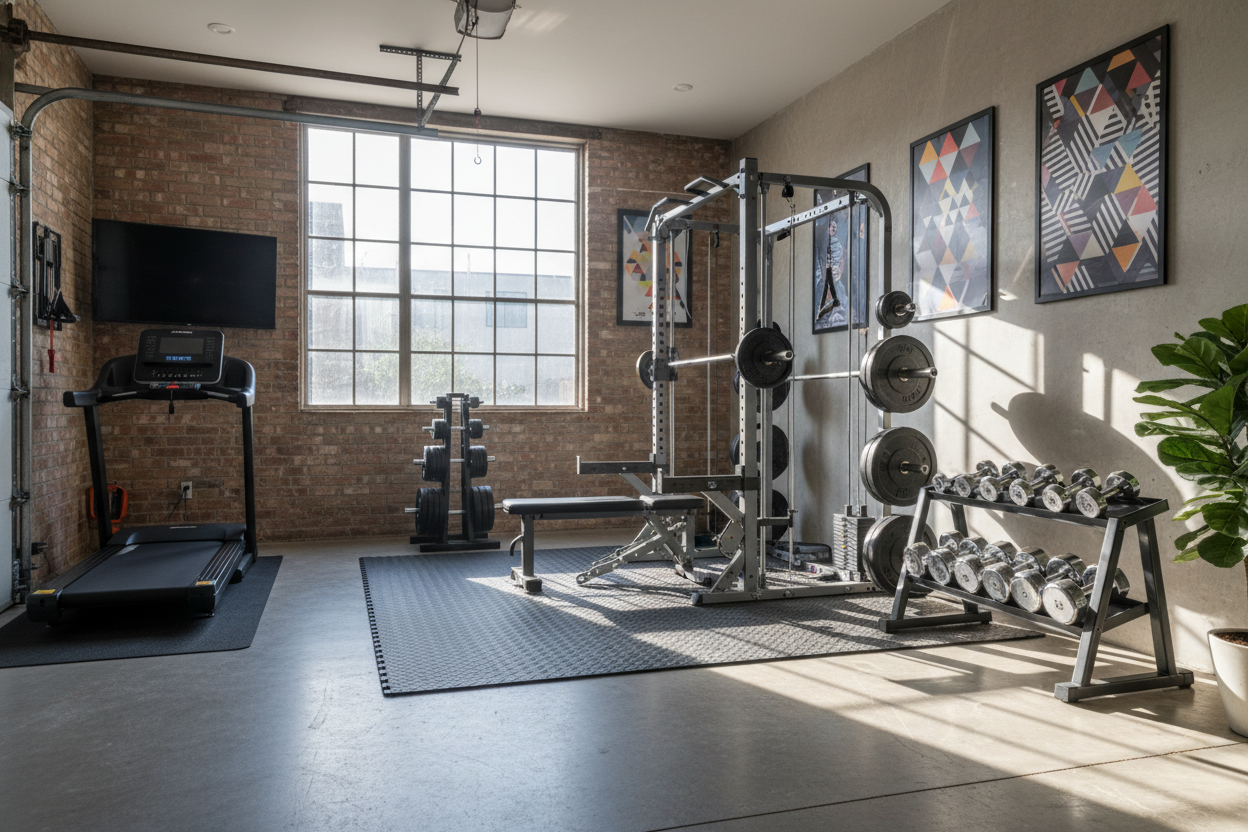
I remember staring at a glossy catalog late at night after my local commercial gym hiked its prices for the third time in two years. The idea of a powerhouse home gym set that replaces every single machine in the building is seductive. You imagine yourself hitting chest, back, and legs in one 10x10 corner of your garage without ever waiting for a squat rack.
But after assembling dozens of these rigs for clients and sweating through my own workouts on them, I've realized the marketing photos often lie. They show a sleek, effortless experience, but the reality involve cable drag, weird pulley ratios, and a footprint that eats your entire floor. Let’s look at whether these massive units actually belong in your training space or if they’re just expensive coat racks.
- Cable Friction: Cheaper pulleys feel like pulling through sand.
- Weight Ratios: A 200lb stack often feels like 100lb due to pulley physics.
- True Footprint: You need way more space than the base dimensions suggest.
- Fixed Paths: Great for isolation, but can be hard on the joints for heavy compounds.
Why We All Fall for the 'All-In-One' Dream
We’ve all been there. You’re tired of the commute and you start looking for a shortcut. The powerhouse multi gym promises to be that shortcut. It looks like a transformer in the photos—pec deck, lat pulldown, leg extension, and chest press all bolted into one frame. It’s the ultimate convenience play.
The problem is that a powerhouse gym set is often a jack-of-all-trades and master of none. When you try to cram ten machines into one, you inevitably sacrifice the quality of the individual movements. I've seen guys spend three days assembling these things only to realize the chest press arm doesn't quite fit their wingspan. If you're looking for complete home gym setups, you have to decide if you want one big machine or a modular system that grows with you.
The Brutal Reality of Cable Friction
This is where most budget-friendly machines fail. A powerhouse fitness cable machine usually relies on nylon pulleys and plastic-coated cables. On day one, it feels okay. By month six, the dust and sweat turn that 'smooth glide' into a jerky, grinding mess. This friction adds 'ghost weight' that isn't consistent throughout the rep.
When I test a high-end commercial unit, the weight feels the same at the start of the concentric as it does at the peak. On a cheaper multi-gym, you often have to 'jump-start' the weight to overcome the initial friction. This ruins your mind-muscle connection. If you actually care about cable work for high-volume hypertrophy, you’re almost always better off with a dedicated wall-mounted cable station. The difference in smoothness is like night and day.
When 200 Pounds Doesn't Feel Like 200 Pounds
Don't be fooled by the numbers on the plates. Most powerhouse weights operate on a 2:1 pulley ratio. This means if the stack says 200 lbs, you’re actually only moving 100 lbs of resistance. Some of the more complex rigs even use 4:1 ratios for certain stations to keep the cables long enough to reach every attachment point.
I've seen intermediate lifters max out the lat pulldown on their powerhouse fitness home gym within the first month. Once you're pinning the whole stack for reps, you have nowhere to go. You end up trying to duct-tape 5lb plates to the top of the stack just to get a stimulus. It’s a frustrating ceiling to hit when you're trying to build serious mass.
Are You Actually Saving Any Garage Space?
The marketing says 'compact,' but my measuring tape says otherwise. A powerhouse multi gym might have a 4x6 foot base, but you can't actually use it in a 4x6 foot space. You need room to extend your legs for the leg press, room for your arms to flare on the pec deck, and room behind the machine to access the weight stack pins.
In reality, you need at least a 3-foot 'dead zone' around the entire perimeter. If you’re tight on space, a Smith machine home gym station can often be a better bet because it sits flatter against a wall while still giving you that guided-weight safety. Don't let a 'compact' label trick you into buying a machine that forces you to park your car on the street.
The Fixed Path vs. Free Weight Problem
The biggest issue I have with these rigs is the fixed movement arc. Your joints aren't designed to move in a perfectly straight line or a fixed circle determined by a steel pivot point. Over time, forcing your body to adapt to the machine's path—rather than the machine adapting to you—can lead to nagging shoulder and elbow pain.
I’m a big believer that the best weights home gym setup involves things that let your body move naturally. Dumbbells and barbells allow for those micro-adjustments in your wrist and elbow position that keep your joints happy. When you’re locked into a powerhouse fitness home gym, you’re stuck with whatever geometry the engineer decided on back at the factory.
My Final Verdict: Who Should Actually Buy One?
If you're a casual lifter who just wants to stay active and move some weight three times a week, a powerhouse home gym set is a decent, safe investment. It keeps the weights off the floor and provides a guided experience that’s hard to mess up. It beats sitting on the couch every time.
However, if you're trying to build a physique or move serious numbers, I’d pass. The combination of cable drag, limited weight stacks, and fixed movement paths will eventually stall your progress. You're better off starting with a solid rack and a bench. You can always add specialized pieces later, but you can't easily fix a machine that's fundamentally limited by its own design.
Personal Experience: The Day the Cable Snapped
I once owned a mid-range multi-gym that I thought was the 'ultimate' solution. I was mid-set on a heavy tricep pushdown when the plastic coating on the cable frayed and the inner steel wire snapped. I ended up punching myself in the chin and falling backward into my lawnmower. It taught me two things: always check your cables for wear, and you get exactly what you pay for when it comes to pulley systems.
FAQ
How long does it take to assemble a powerhouse multi gym?
Expect to spend 6 to 10 hours. It’s not just the bolts; it’s threading the cables through the pulleys correctly. If you mess up the routing, the whole thing will feel 'crunchy' or won't move at all.
Can I upgrade the weight stack later?
Usually, no. Most of these frames are rated for a specific load. Adding more weight than the factory stack can stress the cables and the frame welds, which is a massive safety risk.
Is it better than a membership?
Financially, it pays for itself in about two years. But in terms of exercise variety and equipment quality, a commercial gym will almost always win. Buy this for the convenience, not for better equipment.
Share:
I Train Alone: Why the Best Leverage Home Gym Beats a Power Rack
Smith Machine Lying Leg Press vs. Sled: Which Builds Bigger Legs?