
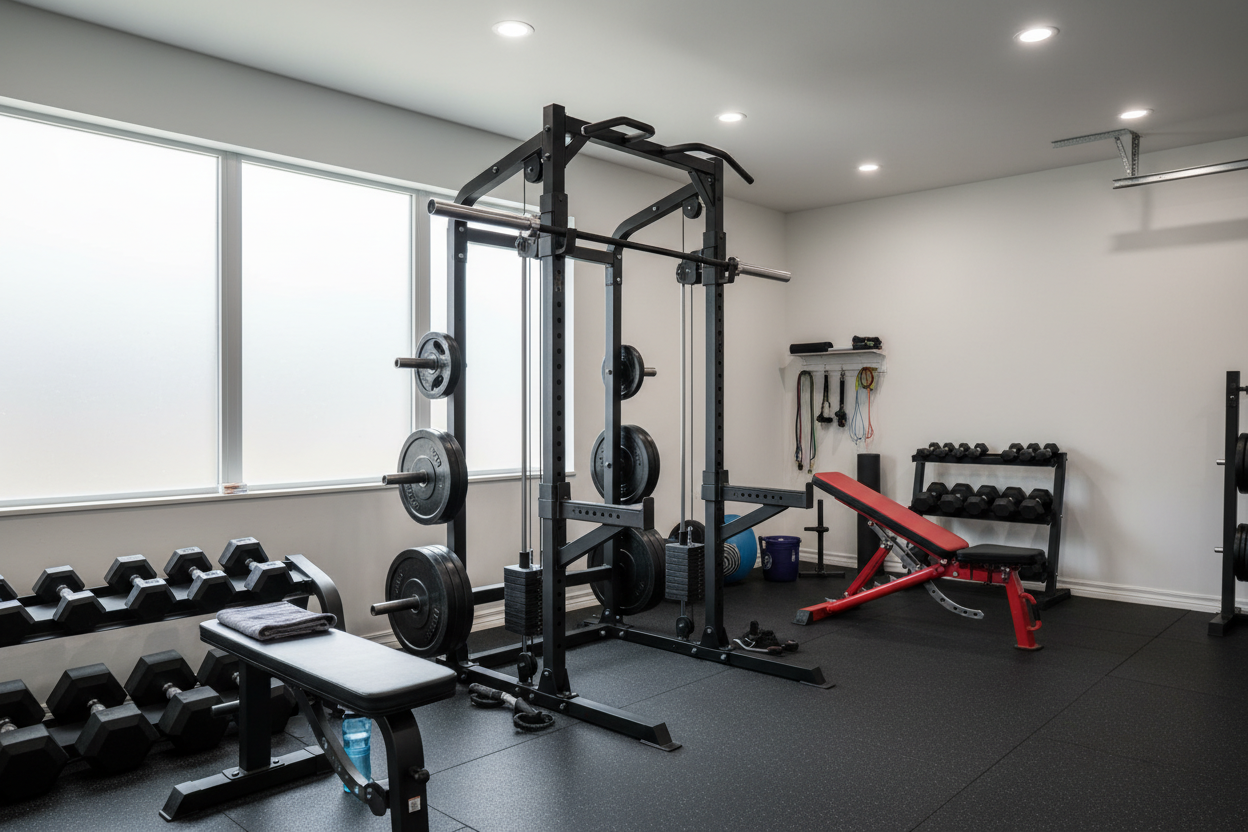
I have spent too many early mornings staring at the rafters of my garage, wondering if this is the set where I finally get pinned by a 225-lb barbell. There is a specific kind of anxiety that comes with solo training. You want to grow, which means pushing reps to the limit, but you also want to keep your ribcage intact without a neighbor having to call an ambulance. Finding the best leverage home gym was the moment I realized I did not actually need a massive power rack to get strong.
Quick Takeaways
- Safety First: You physically cannot get pinned under a lever arm; they have built-in stops.
- Natural Path: The arc of a lever mimics free weight movement better than the vertical track of a Smith machine.
- Space Efficiency: Most leverage systems fit in a smaller footprint than a full cage with spotter arms.
- Intensity: You can push to absolute mechanical failure on every single set without a spotter.
Why Free Weights Suck When You Lift Alone in a Garage
Lifting alone in a drafty garage changes your psychology. You start sandbagging your sets. You leave two or three reps in the tank because the thought of performing a 'roll of shame' at 6 AM is both pathetic and dangerous. This mental governor kills your gains over time. You simply cannot reach the intensity required for serious hypertrophy if you are constantly worried about dying.
The Best At Home Gym Doesnt Exist But This Comes Close, but a high-quality leverage system is the nearest thing to a perfect compromise. It removes the fear of the weight crashing down on you, allowing you to focus entirely on the squeeze and the stretch. When you know the weight is on a fixed pivot, you can grind out that ugly final rep that actually triggers growth.
How Leverage Home Gym Systems Actually Work
Leverage systems are the middle ground between a commercial machine and a barbell. You load Olympic plates directly onto arms that pivot on a central axis. It is a significant evolution for the modern Home Gym. You get the raw, heavy feel of plate-loaded iron without the lateral instability that makes a heavy bench press sketchy when your stabilizers are fried.
The mechanics are simple: the weight is supported by the frame, not your joints. This means you do not waste energy balancing the load. Instead, 100% of your effort goes into the target muscle. If you miss a rep on a leverage squat or chest press, you just let go. The machine catches it. No drama, no injury.
Lever Arms vs. The Classic Smith Machine
Most people confuse lever arms with a Smith Machine Home Gym Station. But the biomechanics are worlds apart. A Smith machine moves on a linear, vertical track. Human joints, however, move in arcs. When you press a barbell, it does not go straight up and down; it moves in a slight J-curve.
Leverage arms naturally follow this arc. Because the arm is pivoting from a fixed point, the weight moves in a way that feels much more 'organic' to your shoulders and elbows. In my experience, leverage systems are far more forgiving on the joints than the rigid, straight-jacket feel of a traditional Smith machine. You get the safety of a guided path without the orthopedic nightmare of forced linear movement.
The Truth About Building a Multi Leverage Gym Setup
If you are looking at a multi leverage gym, you are looking for versatility. These units usually combine a chest press, a high/low pulley, and sometimes a leg developer into one footprint. A good one can realistically handle 80% of your hypertrophy work. The footprint is usually around 4x6 feet, which is a massive win if you are fighting for floor space in a single-car garage.
The downside? You lose some of the 'functional' stabilization work. If your goal is to be a competitive powerlifter, you still need a barbell. But if your goal is to look like you lift and stay injury-free while training solo, the leverage system is arguably the superior tool. It allows for high-volume, high-intensity training that is hard to replicate with a basic rack and bench setup.
3 Specs to Check Before Buying a Lever Machine
First, check the bearings. If the pivot point is just a bolt through a metal sleeve, it will feel like dragging a sled through gravel. You want sealed ball bearings or pillow block bearings for a smooth, silent stroke. Second, check the starting weight. Some arms weigh 15 lbs empty, while heavy-duty ones might start at 45 lbs before you even add a plate.
Finally, look at the max capacity. When comparing a leverage unit to something like the Full Body Multi Training Station Smith Machine Dm01, you need to ensure the frame can handle at least 500 lbs on the main press arms. Even if you aren't benching 500 lbs yet, a higher weight rating is a proxy for frame thickness and weld quality.
Personal Experience: The Alignment Trap
I once bought a budget-tier leverage unit where the arms were slightly misaligned. One side hit my chest about half an inch before the other. It drove me absolutely insane and messed with my mind during heavy sets. I eventually fixed it by shimming the pivot with a stainless steel washer, but it taught me a valuable lesson: precision manufacturing matters more than a fancy powder coat. Don't buy the cheapest unit on the market; buy the one with the best pivot hardware.
Frequently Asked Questions
Can you build as much muscle with a leverage gym?
Absolutely. Your muscles don't know if you're holding a barbell or a lever arm; they only respond to tension and mechanical stress. Because you can safely push closer to failure, many lifters actually see better growth on a leverage system.
Do leverage gyms require special plates?
No, almost all quality leverage systems are designed to take standard 2-inch Olympic plates. Just make sure you have enough 'change plates' (2.5 and 5 lb) to make incremental progress.
Is a leverage gym better than a power rack for a beginner?
It is safer, which builds confidence. However, it is still worth learning basic barbell movements. Many lifters use a leverage gym as their primary 'heavy' station and use dumbbells for accessory work.
Share:
Why Buying Fitness Equipment Cheap Usually Costs You Double
Does a Powerhouse Home Gym Set Actually Build Serious Muscle?