
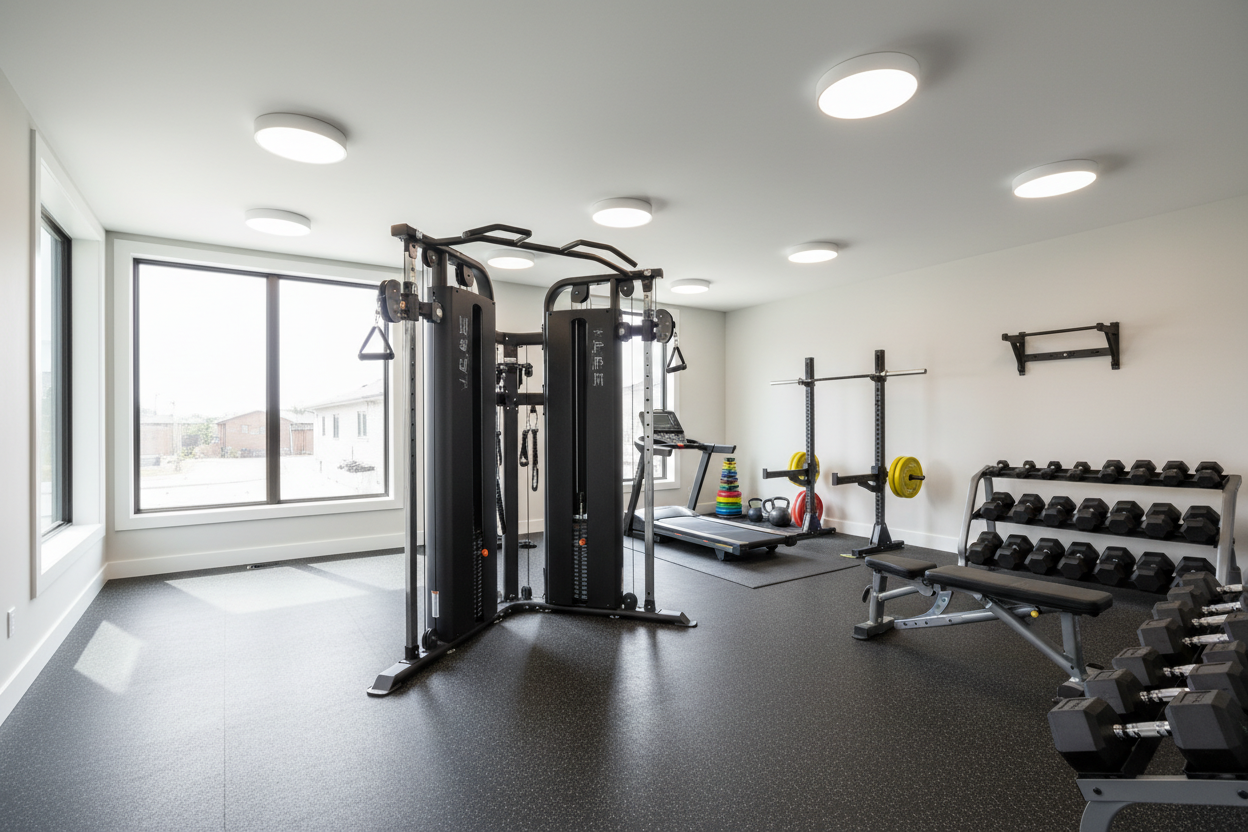
I remember staring at my credit card statement three years ago, seeing that $80 monthly 'maintenance fee' for a commercial gym I hadn't visited in weeks. The commute was a grind, the squat racks were always taken by teenagers filming TikToks, and the air smelled like damp towels and broken dreams. I started hunting for the best full body workout machine for home, hoping to claw back my time and my sanity. Most of what I found during that midnight scrolling session was plastic garbage that looked like it would snap the moment I tried a heavy row.
Quick Takeaways
- Avoid anything using elastic bands; they offer inconsistent resistance and dry rot over time.
- Dual weight stacks are non-negotiable for legitimate functional training and bilateral movements.
- A 2:1 pulley ratio is the sweet spot for smooth travel and long cable reach.
- Hybrid machines (Smith + Cables) save roughly 40 square feet compared to buying individual units.
The 'Do-It-All' Myth: Why Most Home Machines Fail
Most equipment marketed as the best all body exercise machine is built for a marketing brochure, not a garage. You've seen the ads: a guy with 2% body fat smiling while doing a bicep curl with a resistance band attached to a door frame. In reality, that setup offers zero eccentric load and feels like pulling on a giant rubber band because, well, it is. If the machine weighs less than you do, it’s going to shake like a leaf during a 200-lb lat pulldown. I've tested 'all-in-one' units that felt like they were made of recycled soda cans.
The problem is biomechanics. Cheap machines use tiny plastic pulleys that create friction and fray cables within six months. They limit your range of motion, forcing you into awkward angles that chew up your rotator cuffs. A real machine shouldn't dictate how you move; it should provide a stable platform for your natural mechanics. If you can't perform a deep squat or a full-stretch fly without the machine tipping, it isn't a workout tool—it's a coat rack.
We need to stop falling for the '30 exercises in one' trap if those 30 exercises all feel like garbage. Real strength training requires progressive overload, which means you need actual iron or heavy-duty weight stacks. Anything less is just expensive cardio.
The Anatomy of a Legitimate All-In-One Setup
When you're building a functional home gym, you have to prioritize structural integrity over fancy digital screens. The best all-around workout machine needs a skeleton made of 11-gauge or 14-gauge steel. Anything thinner will flex when you rack a heavy bar, and that's a recipe for a disaster. You want a footprint that is wide enough to be stable but compact enough that you aren't parking your car in the driveway for the next decade.
The heart of a high-end machine is the pulley system. Look for aircraft-grade cables and aluminum pulleys with sealed bearings. These provide that 'buttery' feel you get at a commercial gym. You also need dual adjustable pulleys. If the handles are fixed in one position, you're stuck doing the same three movements forever. Adjustable heights allow you to transition from low-cable rows to mid-chest flies to high-cable tricep extensions in seconds.
Weight stacks are another sticking point. I prefer dual stacks because they allow for independent limb movement. This fixes the muscle imbalances most of us develop from years of barbell-only training. If one arm is doing 60% of the work on a chest press, a single-stack machine won't tell you, but a dual-stack setup will expose it immediately. It's about quality of movement, not just moving the pin down the stack.
Why I Finally Ditched the Mismatched Free Weights
My garage used to be a graveyard of 45-lb plates and mismatched dumbbells I scavenged from Craigslist. I spent more time tripping over iron and searching for the 'other' 35-lb hex head than I did actually lifting. It was a logistical nightmare. In a tight space, clutter is the enemy of consistency. I found myself skipping accessory work because I didn't want to dig the bench out from under a pile of plates.
After trading my free weights for a consolidated unit, the transformation was immediate. I didn't just gain floor space; I gained momentum. There's something to be said for a 'cockpit' style setup where everything is within arm's reach. I can move from a heavy compound lift to a cable isolation movement by just moving a pin and a carabiner.
I did make one mistake early on: I bought a cheap power tower thinking it would satisfy my pull-up and dip needs. It wobbled so much I was afraid to use it for weighted dips. That's when I realized that one heavy, multi-functional unit is worth five pieces of flimsy standalone equipment. My current setup takes up a 5x7 foot area, and I can hit every single muscle group without moving a single plate across the room.
Why a Smith and Cable Hybrid Wins the Space War
If you're training solo, safety is the elephant in the room. This is why a hybrid system is the best home full body workout equipment for most people. A Smith machine provides a guided track that acts as a built-in spotter. You can push your limits on squats or bench presses and, with a quick flick of the wrist, lock the bar into place if your form starts to break down. It removes the 'fear factor' of getting pinned under a heavy bar at 6 AM when no one else is awake.
But a Smith machine alone is boring. When you integrate it with a functional trainer (cables), you get the best of both worlds. You get the heavy, stable compound movements of the Smith and the constant tension of the cables. A heavy-duty Smith machine station with integrated pulleys allows you to perform 'supersets' that are impossible with just a rack. You can go from a heavy Smith press straight into cable flies without leaving the machine's footprint.
This hybrid approach also solves the 'dead zone' problem of free weights. With dumbbells, there's no tension at the top of a chest fly. With cables, the resistance is constant throughout the entire range of motion. This leads to better hypertrophy and less joint wear and tear. For someone with old sports injuries like me, that constant, controlled tension is a lifter's best friend.
Making the Investment: Buy Once, Cry Once
Home gym equipment is an investment in your health, but it's also a financial one. My philosophy is 'buy once, cry once.' It's better to spend more upfront on a commercial-grade unit than to spend $500 every two years replacing a rickety machine that you've outgrown. When evaluating a machine, look at the pulley ratio. A 2:1 ratio means 100 lbs on the stack feels like 50 lbs of actual resistance, but it gives you more cable travel, which is essential for walking out lunges or overhead extensions.
The DM01 multi-training station is a prime example of what to look for. It features a 1:1 and 2:1 option, heavy-duty guide rods, and a smooth-as-silk Smith track. It doesn't use the cheap nylon bushings that get sticky after a month; it uses linear bearings. That's the difference between a machine that feels like a toy and one that feels like a professional tool. Check the weight capacity too—if a machine is rated for less than 400 lbs on the Smith bar, keep walking.
Finally, measure your ceiling height twice. There is nothing more heartbreaking than unboxing a 400-lb machine only to realize the pull-up bar is rubbing against your rafters. Give yourself at least 6 inches of clearance for your head during pull-ups. If you do it right, this one machine will be the last piece of strength equipment you ever need to buy.
FAQ
Can I really build as much muscle with a machine as with free weights?
Absolutely. Your muscles don't have eyes; they only know tension and load. High-quality machines provide more consistent tension than free weights and allow you to train to failure more safely, which is often the key to growth.
How much floor space do I actually need?
For a full-scale hybrid machine, you want at least an 8x8 foot area. This gives you room to load plates onto the Smith bar and enough space to pull the cables out for movements like chest flies or walking lunges.
Is a Smith machine 'cheating' for squats?
It's not cheating; it's a different stimulus. It reduces the need for stabilizer muscles, which allows you to put more direct load on your quads. It’s a tool, and when used correctly, it’s incredibly effective for building leg mass safely.
Share:
Is the Hoist Home Gym V2 Actually Worth the Premium Price?
Why I Only Recommend a Dumbbell Set Hex Over Round Iron