
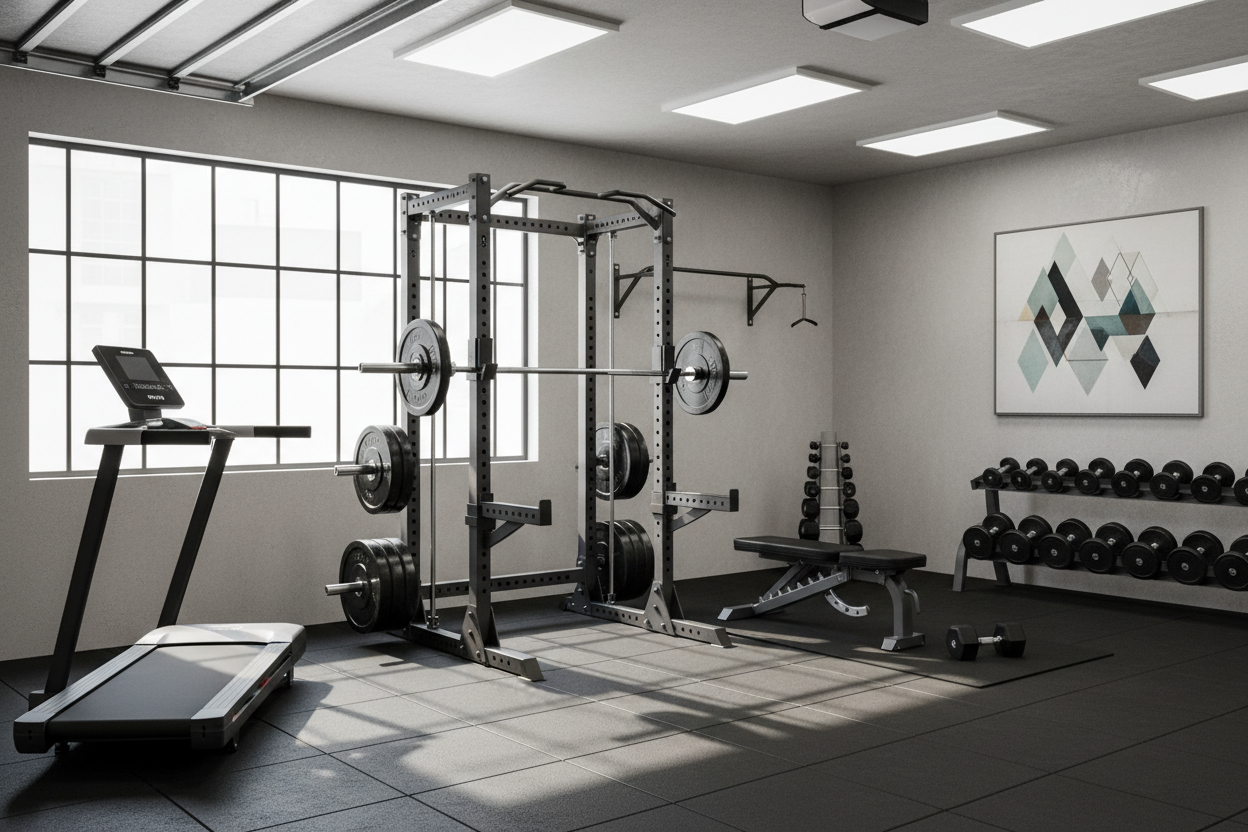
I’ve spent way too many Friday nights scrolling through marketplace listings, looking at every machine for working out that looks great in the photos but feels like a plastic toy in person. You know the feeling—you finally pull the trigger, wait a week for shipping, and then realize the seat wobbles if you breathe too hard and the cables feel like they are grinding through a bucket of sand. It is frustrating, expensive, and a total momentum killer.
Building a home setup is a massive investment. If you buy the wrong gear, you are not just out the cash; you are stuck with a 500-pound paperweight taking up half your garage. I have tested enough Home Gym equipment to know that the spec sheet usually tells a story the marketing photos are trying to hide. You just have to know how to read between the lines.
Quick Specs to Check
- Steel Gauge: Look for 11 or 12-gauge steel; avoid 14-gauge for primary frames.
- Pulley Material: Aluminum or high-grade nylon with sealed bearings beats plastic every time.
- Weight Ratio: Understand if your 200lb stack feels like 200lbs (1:1) or 100lbs (2:1).
- True Footprint: Add 2 feet to every dimension for 'working room.'
The 'Clothes Hanger' Trap (And How to Avoid It)
We have all seen it: the working out machine that eventually becomes a very expensive rack for drying laundry. Most people think this happens because of a lack of discipline. I disagree. Usually, it happens because the stationary exercise machines people buy feel terrible to use.
If the biomechanics are off—meaning the pivot points don't align with your joints—your body will naturally resist using it. Cheap machines exercise enthusiasts often regret are the ones with fixed paths that force your shoulders or knees into awkward angles. If it doesn't feel smooth, you won't use it. Period. Look for adjustable benches and multi-position handles to ensure the machine fits your frame, not the other way around.
Spec 1: The Truth About Weight Capacities
When you browse home gym machines for sale, the weight capacity is the first number they shout at you. But here is the catch: there is a massive difference between static load and dynamic load. A gym workout station might be rated for 600 pounds sitting still, but if you drop a 200-pound barbell on the safeties, will it fold like a lawn chair?
I generally look for a 3-to-1 safety factor. If you plan on benching 200 pounds, your rack should be rated for at least 600. Cheap workout machines often use thinner 14-gauge steel that vibrates and sways when you're moving heavy weight. If the machine weighs less than you do, it is probably going to be a wobbly mess during a heavy set of rows.
Spec 2: Pulley Ratios and Cable Quality
This is where the 'feel' of a machine is won or lost. Most budget machines for exercise use cheap plastic pulleys that create friction. Friction equals a jerky movement that ruins your mind-muscle connection. You want aluminum pulleys or high-quality nylon with sealed ball bearings.
Then there is the ratio. A 1:1 ratio means 100 pounds on the stack feels like 100 pounds in your hand. A 2:1 ratio (common in functional trainers) means 100 pounds feels like 50. This isn't necessarily bad—2:1 is actually better for explosive movements and offers a longer cable travel—but you need to know what you're buying so you don't run out of weight on day one.
Spec 3: Footprint vs. Usable Space
The biggest mistake I see in a gym machine buy is measuring the floor space but ignoring the 'working' space. A machine might be 4 feet wide, but if the plate pegs stick out another 12 inches on each side, you’re in trouble. I once bought a lat pulldown that fit my corner perfectly, until I realized I couldn't actually sit in the seat without hitting my head on a low-hanging fluorescent light.
Think about the bar path and cable extension. If you are debating between a Power Rack Or Smith Machine For Home Gym I Tried Both styles, remember that a Smith machine has a fixed vertical footprint, whereas a rack requires room for you to step back and lunge. Always map out your floor with painter's tape before clicking 'buy.'
Spec 4: The Price-to-Versatility Ratio
The price of exercise machine ownership isn't just the sticker price; it is the cost per exercise. If you spend $500 on a leg extension machine, you can do exactly one exercise. If you spend $1,500 on a Full Body Multi Training Station Smith Machine Dm01, you can hit chest, back, legs, and shoulders in the same 20 square feet.
For most home lifters, versatility is king. I’d rather have one overbuilt, multi-functional rig than four flimsy, single-use pieces. Look for units that include pull-up bars, landmine attachments, and adjustable pulleys. It saves money in the long run and keeps your garage from looking like a cluttered graveyard of failed New Year's resolutions.
My Go-To Recommendation for Most Garages
If you want my honest opinion, most people are best served by a heavy-duty Smith Machine Home Gym Station. It combines the safety of a guided bar with the versatility of a cable system. These home gym workout machines check every box: they are stable, they offer a massive variety of movements, and they usually have the highest resale value if you ever decide to upgrade.
Personal Experience: The 'Budget' Lesson
Early in my lifting career, I bought a $200 cable tower from a big-box store. It looked fine in the box. But the first time I tried to do a heavy face pull, the whole unit tipped toward me because it wasn't weighted correctly at the base. I had to bolt it to a piece of plywood just to keep it upright. I ended up selling it for $50 three months later. The lesson? Buy once, cry once. Investing in quality steel and smooth bearings is always cheaper than buying the same machine twice.
FAQ
What is the best steel gauge for a home gym?
11-gauge is the gold standard for commercial and high-end home use. 12-gauge is a solid middle ground. Avoid 14-gauge if you plan on lifting heavy, as it tends to flex and wobble under load.
Should I get a 1:1 or 2:1 pulley ratio?
It depends on your goals. A 1:1 ratio is better for heavy slow lifts like lat pulldowns. A 2:1 ratio is better for functional movements, crossovers, and shadows boxing because the cable travel is longer and the resistance is smoother.
How much should I spend on a home workout machine?
For a multi-functional station, expect to spend between $1,200 and $2,500 for something that will last a decade. Anything under $800 usually involves significant compromises in steel quality and pulley smoothness.
Share:
Stop Doing Floor Crunches: Why You Need a Leg Lift Machine
Why Every Weight Bench With Barbell and Weights Feels Microscopic