
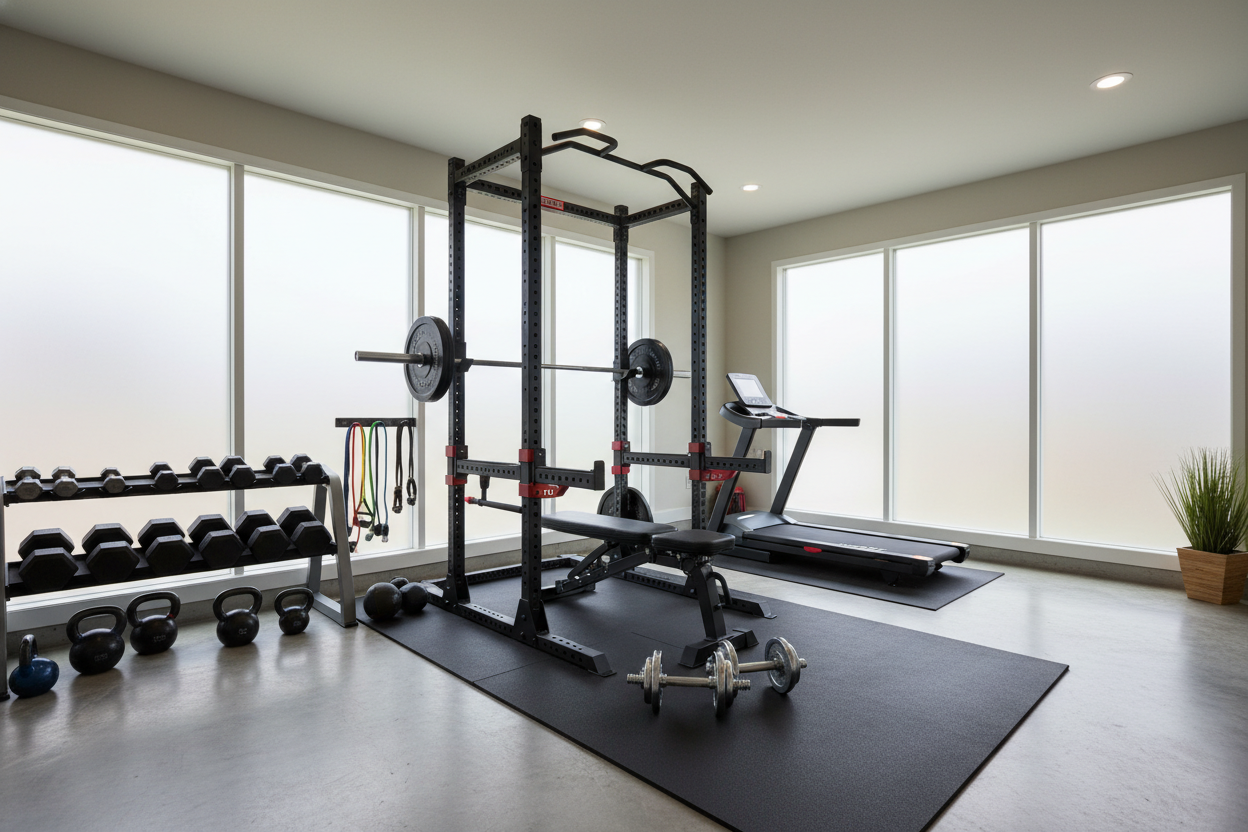
I remember the exact moment I gave up on commercial gyms. It was a rainy Tuesday, I was third in line for a squat rack that looked like it hadn't been greased since the Bush administration, and the guy currently using it was doing bicep curls. I went home and spent three hours scrolling through reviews for the best equipment for home workout setups. I wanted a space where I could actually train, not just 'exercise' among the crowds.
- Prioritize a power rack with at least 11-gauge steel.
- A 20kg Olympic barbell is the foundation of every strong home gym.
- Avoid 'as seen on TV' gadgets; they lack the durability for progressive overload.
- Floor space is your most valuable asset—don't crowd it with single-use machines.
Why You Keep Buying Fitness Gear You Never Use
We've all been there. You see a late-night ad for a folding ab-cruncher or a vibrating platform that promises six-pack abs in six minutes, and for a second, it sounds plausible. This is the psychological trap of the 'magic bullet.' People buy these specialized, single-use gadgets because they promise a shortcut. In reality, the best exercise equipment for home use is usually the most boring-looking stuff in the room.
When you are building a functional home gym, you need to ignore the bells and whistles. Most of those gadgets end up as expensive clothes hangers because they don't allow for progressive overload. You can't get stronger if you can't add weight. If a piece of equipment only does one thing, it’s taking up space that could be used for a versatile setup that actually drives results. Stop looking for the 'innovative' solution and start looking for the heavy-duty staples that have worked for decades.
The best in home exercise happens when you have tools that grow with you. A plastic resistance-band door anchor has a ceiling; a steel rack does not. I’ve seen too many people spend $500 on five different 'innovations' when they could have bought one solid piece of iron that would last a lifetime. Buy once, cry once.
The True Best Piece of Exercise Equipment for Home
If you forced me to pick just one thing—the undisputed heavyweight champion of the garage gym—it’s a power rack paired with a quality Olympic barbell. This combo is the best piece of exercise equipment for home use, period. Why? Because there is almost no movement you can't perform with it. From back squats and overhead presses to rack pulls and even pull-ups, the rack is your command center.
I’ve tested the best at home exercise equipment over the last decade, and I always come back to the barbell. A standard 7-foot Olympic bar allows you to move heavy loads safely. Unlike machines that fix you into a specific path, the barbell forces your stabilizer muscles to work. This translates to real-world strength. When you're looking for the best piece of exercise equipment, you want something that doesn't limit your ceiling. You can start with just the bar (45 lbs) and eventually load it to 500 lbs if your floor (and your spine) can handle it.
Don't settle for a 'standard' 1-inch bar either. They are flimsy, the plates are harder to find, and they feel like toys. Get a bar with decent knurling—that's the sandpaper-like grip—so it doesn't slide out of your hands when you're sweating. A 28.5mm diameter is the sweet spot for most people. It's thick enough to feel secure but thin enough for a solid grip on deadlifts. This is the gold standard for anyone serious about training at home.
How to Pass the 'Versatility Test' Before Buying
Before you click 'add to cart' on that new shiny object, run it through the Versatility Test. If a tool doesn't allow you to perform at least five distinct, foundational movements, it’s probably not the best piece of exercise equipment for your limited square footage. Space is the one thing you can't easily buy more of, so every square inch must be earned.
Think about a set of adjustable dumbbells. You can press them, row them, squat with them, lunge with them, and do curls. That passes the test with flying colors. Now think about a dedicated leg extension machine. It does one thing. Unless you’re a competitive bodybuilder with a 3,000-square-foot warehouse, that machine is a waste of space. I often warn people that the best home exercise equipment UK markets often push is just cheap, high-markup plastic found on massive retail sites. These items rarely pass the versatility test and usually break within the first six months of real use.
If you’re tight on space, look for 'multi-use' over 'multi-gym.' A flat utility bench is better than a bulky machine because you can move the bench out of the way to do deadlifts. A set of gymnastic rings hanging from your rack gives you a dip station, a pull-up bar, and a row trainer in the space of a shoebox. That’s how you win the home gym game.
The 3 Non-Negotiables for Your Setup
If you want a space that actually makes you stronger, you need the trifecta. These are the absolute best exercise equipment to have at home for long-term progression. First: a heavy-duty power rack. Look for 2x3 or 3x3 steel tubing. If the rack weighs less than you do, it's going to wobble when you try to re-rack a heavy squat. That's not just annoying; it's dangerous.
Second: an adjustable bench. You want something that can go from flat to incline. This opens up a massive variety of pressing and rowing angles. Check the gap between the seat and the back pad; if it's wider than two inches, it's going to be uncomfortable for your lower back. Look for a bench rated for at least 600 lbs—remember, that includes your body weight plus whatever you're lifting.
Third: a quality barbell and plate set. Iron plates are classic and take up less room on the bar, but if you're training in a garage, bumper plates (rubber-coated) are the way to go so you don't crack your concrete. For those who are training alone and are worried about safety, or perhaps have limited ceiling height, a Smith machine home gym station can be a viable alternative. It provides a fixed path and built-in safety catches which are great for solo sessions, though I still argue the free-weight barbell is the king of versatility.
Finally, don't forget the flooring. Don't lift on bare concrete or carpet. Get some 3/4-inch horse stall mats. They are cheap, indestructible, and will save your equipment from getting beat up and your ears from the deafening clang of iron on stone. These three items—rack, bench, bar—form the core of 90% of the world's most effective strength programs.
Cardio and Machines: Worth the Floor Space?
Cardio is the area where most home gym owners lose their minds and their money. They buy a massive treadmill that takes up half the room, only to realize they hate running in place. If you want the best in home exercise for your heart, you need to be realistic about what you will actually use. For most lifters, cardio is a 'necessary evil' rather than a passion.
If you're tight on space but need to get your heart rate up, skip the industrial-sized treadmill. Instead, look for something like a foldable upright exercise bike. It gives you a legitimate metabolic hit but can be tucked into a corner or a closet when you're done. I personally use a bike for low-intensity steady-state work on recovery days because it doesn't beat up my joints the way running does, leaving me fresh for my heavy squats the next day.
Another great option is a simple jump rope or a heavy kettlebell for swings. Both take up zero floor space and provide a level of conditioning that most 'cardio machines' can't touch. If you must buy a machine, make sure it’s something you enjoy. If you hate rowing, don't buy a rower just because a YouTuber said it's the 'best' workout. The best cardio machine is the one you’ll actually sit on for 20 minutes without wanting to quit life.
Personal Experience: My $200 Mistake
Early in my lifting career, I bought a 'bargain' rack off an auction site. It was thin, the powder coating flaked off in a week, and the safety bars were held in by tiny, flimsy pins. One afternoon, I missed a squat at 315 lbs. The rack groaned, shifted about four inches to the left, and I genuinely thought the whole thing was coming down on me. I sold it that weekend for a fraction of what I paid and bought a real, 11-gauge steel rack. I learned the hard way: your safety is worth the extra $200. Don't skimp on the things that hold the weight above your head.
FAQ
How much space do I actually need for a home gym?
For a full power rack setup, you want at least an 8x8 foot area. This gives you room for the 7-foot barbell and space to load plates on the ends without hitting the walls. If you have less space, consider a folding rack or adjustable dumbbells.
Is it cheaper to build a home gym or keep a membership?
Initially, a home gym is more expensive. However, if you spend $1,500 on a solid setup and your gym membership was $50 a month, the home gym pays for itself in 2.5 years. Plus, you save on gas and the 'time tax' of commuting.
Should I buy iron or bumper plates?
If you plan on doing Olympic lifts (cleans, snatches) or deadlifting and dropping the weight, get bumper plates. If you are just doing traditional powerlifting and have good flooring, iron plates are thinner and allow you to fit more weight on the bar.
Share:
Why Your Cable PR Is Fake (Life Fitness Weight Stack Conversion)
Everyone Asks What Are the Best Home Gyms. Here is My Answer.