
I used to be that guy. You know the one—the lifter who would wait twenty minutes for the only power rack in the gym rather than look at the 'assisted squat rack.' I bought into the internet snobbery that said a fixed bar path was for people who didn't want to work hard. Then I tore a labrum and realized that my stabilizers were constantly the bottleneck for my actual muscle growth. That is when I finally asked: how do you use a smith machine properly without wasting your time?
Quick Takeaways
- The Smith machine is an isolation tool, not a replacement for the squat rack.
- Always set your safety catches before you load the plates.
- A slight 'wrist flick' is all it takes to unrack—practice this with an empty bar first.
- Foot placement is everything; since the bar is fixed, you have to move your body to find the right leverage.
Wait, What Is the Smith Machine Actually Good For?
Let's kill the ego. The smith machine at gym floors across the country is often mocked by free-weight purists. But here is the reality: the barbell machine is a hypertrophy monster. Because the bar moves on a fixed vertical or slightly angled track, you do not have to worry about the weight tipping forward or backward. This takes stabilization out of the equation.
When you remove the need to balance, you can push your prime movers—like your quads or chest—to absolute failure without your form breaking down. Most commercial units use a counterweight system, meaning that 45-lb bar might actually only feel like 15 or 25 lbs in your hands. This allows for insane precision. If you are wondering if this gear is worth the floor space, consider this: it is the only way to safely perform true high-intensity techniques like rest-pause sets or drop sets when you are training solo.
The Setup: How Do You Use a Smith Machine Safely?
The proper way to use smith machine mechanics starts with the unrack. Unlike a standard rack where you lift up and out, a smith machine how to use guide always starts with the rotation. You lift the bar slightly and flick your wrists back to clear the hooks. To re-rack, you simply rotate your wrists forward until the hooks catch the pins. It is a 'clank' that sounds like safety.
Before you even touch the bar, set the safety stoppers. These are the adjustable blocks at the bottom of the rails. If you are benching, set them just an inch below your chest. If you fail a rep, you can just let the bar drop onto the stoppers instead of wearing the barbell as a necklace. Also, pay attention to the angle. Many machines have a 7-degree tilt. If you are pressing, you generally want to face the direction that mimics a natural pressing arc—usually facing away from the machine.
5 Exercises Where the Barbell Machine Beats Free Weights
Using the smith machine is not about doing everything; it is about doing the right things. Here are the five moves where the fixed path is actually an upgrade over a loose barbell.
1. The Forward-Stance Hack Squat
This is the king of smith machine uses. By placing your feet 12 to 18 inches in front of the bar and leaning your back into it, you can squat with a perfectly vertical torso. This removes almost all the shear force from your lower back and puts it directly on your quads. It feels like a leg press but with the core engagement of a squat. It is a quad-torcher that you simply cannot replicate with a free barbell.
2. The Solo Heavy Incline Press
I love heavy incline, but I hate having a stranger's crotch in my face for a spot. Using the smith machine for incline press allows you to line the bench up perfectly with the bar path. You can load up three plates, go for that grindy sixth rep, and if you hit a wall, you just flick your wrists. The safety catches have your back. It allows for a level of intensity you can't reach when you're worried about dropping the bar on your throat.
3. The Zero-Setup Hip Thrust
If you have ever tried to roll a loaded 315-lb barbell over your shins while sitting on the floor, you know it sucks. The smith machine at the gym makes glute work effortless. Set the bar height to your hip level, slide under it with a pad, and go. No balancing act, no bruised shins, just pure glute isolation. It turns a 10-minute setup into a 30-second one.
4. The Strict Seated Overhead Press
Shoulder pressing with free weights often turns into a 'standing incline press' as you lean back to cheat. The smith machine usage here forces a strict vertical path. Set your bench to a high incline (about 85 degrees), align the bar so it just clears your nose, and press. It keeps the tension on the front and side delts without letting your lower back take over the movement.
5. The Lower-Back-Friendly Bent Over Row
When you do a standard barbell row, your lower back often gives out before your lats do. Because the smith machine provides the path, you can focus entirely on pulling your elbows back. You can use a slightly more upright posture and really squeeze the shoulder blades. It is a 'bodybuilder' row rather than a 'powerlifter' row, and the mind-muscle connection is significantly better.
Bringing the Fixed Bar Path to Your Garage Gym
If you are building a home setup, the old-school assisted squat rack has evolved. You don't need a massive commercial footprint anymore. I spent months looking for the best Smith machine for a garage gym that didn't feel like a wobbly department store toy. Modern units are surprisingly smooth, using linear bearings that feel like silk.
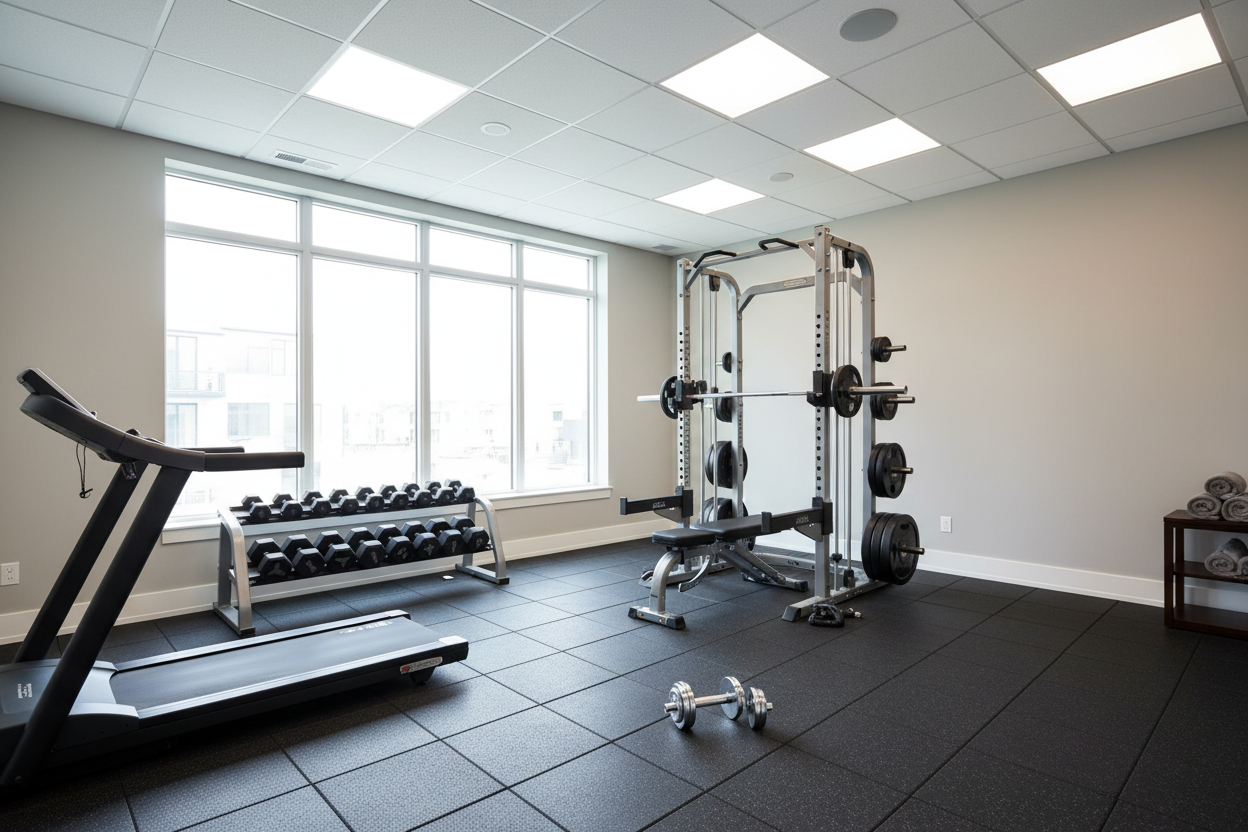
If you are tight on space, an all-in-one Smith machine is the smartest play. It combines the fixed bar with a cable crossover system, giving you 90% of a commercial gym in a 6x8 foot area. Whether you want a dedicated Smith machine home gym station or a hybrid rack, the goal is the same: more muscle, less injury risk, and the ability to train heavy when nobody is around to spot you.
My Honest Take
I spent years avoiding this machine because I thought it was 'cheating.' That was a mistake. I missed out on years of quad and upper chest development because I was too proud to use a tool that provided stability. My 'clank of shame' moment happened when I tried to max out on a cheap home Smith machine that had plastic bushings instead of bearings—the bar literally seized halfway up. Don't buy the cheap stuff. If the bar doesn't glide with one finger, it's going to ruin your joints. Get a machine with real bearings, and don't be afraid to use it.
FAQ
Is the bar on a Smith machine 45 pounds?
Rarely. Most commercial Smith bars are counterweighted to weigh between 15 and 25 pounds. Always check the sticker on the side of the machine, as some 'starting weights' can be as low as 6 pounds or as high as 30.
Is a Smith machine bad for your knees?
Only if your foot placement is garbage. If you try to squat with your feet directly under the bar like a free-weight squat, you can put weird pressure on the patella. Move your feet forward 6-12 inches and your knees will actually feel better than they do with a regular barbell.
Can you get strong using only a Smith machine?
You can get very big and very strong, but you won't build the 'stabilizer' strength needed for a world-record free-weight squat. It is a tool for hypertrophy and specific strength, not a total replacement for the iron.
Share:
Why a Simple Cast Iron Adjustable Dumbbell Beats a $400 Dial System
I Stashed 400 lbs of Iron in My Office: Small Home Gym Ideas