
Ever tried to do a heavy pistol squat with a dumbbell and ended up doing a weird interpretive dance to avoid falling over? It is frustrating as hell. You have the leg strength to move 100 pounds, but your stabilizer muscles are screaming for help at 40. That is where the one leg squat smith machine setup saves your leg day. It takes the guesswork out of the movement so you can actually focus on the burn instead of the floor.
- Eliminates the balance bottleneck for better muscle recruitment.
- Allows for safer training to absolute muscular failure.
- Easily adjustable for quad or glute dominance.
- Perfect for small garage gyms with no room for a leg press.
The Problem With Free-Weight Single-Leg Training
Most 'functional' gurus will tell you that if you cannot balance, you should not load the movement. I disagree. If your goal is hypertrophy—actually growing your quads and glutes—balance is often just noise. When you do a single leg squat smith machine style, you remove the neural tax of not falling over.
When you are wobbling on one foot with a barbell, your brain is busy sending signals to your ankles and core to keep you upright. That is energy that should be going to your quads. By removing the stability requirement, you can push your legs to true failure. Your heart rate will still redline, and your legs will still shake, but you won't end up face-planting into your power rack.
Why the Fixed Track is a Unilateral Cheat Code
The beauty of the smith machine single leg squat is the fixed bar path. You are not fighting the bar forward or backward; you just push. To make this work, you need a smooth and reliable Smith machine with a fluid guide rod system. If the bearings are sticky, you will feel every hitch in your patella.
A good machine lets you lean into the bar slightly, turning a precarious balance act into a pure strength movement. This stability allows you to load significantly more weight than you ever could with a kettlebell or dumbbell. We are talking about 30-40% more load in some cases, simply because you are not wasting force on stabilization. That extra weight is what builds real density in the lower body.
True Pistol vs. Bulgarian Split Squat
There is a massive difference between a smith machine one leg squat (a true pistol) and a Bulgarian split squat. In the pistol version, your non-working leg is extended out front. It is a brutal quad killer and requires massive hip flexion. The split squat, with your foot on a bench behind you, is more stable but shifts some load to the back leg. I prefer the front-extended version on the Smith because the bar handles the balance, making it a pure isolated effort for the working leg.
Dialing In Your Foot Placement
Foot placement is your volume knob for muscle recruitment. If you tuck your foot back closer to the bar's vertical line, you are going to feel a massive stretch in the quad. This is the 'quad sweep' builder. If you step out about 12 inches, you shift the center of mass, allowing for more hip hinge and glute involvement.
I usually mark my floor with a piece of tape so I hit the same spot every set. Consistency is how you actually track progress. If you are 2 inches off, the leverage changes, and your logbook becomes useless. Find the spot where your heel stays glued to the floor and your knee feels stable, then stay there.
No Leg Space in the Garage? Do This Instead
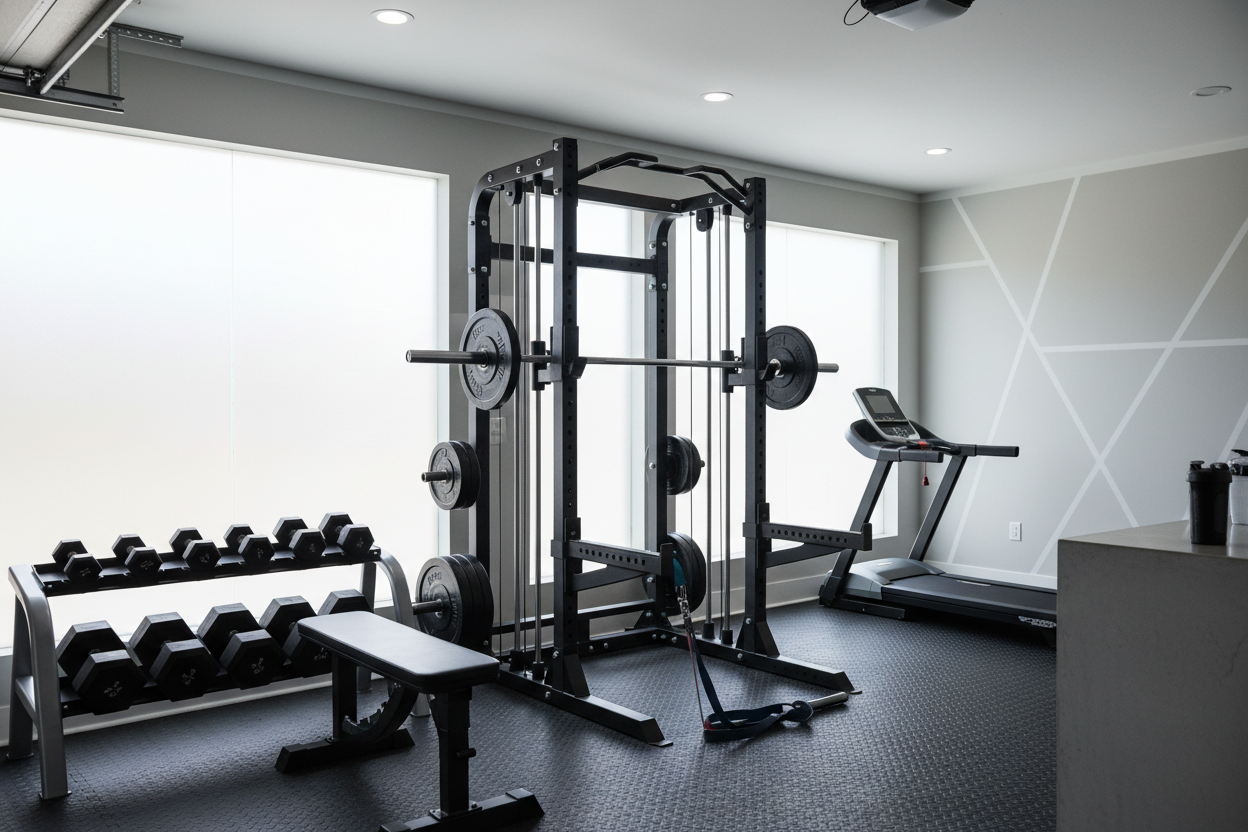
Most of us do not have room for a 400-pound leg press in a standard two-car garage. This one leg smith machine squat variation is the best way to get leg-press-level intensity without the massive footprint. If you are already setting up a hack squat on a Smith machine, you know how versatile this rack can be. It is about maximizing every square inch of your rubber flooring.
Of course, if you ever find the space and the budget, a dedicated compact leg press machine is the ultimate upgrade for your lower body days. But until then, the Smith is your best friend for high-intensity unilateral work. It turns a 4x4 foot area into a complete leg station.
Common Mistakes That Will Wreck Your Knees
Do not let your knee cave inward. This 'valgus' collapse is a fast track to a physical therapy appointment. Keep your knee tracking over your middle toe at all times. Also, pay attention to the angle of your Smith machine's rails. Most have a slight 7-to-10 degree tilt. Always face the direction that allows the bar to move slightly away from you as you descend, matching the natural arc of your hips.
Personal Experience: Why I Switched
I remember trying to ego-lift 60-pound dumbbells for Bulgarian split squats. I spent more energy hopping around like a wounded bird than actually squatting. I switched to the Smith machine, swallowed my pride about 'functional' training, and my quads grew more in three months than they had in the previous two years. The stability allowed me to actually reach RPE 10 without fearing for my life. It is not cheating; it is optimizing.
FAQ
Is the Smith machine version better than free weights?
For pure muscle growth, yes. It removes the balance bottleneck, letting you load the muscle heavier and closer to failure.
Can I do this on a vertical Smith machine?
Yes, but you will need to adjust your foot slightly further forward to account for the lack of a natural tilt in the bar path.
Does this put too much stress on the knees?
Not if your form is correct. Ensure your heel stays flat and your knee does not travel too far past your toes if you have existing joint issues.
Share:
Why Your Heaviest Lifts Should Be Machine Compound Exercises
Is Leg Press Equipment Actually Worth Giving Up Your Garage Parking?