
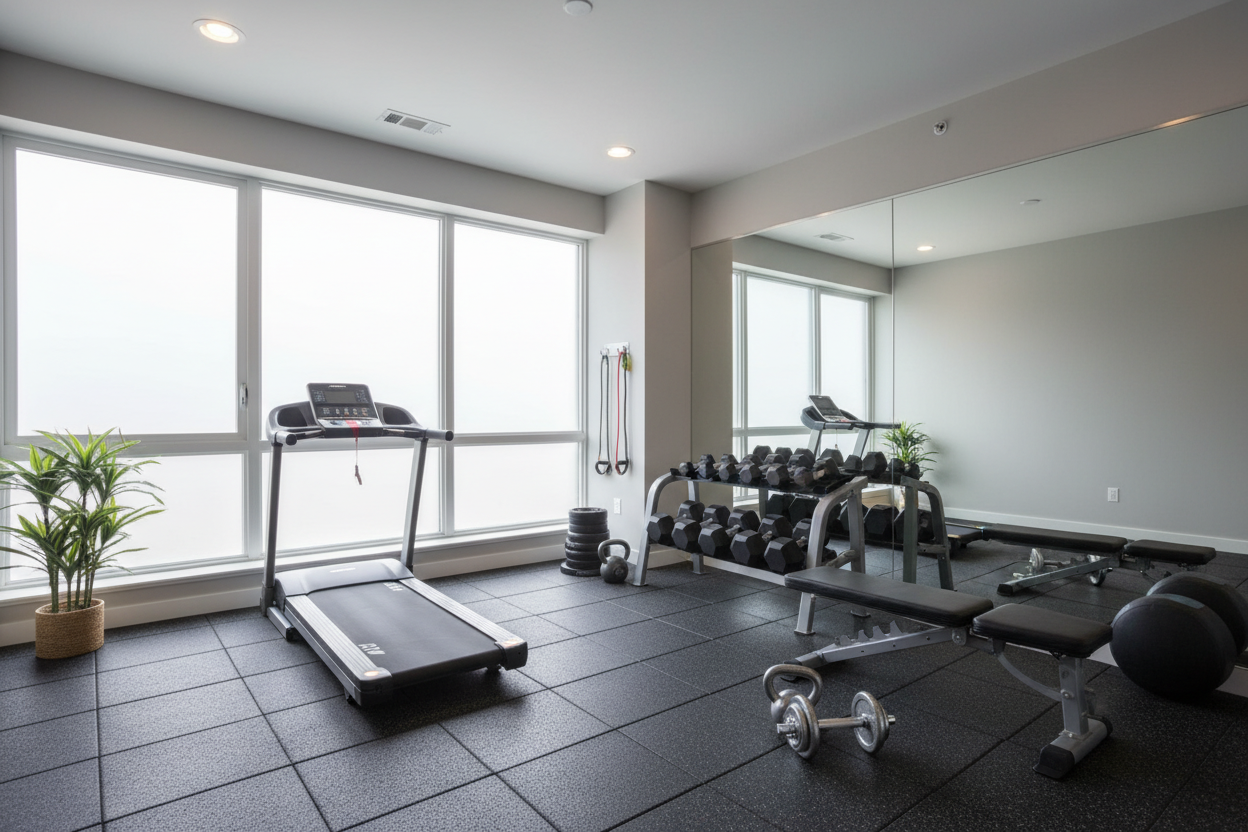
I remember my first third-floor walk-up. I spent three hours dragging a cheap, 200-pound power rack up narrow stairs, only to realize that every time I racked the bar, the neighbor’s chandelier downstairs rattled like an earthquake. Finding the right apartment workout equipment is a balancing act between your desire to get strong and your desire to keep your security deposit.
You don't need a 2,000-square-foot garage to build a serious physique. You just need to stop buying gear designed for commercial gyms and start buying gear designed for high-density living. Here is how I built a heavy-duty training space in a 600-square-foot flat without losing my mind or my lease.
- Prioritize Magnetic Resistance: It is the only way to do cardio at 11 PM without a noise complaint.
- Double Your Flooring: One layer of foam is a joke; you need high-density rubber to kill vibration.
- Vertical Storage is King: If it doesn't fold or stand on its end, it doesn't belong in your living room.
- Control the Eccentric: Dropping weights is for people with garages; controlled negatives are for people with neighbors.
The 'Upstairs Neighbor' Test for Buying Gear
Before you click 'buy' on that flashy new rig, you have to pass the upstairs neighbor test. In an apartment, your floor isn't just a floor—it’s someone else’s ceiling. The three non-negotiables for any piece of gear are footprint, floor loading, and impact vibration. Most modern apartment buildings are rated for roughly 40-50 pounds of live load per square foot. If you cram a massive rack, 500 pounds of plates, and your own body weight into a 4x4 corner, you are pushing structural limits.
Vibration is the real killer. It isn't the sound of the machine that gets you evicted; it is the low-frequency hum that travels through the floor joists. When I evaluate gear, I look for contact points. Does the machine have rubber feet? Can I put it on a 3/4-inch stall mat? If the answer is no, it stays in the warehouse. You want equipment that distributes its weight across a larger surface area to prevent permanent divots in your carpet or hardwood.
Space is your most expensive asset. A piece of gear that takes up 20 square feet but only serves one purpose is a bad investment. I look for a footprint that fits within a standard 6x8 equipment mat. Anything larger starts to bleed into your 'living' space, and suddenly your apartment feels like a cluttered basement instead of a home. Stick to multi-functional pieces that allow for a full range of motion without requiring you to move your coffee table every single morning.
Why Your Cardio Machine Sounds Like a Jet Engine (And What to Use Instead)
Physics is a jerk when it comes to apartment cardio. Motorized treadmills use a belt that slaps against a deck, creating a rhythmic thud that is impossible to dampen. Air bikes use a massive fan that sounds like a Cessna taking off in your spare bedroom. If you want to keep your neighbors happy, you have to embrace magnetic resistance. It is virtually silent because nothing is actually touching the flywheel.
I’ve tested dozens of setups, and a foldable upright exercise bike is usually the smartest move for small spaces. Because the resistance is controlled by magnets moving closer to or further from the wheel, there is no friction, no heat, and most importantly, no screaming fan. It allows you to get your heart rate into Zone 4 while someone is sleeping in the next room. If you are browsing quiet exercise bike options, look for a heavy flywheel—at least 30 pounds—as this provides a smoother pedal stroke that won't jerky or vibrate through the floorboards.
Rowers are another popular choice, but be careful with water rowers. While the 'whoosh' sound is relaxing, the tank can be heavy and prone to leaking over time if not maintained. Magnetic rowers or compact bikes offer the best decibel-to-calorie ratio. The goal is to find a machine that lets you focus on your intervals rather than worrying if the guy in 4B is about to bang on his ceiling with a broomstick. Always check the folded dimensions; if it doesn't tuck into a corner or a closet, you'll stop using it within a month.
Free Weights vs. Hardwood Floors: How to Keep Your Security Deposit
Lifting heavy iron in a rental requires a shift in mindset. You are not at a CrossFit box. You cannot drop a 405-pound deadlift and expect your floor to survive. However, you can still move serious weight if you are smart about your selection. Adjustable dumbbells are the gold standard here. A single pair of high-quality adjustables can replace an entire rack of fixed bells, saving you about 15 square feet of floor space. I prefer the ones that go up to at least 50 or 80 pounds per handle to ensure I don't outgrow them in six months.
When searching for the best exercise equipment for whole body workouts, focus on versatility. A flat bench that can be tipped up vertically is a must. If you must have a barbell, look for a 'shorty' bar. A standard Olympic bar is over 7 feet long, which is a nightmare to maneuver in a hallway. A 6-foot bar gives you the same sleeve diameter for your plates but keeps you from punching holes in your drywall during overhead presses. Use high-density rubber tiles—the kind they use in commercial gyms—rather than the cheap foam puzzle mats from big-box stores. Foam compresses and offers zero protection for your subfloor.
If you really want to pull heavy, buy a pair of crash pads. They are essentially thick foam silencers that you drop the weights onto. They kill the noise and the impact completely. I’ve pulled 400+ lbs on the second floor using crash pads and nobody was the wiser. It’s about being a pro. Control the weight on the way down, use the right padding, and your hardwood floors will look brand new when you finally move out.
Stop Wrecking Your Doorframes With Cheap Pull-Up Bars
I have a personal vendetta against those 'no-screw' tension pull-up bars. I’ve seen them crush door trim, leave black scuffs on white paint, and, in the worst cases, slip mid-set and send the lifter straight to the ER. If you are renting, your doorframes are likely made of cheap pine or MDF. They aren't designed to support 200 pounds of swinging human. The damage they leave behind is a guaranteed deduction from your security deposit.
Instead, look for a free-standing tower with a small footprint or a wall-leaning station. These units distribute the force downward into the floor rather than outward into your door trim. If you're tight on space, suspension trainers are a far superior alternative. You can anchor them to a closed door, and as long as you pull in the direction the door closes, the stress is distributed across the entire frame rather than a single point on the trim. They pack down into a bag the size of a toaster and allow for hundreds of movements beyond just pull-ups.
Another option is a high-end power tower that doubles as a dip station. Yes, it takes up more room, but it provides a stable platform that won't wobble. If you absolutely must use a doorway bar, get the ones that hook over the top of the frame and use a wide plastic shim to protect the wood. But honestly? Just buy a standalone unit. The peace of mind is worth the extra $50.
The Art of Hiding Your Gear When Guests Come Over
Unless you want your living room to look like a dungeon, you need an exit strategy for your gear. The 'gym-in-a-closet' concept is what separates successful apartment athletes from the people who end up selling their gear on Facebook Marketplace three months later. Modular equipment is the secret. I look for benches with wheels and upright storage capabilities. Being able to flip a bench 90 degrees and roll it into a corner changes the entire vibe of the room.
When you buy the best equipment for home exercise, you are looking for pieces that blend in. Black powder-coated steel is standard, but some brands are now making gear with wood accents or sleeker profiles that don't scream 'industrial warehouse.' I use an ottoman to store my resistance bands, collars, and chalk. My kettlebells sit on a low, heavy-duty shelf that looks like furniture but can actually support the 200 pounds of iron I’ve stacked on it.
Don't forget about cable machines. A massive functional trainer is out of the question, but a single-post wall-mounted cable tower has a tiny footprint and offers incredible versatility. If you can't bolt it to the wall, look for a plate-loaded version with a wide base. It’s about maximizing the 'work-per-square-foot' metric. If a piece of gear only does one thing and can't be hidden, it better be the most important thing in your program.
My Honest Mistake: The Chandelier Incident
I once bought a used commercial-grade treadmill for $200. It was a steal. It was also a 300-pound beast with a motor that hummed like a refrigerator from the 70s. I thought a thick mat would save me. Two days later, my landlord called. The vibration wasn't just loud; it was resonating with the floor joists and making the neighbor's kitchen light fixture unscrew itself. I had to sell it at a loss a week later. The lesson? Never underestimate the power of vibration. If it’s heavy and has a motor, it’s probably not for your apartment.
Apartment Gym FAQ
Can I deadlift in an apartment?
Yes, but you need 1.5-inch thick rubber mats or dedicated crash pads. You also need to realize that 'deadlifting' in an apartment means never actually dropping the bar. If you can't lower it silently, you're going too heavy for the space.
What is the best flooring for a rental?
High-density rubber tiles are the only real answer. Foam 'puzzle' mats are too soft and will tear under heavy weights. Rubber tiles protect the floor and kill the noise. Just make sure to get 'low-odor' rubber so your bedroom doesn't smell like a tire shop.
How much space do I actually need?
You can get a world-class workout in a 6x8 foot area. That is enough room for a bench, a set of adjustable dumbbells, and a cardio machine that folds. Anything more is a luxury.
Share:
The 3 Specs That Make a Real Gym Weight Bench Feel So Solid
I Tested a Classic Home Gym Weider Setup to See If It Still Holds Up