
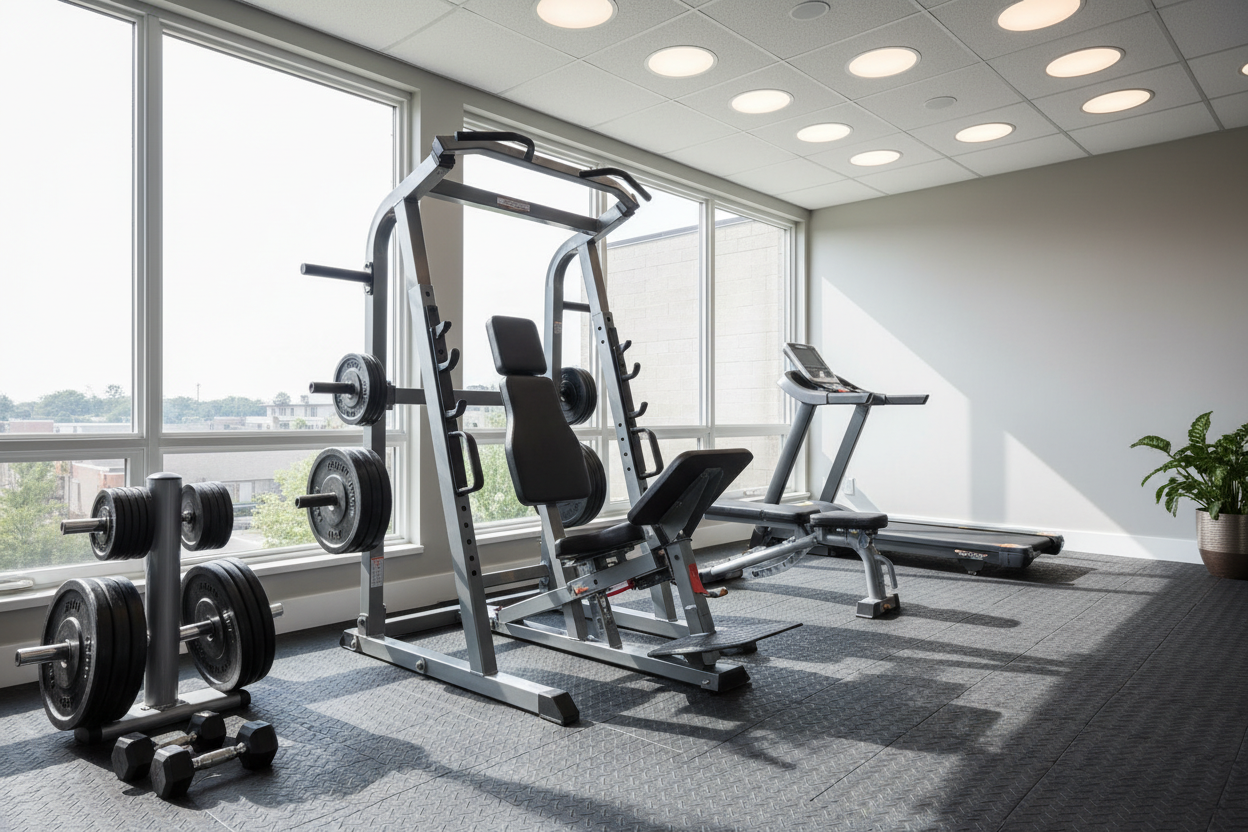
Why I Finally Stopped Forcing the Free Weight Barbell Squat
I used to be a barbell purist. If it wasn't a heavy back squat with a stiff bar, I didn't think it was training. Then I turned 35, and my lower back started sending me invoices for all those years of ego lifting. I spent three months barely able to tie my shoes before I realized that my quads don't actually care if the weight is on a bar or a sled. My muscle fibers just respond to tension, not the prestige of the lift.
Switching to a dedicated machine for squats was the smartest move I ever made for my longevity. I stopped fighting my anatomy and started actually training my legs again. I realized that the mental hurdle of ditching my traditional squat rack was purely based on pride, not physiology. When you remove the stability requirement of a free-floating bar, you can actually push your quads to absolute failure without your lower back giving out first.
The shift allowed me to focus on the eccentric phase and deep knee flexion—the stuff that actually builds mass. No more bracing for dear life just to survive a set of ten. Now, I load the machine, lock my back into a padded seat, and let the quads do the work they were meant to do.
The Commercial Heavyweights: Replicating Squat Machines at Gym Facilities
When you look at the massive squat machines at gym facilities, you're seeing units built for 24/7 abuse. They weigh 800 pounds and have footprints that would swallow a standard garage bay. These commercial units use heavy-gauge steel and oversized industrial bearings because they have to survive thousands of users. But for a home setup, we don't need a machine that can survive a nuclear blast; we need one that replicates that smooth, friction-free movement in a tighter package.
The goal is to find a squat gym machine that offers the same linear path or arc as the big brands without requiring you to park your car on the street. Most commercial units are over-engineered for home use, but the biomechanics—the way the weight moves relative to your hips—is what you should be looking to mimic.
The True Hack Squat Exercise Machine
The hack squats machine is the gold standard for quad isolation. By placing you on a 45-degree angle with your back supported, it eliminates the 'good morning' effect where your hips rise faster than the bar. I’ve found that a true linear bearing hack squat feels like butter. It allows you to place your feet lower on the platform to hammer the vastus lateralis, or higher to bring in some glute and hamstring help.
Because the sled is on a fixed track, you don't have to balance. You just push. This is where you really see the growth. I personally use this for high-rep finishers where I want to hit failure without the risk of getting pinned under a heavy bar.
The Pendulum Squat Gym Machine
If the hack squat is the king of isolation, the pendulum squat gym machine is the king of mechanics. Instead of moving in a straight line, it moves in an arc. This arc mimics the natural path of a squat but shifts the load away from the spine and onto the legs. The counterweight system on these is a lifter's dream; it makes the bottom of the movement—the hardest part—feel slightly more manageable, which protects your knees during that deep transition.
It’s the closest thing to a cheat code for deep squats I’ve ever found. You get the depth of an Olympic lifter without needing the ankle mobility of a gymnast. It’s a specialized piece, but if you have the room, it’s the most 'natural' feeling machine on the market.
The Highly Misunderstood Smith Machine
Purists love to hate on the Smith machine, but they're wrong. When used as a squat exercise machine, it's incredibly effective because of the fixed bar path. The trick is foot placement. Unlike a barbell squat where your feet must stay under the bar, a Smith machine home gym station lets you walk your feet out in front. This turns the movement into a vertical leg press of sorts, putting massive tension on the quads while your back stays perfectly vertical against the bar.
I often suggest a hack squat on a Smith machine setup for those who don't have the cash or floor space for a dedicated sled. You put your feet out, lean back into the bar, and squat. It’s not 'cheating'; it’s using a tool to isolate a muscle group. If you're chasing hypertrophy, the Smith machine is one of the most versatile pieces you can own.
How to Squeeze a Leg Destroyer Into a Two-Car Garage
The biggest hurdle for most of us is space. A dedicated hack squat and a separate leg press would take up half my gym. That’s why the industry has shifted toward combo units. These are the real winners for garage gym owners. You want a machine that can transition from a leg press to a hack squat in under thirty seconds. I’ve tested units where you just flip the footplate and move the backrest, and suddenly you’ve got a whole new workout.
A compact leg press and hack squat combo is usually the sweet spot. Look for one that uses a 30 to 45-degree angle. Anything shallower and you lose the range of motion; anything steeper and it becomes a logistical nightmare to load plates in a low-ceiling garage. If you are really tight on space, a 3-in-1 hack squat combo machine provides the most bang for your buck, often adding a calf raise block into the mix.
The key is measuring your overhead clearance. Remember, when that sled is at the top of the rails, those weight horns might be 7 feet in the air. Don't find that out by putting a hole in your drywall.
The 3 Specs You Must Check Before Buying
- Bearings vs. Wheels: Never buy a machine that uses cheap plastic wheels on a square tube. You want linear bearings on solid steel rods. If the movement isn't smooth, you'll feel every 'hitch' in your knees and hips.
- Footplate Adjustability: Your ankles aren't the same as mine. You need a footplate that can tilt. Being able to adjust the angle of the platform allows you to find the 'sweet spot' where you can get full depth without your heels lifting.
- Loading Capacity: Don't just look at the max weight. Look at the length of the sleeves. If the sleeves are only 10 inches long, you'll run out of room for iron plates long before your legs are actually tired. You want at least 12-15 inches of loadable space per side.
FAQ
Is a machine for squats as good as a barbell?
For building muscle, yes. For building 'functional' stability or powerlifting strength, the barbell is better. But if your goal is quads that stretch your jeans, the machine allows for better isolation and higher intensity without injury risk.
Do squat machines hurt your knees?
Only if your form is bad or the machine is poorly designed. Ensure your feet are placed high enough on the plate so your knees don't track too far past your toes if you have existing patellar issues. Most modern machines are designed to reduce joint sheer.
How much space do I really need?
Most combo machines need an 8x5 foot area to be safe. This gives you room to load plates on the sides and move around the machine without hitting your shins on everything else in the gym.
Share:
Your Garage Floor Probably Can't Handle a 5 100 Dumbbell Set
Why I Actually Hunted Down a Pair of 14 lb Dumbbells